What Technology Can’t Change About Happiness

As pills and gadgets proliferate, what matters is still social connection.

Source: What Technology Can’t Change About Happiness

In 2014, researchers at the University of Warwick in England announced they had found a strong association between a gene mutation identified with happiness and well-being. It’s called 5-HTTLPR and it affects the way our body metabolizes the neurotransmitter serotonin, which helps regulate our moods, sex drives, and appetites. The study asks why some nations, notably Denmark, consistently top “happiness indexes,” and wonders whether there may be a connection between a nation and the genetic makeup of its people. Sure enough, controlling for work status, religion, age, gender, and income, the researchers discovered those with Danish DNA had a distinct genetic advantage in well-being. In other words, the more Danish DNA one has, the more likely he or she will report being happy.

This tantalizing piece of research is not the only example of the power of feel-good genes. One body of research suggests we are genetically pre-programmed with a happiness “set point”—a place on the level of life satisfaction to which, in the absence of a fresh triumph or disappointment, our mood seems to return as surely as a homing pigeon to its base. As much as 50 percent of this set point, some researchers have demonstrated, is determined genetically at birth. The genetic determinants of a higher set point may be what the Danes are blessed with.

Neuroscientists are also studying a gene variant that leads to higher levels of a brain chemical called anandamide, which contributes to a sense of calm. Individuals with mutations that cause them to make less of an enzyme that metabolizes anandamide are less prone to trudge through life with the weight of the world on their shoulders. In 2015, Richard A. Friedman, a professor of clinical psychiatry at Weill Cornell Medical College, lamented in a New York Times op-ed “that we are all walking around with a random and totally unfair assortment of genetic variants that make us more or less content, anxious, depressed or prone to use drugs.” “What we really need,” Friedman continued, “is a drug that can boost anandamide—our bliss molecule—for those who are genetically disadvantaged. Stay tuned.”

“Close relationships and social connections keep you happy and healthy. Basically, humans are wired for personal connections.”

Some scientists have already tuned in to the future. James J. Hughes, a sociologist, author, and futurist at Hartford’s Trinity College, envisions a day not too far from now when we will unravel the genetic determinants of key neurotransmitters like serotonin, dopamine, and oxytocin, and be able to manipulate happiness genes—if not 5-HTTLPR then something like it—with precise nanoscale technologies that marry robotics and traditional pharmacology. These “mood bots,” once ingested, will travel directly to specific areas of the brain, flip on genes, and manually turn up or down our happiness set point, coloring the way we experience circumstances around us. “As nanotechnology becomes more precise, we’re going to be able to affect mood in increasingly precise ways in ordinary people,” says Hughes, who also serves as executive director of the Institute for Ethics and Emerging Technologies, and authored the 2004 book Citizen Cyborg: Why Democratic Societies Must Respond to the Redesigned Human of the Future.

It would be easy to conclude the redesigned human of the future will be able to pop a mood bot and live in bliss. But not so fast, say psychologists, sociologists, and neurologists who study happiness. Just because scientists have decoded some of the underlying biology of this ineffable state of being, paving the way for a drug to stimulate it, does not guarantee that our great-great-grandchildren will live happy and satisfying lives. Human nature is more than biology, the scientists assure us. And generations of happiness research offer a clear window into what it takes to live a long and satisfying life.

Piore_BR-5

TOGETHER: Strong personal relationships lead to better health outcomes, and can shift the architecture of the brain.   (Constance Bannister Corp / Getty)


The squishiness of the term “happiness” has long caused problems for those who study it. To gauge happiness and sidestep semantic problems, many of the psychologists who have tried to quantify it have used a measure called “Subjective Well-Being.” This measure, as its name implies, relies on individuals themselves to tell researchers how happy they are. Ed Diener, a University of Virginia psychologist nicknamed “Dr. Happiness,” pioneered the approach in the 1980s. Today, Diener serves as a senior scientist at The Gallup Organization, which provides a key survey used in happiness indexes put out by most groups compiling such lists, including the United Nations.

But in recent years, a growing number of researchers have begun to acknowledge that this isn’t a particularly good fix; maybe a little more refinement is needed. What we really mean when we tell a researcher from a place like Gallup that we are “happy” can vary widely. If you ask a teenager or young adult to rate his happiness, he’s liable to base his answer on his weekend plans, how much money he has in his pocket, and how his peers treated him during lunch break. If you ask somebody with a little more mileage—someone with children, for instance—they are liable to look at a bigger picture, even if they have a bad back that’s been acting up, no babysitter for Saturday, and an appointment that afternoon for a colonoscopy.

Over the past decade or so, a growing number of researchers have begun to rethink exactly what happiness is and distinguish between two types: “hedonic” happiness, that positive mental high, and “eudaimonic” happiness. Aristotle was referring to this second kind when he wrote 2,300 years ago: “Happiness is the meaning and the purpose of life, the whole aim and end of human existence.” This is the kind of happiness that qualifies a life well-lived, time on this planet well-spent. Medical technology may soon be able to engineer a momentary absence of fear, or the presence of a moment-to-moment sense of well-being, but engineering this second kind of happiness would be far more difficult.

Daniel Gilbert, a Harvard psychologist and author of the best-selling Stumbling On Happiness, suggests humans are already hardwired to raise their own hedonistic happiness, and we’re pretty good at it, without resorting to mood bots. Gilbert has spent his career studying the way we convince ourselves to accept our external circumstances, and return to a hedonic equilibrium, no matter what comes.

In a 2004 TED talk, Gilbert powerfully demonstrates this by displaying two pictures side by side. The picture on the left depicts a man in a black cowboy hat holding up an oversized lottery check. He has just won $314.9 million. The picture on the right displays another man, approximately the same age, sitting in a wheelchair, being pushed up a ramp. “Here are two different futures that I invite you to contemplate, and you can try to simulate them and tell me which one you think you might prefer,” Gilbert says to the audience. Data exists, he assures them, on how happy groups of lottery winners and paraplegics are. The fact is, a year after losing the use of their legs, and a year after winning the lotto, lottery winners are only slightly happier with their lives than paraplegics are.

The findings are unequivocal: Online connection decreases depression, reduces loneliness, and increases levels of perceived social support.

The reason people fail to appreciate that both groups are equally happy is a counterintuitive phenomenon that Gilbert calls “impact bias,” a tendency to overestimate the hedonic impact of future events. We see this tendency, he notes, with winning or not winning an election, gaining or losing a romantic partner, winning or not winning a promotion, passing or not passing a college exam. All these events “have far less impact, far less intensity, and for much less duration than people expect them to have.”

It’s that happiness set point again, returning to its base. But surely some things affect happiness? In fact, Gilbert tells Nautilus, “Much of our happiness is produced by things that have long evolutionary histories. I will place any wager that in 2045 people are still happy when they see their children prosper, when they taste chocolate, when they feel loved, secure, and well fed.”

These are the “staples of happiness,” he continues. “It would take an evolutionary change on the order of species to even consider the possibility that those would change too. This question could have been posed a few years ago, 300 years ago, 2,000 years ago. It would never have been wrong to say, ‘You are the most social animal on Earth, invest in your social relationships, it will be a form of happiness.’ ” It’s an answer that is so obvious that most people dismiss it.

“There is utterly no secret about the kind of things that make people happy,” Gilbert says. “But if you list them for people, they go, ‘Yeah, that kind of sounds like what my rabbi, grandmother, my philosopher have said all along. What’s the secret?’ The answer is there is no secret. They were right.”

Piore_BR-4

WHO’S HAPPIER?: The Harvard psychologist Daniel Gilbert has pointed out that lottery winners are only slightly happier a year after their win, than paraplegics are a year after losing the use of their legs.     [Keystone-France / Getty (left) and Barcroft / Getty (right)]

erhaps the most compelling evidence on the importance of relationships stems from a study of a cohort of people who are today mostly grandparents themselves. The information is stored in a cramped room in downtown Boston, lined with file cabinets that hold the details of one of the most comprehensive longitudinal studies on the development of healthy, male adults ever compiled: the Harvard Study of Adult Development, previously known as the Grant Study in Social Adjustments.

In 1938, researchers began conducting tests and interviewing carefully selected college sophomores from the all-male Harvard classes of 1939, 1940, and 1941. The men were chosen not because they had problems that made them likely to fail, but because they showed promise. (The cohort included, among others, future president John F. Kennedy and Ben Bradlee, who would lead the Washington Post during Watergate.) The original intent was to follow these men, who seemed destined for success, for perhaps 15 to 20 years. Today, more than 75 years later, the study is still going. Thirty of the original 268 men in the study are still alive.

In 1967, the files were merged with the Glueck Study, a similar effort that included a second group of 456 poor, non-delinquent, white kids who grew up in Boston’s inner city in the early 1940s. Of those, about 80 are still around, though the ones that aren’t lived, on average, nine years less than those in the Harvard cohort.

In 2009, the study’s longest-serving former director George Vaillant was asked by Joshua Wolf Shenk of The Atlantic what he considered the most important finding of the Grant study since its inception. “The only thing that really matters in life are your relations to other people,” he responded.

After Shenk’s article came out, Vaillant found himself under attack from skeptics around the globe. In response, Vaillant created what he called the “Decathlon of Flourishing,” which included a list of 10 accomplishments in late life (60-80) that might be considered success. They included earning an income in the study’s top quartile, recognition in Who’s Who in America, low psychological distress, success and enjoyment in work, love, and play since age 65, good physical and mental health, social support other than wife and kids, a good marriage, and a close relationship with kids.

High scores in all of these categories turned out to be highly correlated with one another. But of all the factors he looked at, only four were highly correlated with success on all the measures, and those all had to do with relationships. Once again, he proved that it was the capacity for intimate relationships that predicted success in all aspects of the men’s lives.

“Mood bots,” once ingested, will travel directly to specific areas of the brain, flip on genes, and manually turn up or down happiness.

However, Vaillant, who detailed his findings in the 2012 book Triumphs of Experience, objects to the term “happiness.” “The most important thing in happiness is to get the word out of your vocabulary,” he says. “The point is that a great deal of happiness is simply hedonism and I feel OK today because I’ve just had a Big Mac or a good bowel movement. That has very little to do with a sense of well-being. The secret to well-being is experiencing positive emotions.” And the secret to that, Vaillant argues, might sound trite. But you can’t argue with the facts. The secret is love.

“In the 1960s and ’70s, I would have been laughed at,” to suggest such a thing, Vaillant says. “But here I was finding hard data to support the fact that your relationships are the most important single thing in your well-being. It’s been gratifying to find support for something as sentimental as love.”

Robert Waldinger, the psychiatrist and Harvard Medical School professor who currently leads the study, notes that it is not just measures of material success and psychological feelings of well-being that are linked to good relationships. It’s also physical health.

“The biggest take home from a lot of this, is that the quality of people’s relationships are way more important than what we thought they were—not just for emotional well-being but also for physical health,” he says. Marital happiness at age 50, he says, is a more important predictor of physical health at 80 than cholesterol levels at 50. “Close relationships and social connections keep you happy and healthy. That is the bottom line. People who were more concerned with achievement or less concerned with connection were less happy. Basically, humans are wired for personal connections.”

Not only did strong personal relationships lead to better health outcomes, it affected the architecture of the brain. People who feel socially isolated get sicker earlier, their brains decay earlier, their memories are worse, Waldinger says. Using brain-scan technologies, Waldinger and his team discovered that those who were most satisfied with their lives had greater brain connectivity. Their brains lit up more robustly when they looked at visual images than people who were less satisfied.

“The people who were most engaged were the happiest,” Waldinger says. “They could be raising kids, they could be planting a garden, they could be running a corporation. If you really care about something, if it means something to you, and particularly if you have meaningful engagement with other people when you do these things—those are the things that light you up.”

Even Nicholas Christakis, a Yale sociologist, who coauthored a seminal study of twins that demonstrated a 33 percent variation in life satisfaction could be attributed to the 5-HTTLPR gene, agrees that the key component to happiness is social. “I’m very skeptical that technological advances will affect what I regard as foundational features of human nature,” he says. “So I don’t think that any technological developments or futuristic things are going to fundamentally affect our capacity for happiness.”

Christakis, who studies social networks, says the influence of genes like 5-HTTLPR on happiness is less direct than a straight subjective feeling of well-being (though that may be part of it). Instead, he suggests, it’s their effect on our behavior that may be key—and the effect that has on our relationships. “It’s not just what genes do inside our body, how they modify our neurophysiology or transmitters, but what genes do outside our body, how they affect how many friends you make, or whether you will pick happy or sad friends, which also affects happiness,” Christakis says. “Even if you have genes that predispose you to pick happy friends, the unavailability of them may make you unhappy.”

Piore_BR-6.

DIGITAL BOND: Some scholars now argue that social media and the Internet draw people close together, enhancing already existing relationships.  (Hero Images)


enerations of happiness research, stressing the importance of personal relationships, drops us into the middle of a surprisingly contemporary debate. We live in an increasingly networked society, and the rate of us in social networks, and the amount of time we spend online, continues to grow each year. Vaillant, of the longitudinal Harvard study, has no hesitation in saying what our lives online are doing to us.

“Technology drives us up into our cortex away from our heart,” he says. “What makes the world go round is not technology. It’s not having a better and better iPhone; I’ve got a fancy new phone and I just hate it. The technology is just going to distract us back into our heads so that my daughter feels it’s cooler to text someone than it is to talk to them on the telephone. That doesn’t bode well for happiness in 2050.”

The fears of a dystopian new world, where we all text at the dinner table and have problems making eye contact, were perhaps most articulately summed up by Sherry Turkle, professor of the Social Studies of Science and Technology in the science, technology, and society program at the Massachusetts Institute of Technology. She explores the paradox of how technology connects us, yet also makes us lonelier, in her 2011 book Alone Together: Why We Expect More from Technology and Less from Each Other.

“Human relationships are rich and they’re messy and they’re demanding,” she argues passionately in a 2012 TED talk. “And we clean them up with technology. And when we do, one of the things that can happen is that we sacrifice conversation for mere connection. We short-change ourselves. And over time, we seem to forget this, or we seem to stop caring.”

Some of the earliest studies on the use of the Internet and technology supported the idea that the networked age was driving us toward a sad, lonely future. In a groundbreaking 1998 study, Robert E. Kraut, a researcher at Carnegie Mellon University, recruited volunteer families with high-school-aged children, gave them computers and Internet access, and then tracked their usage. The more his participants used the Internet, he found, the more their depression increased, and the more social support and other measures of psychological well-being declined.

Since then there have been other negative studies and a spate of bad press. One widely cited 2012 study conducted by researchers at Utah Valley University of 425 undergraduates found that the more they used Facebook, the more they felt that others were happier and had better lives than they did. The researchers named the study, “They Are Happier and Having Better Lives Than I Am: The Impact of Using Facebook on Perceptions of Others’ Lives.”

Even the Vatican has expressed concern. In 2011, Pope Benedict XVI warned in one of his messages to the world that “virtual contact cannot and must not take the place of direct human contact.”

But in recent years, a more nuanced consensus has begun to emerge—a consensus that suggests technology is not such a bad thing for human relationships. Carnegie Mellon’s Kraut now argues that his 1998 study might tell us about the present. The problem, he says, was there were comparatively fewer people on the Internet at the time. The individuals who participated in his study were forced to communicate with people they did not know in far-flung places, what Kraut calls “weak ties.” “What we realized is that by necessity they had to talk to relative strangers,” he says. “But that was the early days. Now virtually everybody you know is online.”

Kraut’s more recent research has found that today most people spend their time online communicating with people with whom they already have strong ties. In those cases, he argues, the findings are unequivocal: Online connection decreases depression, reduces loneliness, and increases levels of perceived social support.

It does so by enhancing offline relationships. Online interactions, like offline ones, are more fulfilling if they are with people with whom we have strong ties. They mean a lot less if they are with strangers. But most of us use technologies to communicate with people we already know. And that helps relationships grow stronger. “Communication online has the same beneficial effects that communication offline would have if we already know people,” Kraut says.

Keith Hampton, an associate professor of communication and public policy communication at Rutgers University, has conducted a number of studies in collaboration with the Pew Research Center measuring the effects of Internet use on relationships, democracy, and social supports. The idea that we interact either online or offline, he argues, is a false dichotomy. Through his studies, he too has become convinced that social media and the Internet are drawing us closer together—online and off. “I don’t think it’s people moving online, I think it’s people adding the digital mode of communication to already existing relationships,” he says.

In fact, his research has found that the more different kinds of media that people use to interact, the stronger their relationships tend to be. People who don’t just talk on the phone but also see each other, and email each other and communicate through four or five different mediums, tend to have stronger relationships with one another than those who communicate through fewer mediums, he has found.

Facebook, he argues, is fundamentally changing the nature of relationships in ways that have been lost since the dawn of the Industrial Revolution, when people began leaving their native villages behind to head to cities for new opportunities, and lost contact with the people they grew up with. “Thanks to social media, those types of relationships are persistent,” he says. “Now we may be connecting with people over the course of life that we didn’t before.”

Of course, Facebook and technology, Hampton argues, are not sufficient in their own right to fend off loneliness. But in conjunction with other modes of interaction, they can bolster existing relationships, contribute to diverse relationships, and keep dormant relationships alive. The overall effect of technology is to overcome the constraints of time and location that would have proven insurmountable before. Instead of Christmas cards, we get a constant stream of information. We can share in triumphs and know when to offer solace during tragedy. We are less isolated.

Hampton has heard the assertions by Turkle and others that technology is atomizing us and killing traditional interactions. So he decided to examine that contention too. In a 2014 article in the journalUrban Studies, Hampton and collaborators reported that they had studied four films taken in public spaces over the course of the last 30 years. For their study they observed and coded the behavior and characteristics of 143,593 people. They analyzed that behavior to see if, in fact, we really are “alone together” in a crowd.

In fact, Hampton found the opposite. There was, in the same public spaces, a notable increase in the numbers of people interacting in large groups. And despite the ubiquity of mobile phones, the rate of their use in public was relatively small, especially when individuals were walking with others. Mobile phones appeared “most often in spaces where people might otherwise be walking alone,” he wrote. “This suggests that, when framed as a communication tool, mobile phone use is associated with reduced public isolation, although it is associated with an increased likelihood to linger and with time spent lingering in public.”

None of this surprises Amy Zalman, president and CEO of the World Future Society, who spends her days organizing conferences, conducting research, and speaking with people who try to predict what society might look like a few decades in the future. She expects that technological tools to pursue human relationships will continue to evolve in unexpected ways. But she doesn’t expect them to change human nature. Human relating, she argues, has always been a highly mediated activity—even language can be seen as a tool on the same spectrum as technologies like social media or cell phones, a spectrum of tools we use to interface with others. It’s just that we notice these tools more. But that too will change. “Technology is going to get closer and closer, it’s going to get invasive—we are going to wear it; it’s going to be inside of us—and then it’s going to disappear and we are not even going to notice it,” Zalman says.

Some futurists believe we may plug into a matrix and communicate through a hive mind. Or perhaps we will relate through personal avatars, robots that resemble us, which we occupy remotely. Maybe our brains will be uploaded to computers. But whatever happens, in the end, the verities of happiness will remain the same as they were in the days of Aristotle. It’s never a mistake to go out and play, make friends, make love, and make an impact on society. Happiness is and has always been about our relationships with other people.


Adam Piore is a freelance writer based in New York.
 

16 Basic Principles of Mass Indoctrination

Tags

, ,

Source: 16 basic principles of mass indoctrination

Aspie Savant

Sep 10, 2015


1. Start while they’re young.


2. Create the illusion of political freedom.


3. Use simplistic stereotypes to sway public opinion.

4. Mix facts with lies.


5. A big lie is more convincing than a small lie.


6. Give the masses “bread and circuses” to keep them well-fed and distracted.


7. Simplify complex issues by portraying them as dichotomies. Eliminate nuance.


8. Spread propaganda by all means possible.


9. Ostracize dissident voices through ridicule or defamation.


10. Faith in the correctness of a religion or ideology is more powerful than force.


11. Manipulate history records to support your religion or ideology.


12. Control different sides of the same debate and you control the outcome.

13. The masses are less swayed by reason than by stirring their emotions.

14. Drive the opposition in a corner. When they fight back, act like a victim.


15. Label all non-conformistic behavior as pathological and promote “cures” for them.


16. Use rituals and mass events to keep people occupied and strengthen their faith.

How the Brain Separates Relevant and Irrelevant Information


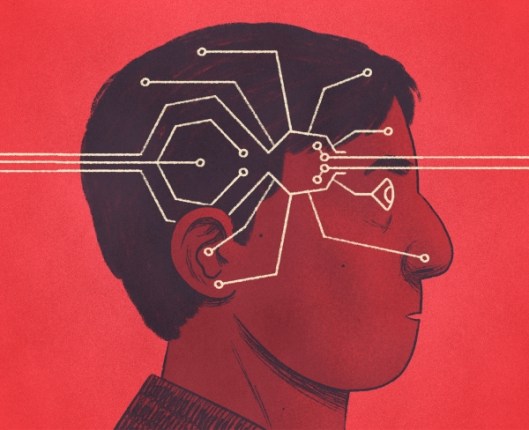
Researchers have developed a new theory that outlines how the brain separates relevant from irrelevant information.

Source: How the Brain Separates Relevant and Irrelevant Information


Imagine yourself sitting in a noisy café trying to read. To focus on the book at hand, you need to ignore the surrounding chatter and clattering of cups, with your brain filtering out the irrelevant stimuli coming through your ears and “gating” in the relevant ones in your vision—words on a page.

In a new paper in the journal Nature Communications, New York University researchers offer a new theory, based on a computational model, on how the brain separates relevant from irrelevant information in these and other circumstances.

“It is critical to our everyday life that our brain processes the most important information out of everything presented to us,” explains Xiao-Jing Wang, Global Professor of Neural Science at NYU and NYU Shanghai and the paper’s senior author. “Within an extremely complicated neural circuit in the brain, there must be a gating mechanism to route relevant information to the right place at the right time.”

The analysis focuses on inhibitory neurons—the brain’s traffic cops that help ensure proper neurological responses to incoming stimuli by suppressing other neurons and working to balance excitatory neurons, which aim to stimulate neuronal activity.

“Our model uses a fundamental element of the brain circuit, involving multiple types of inhibitory neurons, to achieve this goal,” Wang adds. “Our computational model shows that inhibitory neurons can enable a neural circuit to gate in specific pathways of information while filtering out the rest.”

In their analysis, led by Guangyu Robert Yang, a doctoral candidate in Wang’s lab, the researchers devised a model that maps out a more complicated role for inhibitory neurons than had previously been suggested.

Of particular interest to the team was a specific subtype of inhibitory neurons that targets the excitatory neurons’ dendrites—components of a neuron where inputs from other neurons are located. These dendrite-targeting inhibitory neurons are labeled by a biological marker called somatostatin and can be studied selectively by experimentalists. The researchers proposed that they not only control the overall inputs to a neuron, but also the inputs from individual pathways—for example, the visual or auditory pathways converging onto a neuron.

This was thought to be difficult because the connections from inhibitory neurons to excitatory neurons appeared dense and unstructured,” observes Yang. “Thus a surprising finding from our study is that the precision required for pathway-specific gating can be realized by inhibitory neurons.”

The study’s authors used computational models to show that even with the seemingly random connections, these dendrite-targeting neurons can gate individual pathways by aligning with excitatory inputs through different pathways. They showed that this alignment can be realized through synaptic plasticity—a brain mechanism for learning through experience.


ABOUT THIS NEUROSCIENCE RESEARCH ARTICLE

The study’s other co-author was John David Murray, a postdoctoral researcher at the time of the work and now an assistant professor at Yale University.

Funding: The work was supported by grants from the National Institute of Health (R01MH062349) and the Office of Naval Research (N00014-13-1-0297).

Source: James Devitt – NYU
Image Source: This NeuroscienceNews.com image is in the public domain.
Original Research:Full open access research for “A dendritic disinhibitory circuit mechanism for pathway-specific gating” by Guangyu Robert Yang, John D. Murray and Xiao-Jing Wang in Nature Communications. Published online September 20 2016 doi:10.1038/ncomms12815

Study: We understand that social media does not equal social interaction | PsyPost

Source: Study: We understand that social media does not equal social interaction | PsyPost

BY ON AUGUST 11, 2016

If you worry that people today are using social media as a crutch for a real social life, a University of Kansas study will set you at ease.

Jeffrey Hall, associate professor of communication studies, found that people are actually quite adept at discerning the difference between using social media and having an honest-to-goodness social interaction. The results of his studies appear in the journal New Media & Society.

“There is a tendency to equate what we do on social media as if it is social interaction, but that does not reflect people’s actual experience using it,” Hall said. “All of this worry that we’re seeking out more and more social interaction on Facebook is not true. Most interactions are face to face, and most of what we consider social interaction is face to face.”

According to Hall, social media is more like old-fashioned people-watching. “Liking” something is similar to a head nod. It’s not social interaction, but it’s acknowledging you are sharing space with someone else.

“Keeping tabs on other people sharing our social spaces is normal and part of what it means to be human,” Hall said.

Hall is no stranger to research on social media. New Media & Society published an earlier study of his that found people can accurately detect the personality traits of strangers through Facebook activity.

In his current paper in the journal, Hall details three studies. The first demonstrates that when using social media, most of us are engaged in passive behaviors that we don’t consider social interaction, like browsing others’ profiles and reading news articles.

The second diary study demonstrates that most of what we consider social interaction with people in our close circle of friends happens face to face. When interaction with these close others is through social media, it’s not something passive like browsing or “liking” but rather using chat or instant message functions.

Here’s where it gets interesting, Hall said. The first study found that chatting and commenting — things that we would even consider social interaction — are but 3.5 percent of our time on social media.

The third study had participants contacted at random times throughout the day. This study drives home how adept we are at separating social media use with social interaction. People reported 98 percent of their social interactions took some other way than through social media.

“Although people often socially interact and use social media in the same time period, people understand they are different things,” Hall said. “People feel a sense of relatedness when they’re interacting face to face, but using social media does not make them feel connected.”

All three studies, Hall said, circle around the idea that we still value face-to-face time with close others for the purpose of talking.

“If we want to have a conversation, we’re not using social media to do it,” he said.

The findings speak to a broader anxiety that many still have regarding social media.

“There’s a worry that people are seeking out more and more social interactions on Facebook and that social media is taking over our face-to-face time,” Hall said. “I’m saying, ‘Not so fast.’ People use social media to people-watch and still seem to enjoy a good face-to-face conversation.”


What Is a Constant Cycle of Violent News Doing to Us?

Tags

, , , , ,

Nothing good. Experts suggested limiting your exposure to violent imagery and social media.

Source: What Is a Constant Cycle of Violent News Doing to Us?

How Computers are Learning to Be Creative

TED Talk by Blaise Aguera y Arcas

We’re on the edge of a new frontier in art and creativity — and it’s not human. Blaise Agüera y Arcas, principal scientist at Google, works with deep neural networks for machine perception and distributed learning. In this captivating demo, he shows how neural nets trained to recognize images can be run in reverse, to generate them. The results: spectacular, hallucinatory collages (and poems!) that defy categorization. “Perception and creativity are very intimately connected,” Agüera y Arcas says. “Any creature, any being that is able to do perceptual acts is also able to create.”

Can Neuroscience Make Your Message Stickier?

A cutting edge technique pinpoints how our brains react to fear appeals in marketing.

Source: Can Neuroscience Make Your Message Stickier?

Several years ago, the Centers for Disease Control and Prevention launched a national advertising campaign highlighting the grisly dangers of smoking. “Tips From Former Smokers” featured stark, disturbing imagery of real former smokers and the toll that tobacco addiction has taken on their bodies. Some had amputated fingers; others revealed a gaping hole in their throat.

The campaign successfully reduced the number of smokers. But while such fear appeals can be effective for public health, environmental awareness, or political campaigns, the method comes with both risks and limitations.

For one, overly strong fear appeals in advertising sometimes backfire, causing viewers to mentally and emotionally withdraw from the message—a phenomenon known as the “boomerang effect.” Moreover, some of the biggest risks humans face, like climate change, are very abstract in nature—and try as we might, it is hard to get people to engage at all.

But what if there was a way to avoid the boomerang effect and also persuade your audience to engage with an abstract fear?

“Most of our brain is hidden from us. … Normally, we have no access to whatever is happening under the hood.”

New research from the Kellogg School uses a cutting-edge neuroscience technique to identify the sweet spot where fear-based campaigns have the utmost impact. It finds that people can increase the level of fear they experience while watching a piece of content if they imagine a specific scary aspect of it before they start watching. This in turn increases the likelihood that content, such as an ad’s message, will register, be remembered, and potentially affect future behavior.

“If I show you an ad against drinking and driving, will that really make you do it less? We do not know,” says Moran Cerf, an assistant professor of marketing and neuroscience at the Kellogg School.

“As a start, we decided to investigate your ability to control your own experience of fear,” he says. “We wanted to see if you yourself can identify the things that will help the message influence you the most.”

Watching Brain Cells Fire

Previous neuroscience research in the area of fear control has focused extensively on studying people’s ability to reduce negative emotions. Less attention has been paid to the opposite phenomenon, a voluntary increase in negative feelings. This is likely because fear and sadness are generally undesirable and are often intense enough as is.

However, when it comes to persuading the public, increasing fear in viewers has the potential to save lives.

Cerf collaborated with Eric Greenleaf, Tom Meyvis, and Vicki Morwitz at New York University. They recorded, in real time, how frightened a person was—not by asking them but by actually eavesdropping on the inner workings of their brain using electrodes implanted in their heads. The process, called single-neuron recording, tracks the firing activity of brain cells linked to fear.

Single-neuron recording is typically used only in animals. But the technique can be used for human studies in unique situations where the research is conducted during brain surgery for epilepsy treatment.

In such a treatment, physicians surgically remove the area of the brain where seizures originate to cure patients whose epilepsy cannot be successfully treated with medication. To find the correct region on which to operate, neurosurgeons implant thin, hollow electrodes directly into the brain. A set of even thinner wires can be inserted through these electrodes to detect firing from individual neurons. The patients can then participate in research studies while they wait in the hospital for doctors to identify the exact onset source of their seizures.

“Most of our brain is hidden from us. It operates, and we see the output. Normally, we have no access to whatever is happening under the hood,” Cerf says. “Now with single-neuron techniques, we do have access.”

Single-cell recording gathers different data than other techniques like fMRI and EEG that look at brain activity—and is particularly ideal for studying feelings, says Cerf.

“What we can see when we are using single-neuron recording is how emotions are coded in the brain,” Cerf says. “We can not only see where you feel things like sadness and anger— but can also see them as they dawn on us, sometimes even earlier than your subjective experience occurs.”

Increasing Fear

In their study, Cerf and his colleagues measured fear responses in neurosurgical patients who had undergone the brain electrodes implantation. The patients watched a number of video clips, including one from Al Gore’s “An Inconvenient Truth,” to test their emotional response. Climate change was deliberately chosen as it is an abstract and distant fear—something humans have difficulty imagining and feeling viscerally scared of.

Each patient watched the clip in two conditions: as they naturally would and again immediately after mentally focusing on the aspects of climate change that frighten them—like seeing loved ones hurt.

While watching the clip as they naturally would, fear-responsive neurons fired at a rate comparable to baseline levels. In other words, the subjects did not feel particularly scared. However, when they imagined specific aspects of climate change that were tailored to their own fears, the firing rate of these same neurons increased.

But critically, not all threats are created equal, and not all can be controlled. The researchers find that this tactic is most useful when addressing fears that are abstract rather than more instinctual or innate.

To demonstrate this, the researchers showed the patients another clip, one that was inherently terrifying—a large spider crawling towards the camera. Right off the bat, this clip elicited a much sharper fear response than the climate change video ever did—the type of response that might be expected to spur a boomerang effect. Asking the patients to imagine something even more frightening about spiders beforehand did not increase their fear.

Implications for Marketers

The results suggest that we can enhance fear response to an otherwise abstract threat by identifying an aspect of the threat that is particularly scary to us. Tailoring the experience around that threat makes the content more likely to be remembered as a threat, potentially allowing for a change in our behavior without enhancing the threat too much—which would cause us to recoil in disgust.

And if enough people are frightened by the same aspects of an abstract threat, it may be possible for marketers or those making public service announcements to tailor the original message accordingly.

“With the help of these patients, we actually learned what techniques and thoughts they triggered to enhance their climate-change fear,” Cerf says. “Now that we have identified the optimal ways to increase fear across individuals, we can calibrate the message to make sure an ad or a speech by Vice President Gore has a stronger effect.”

However, Cerf does not see single-neuron recording becoming a widespread method of measurement for market or consumer research any time soon, as it requires the participation of patients and a hospital’s neurosurgery department. But he thinks organizations and marketers can gain business insights from scientific studies that employ this and other neuroscience methodologies, perhaps by hiring a neuroscientist to interpret the often-impenetrable scientific literature.

“Leaders should read up on the latest discoveries in the popular press on fundamental topics like memory, persuasion, self-control, and emotion regulation—subjects that appeal to both neuroscientists and marketers,” Cerf says.

“The reason I’m at Kellogg is that there is a movement—a trend of neuroscientists who try to bridge this gap between neuroscience and marketing,” he says. “I think that we are in a state right now where neuroscience is answering a lot of the questions that marketing practitioners care about and were unable to fully address quantitatively for years. It was hard because of the difficulty of quantifying our psychology. Now, with the help of neuroscience, we can start looking at ways to break down complex psychological phenomena using tangible, testable metrics.”

Kellogg School of Management at Northwestern University

From the BBC: The Psychological Tricks Behind Pokeman Go’s Success

Tags

, , , , , ,

Nintendo’s latest video game has become an overnight sensation. What’s the appeal?

By Chris Baraniuk

“Basically the reason I downloaded it is because a lot of my friends in the States have been going mad for it,” says Jon Norris. “They’re quite sensible adults but they were absolutely freaking out about it.”

Norris, head of content at Brighton-based digital agency Rocketmill, is talking about Pokemon Go. It’s a new augmented reality mobile game – and it’s taking the world by storm. The title, which has been available in the US for less than a week, has racked up millions of downloads already. The app lets players track down and “catch” virtual Pokemon that appear somewhere in the world around them.

Although not yet officially available in the UK, eager players like Norris have been able to install the app via some technical workarounds. The app has not risen to fame without controversy, though. For one thing, some have raised concerns over the fact that it can have very broad access to user data – from emails to search history and Google Drive – when users give it access to their Google accounts on iOS devices.

So what is the big attraction? And could its success have been predicted?

Admissions tests

Psychologist Andrew Przybylski at the Oxford Internet Institute has studied what attributes are essential for games to have the chance of being successful. These range from whether they are pitched at the right difficulty for players to how much they build in, or foster, social interaction with others, and he thinks one important factor is the ‘barrier of admission’ to having a good time.

A crucial feature of Pokemon Go, for example, is that it relies on technologies many people have and are already familiar with – their smartphone and GPS. Contrast this with geocaching, for example, which requires a more advanced knowledge of GPS (and even an array of physical equipment).

Many of the games that have enjoyed surprisingly broad appeal in the past – from Snake to Angry Birds and many of the original Wii titles – also married highly accessible gameplay with technology that was relatively new but easy to use, adds Przybylski.

“People have already learned how to use their phones – just like they know how to use their bodies for Wii Tennis,” he explains. “The work has already been done.”

“You can dive into it very easily,” agrees Norris.

Another factor is nostalgia. While Norris, for one, never played any of the previous Pokemon games, many Pokemon Go fans have fond memories of titles dating back to 1996, when the first instalments in the series were released. Even the very fact that people are talking about Pokemon more than usual again has prompted reminiscences among some older fans.

But for Przybylski, if a game tries to use nostalgia as part of its appeal, it must also deliver on its promise of novelty and fun. Pokemon Go, at least, certainly seems to have done so for some.

“The only way to deliver fun is to have players feel confident, give them a sense of exploration and connect them socially to others – on those three very important counts, the game looks like it’s succeeded,” he says.

Indeed, Norris immediately points out an unexpected benefit of wandering around Brighton, Pokemon Go app in hand.

“All the little Pokestops [where players collect in-game items] are associated with various pieces of street art in Brighton,” he comments. “It’s actually shown me a couple of pieces of street art I haven’t seen before.”

People have apparently been willing to wander around outside late at night in search of that elusive Squirtle or Meowth – or even make a catch while they wait for their wife to give birth. This has turned Pokemon Go into a bizarre phenomenon that has helped provide the game with its other, perhaps most important, dimension of success: it is excellent fodder for social media.

In 2013, British writer and TV presenter Charlie Brooker cited Twitter as one of his top 25 video games that changed the world. How is Twitter a video game? By Brooker’s logic, it has a graphical interface and a points-based system of competition (number of followers, for example). The idea that social media is a game, or that it can be played like one, is provocative – but with an app like Pokemon Go in mind this seems to make sense. Part of the game’s appeal, whether its makers intended this or not, seems to be the opportunity to meme-ify and share experiences about it on sites like Reddit, Snapchat and Imgur.

Thus, Pokemon Go plays out not just within the official app, but via these social networks too.

Psychologists are beginning to understand why using social media is so enjoyable, and one aspect of particular interest is the opportunity to craft and experiment with one’s sense of self. We do this offline too, but online we are offered different possibilities – and different potential rewards, such as new friends or increased levels of interaction.

Interestingly, there are many stories online of Pokemon Go players bumping into each other while on the hunt – the game clearly encourages social interaction both via the web and face-to-face, which is unusual.

Pokemon Go, then, may well be the perfect game for the social media age – we’re primed for it, argues Przybylski. Using social media has, he suggests, readied us for this sort of experience.

“The modern era has trained people for playing Pokemon Go,” he says.

Indeed, the way the game is being played and talked about online certainly seems to capture the essence of Mark Zuckerberg’s mantra that social media should enable “frictionless sharing” – activity that happens naturally and that appeals directly to the needs and desires of users.

Of course, it’s not clear how long players will remain enthralled by Pokemon Go. It’s still very new. But as with all overnight successes, this is another phenomenon that has managed to tap into some fundamental desire shared by many.

In doing so, Pokemon Go might just have revealed a little bit more about what motivates people. Whether or not you enjoy playing video games yourself, that’s certainly something worth thinking about.

Chris Baraniuk is a freelance science and technology writer. He Tweets as @machinestarts.

This Is How Much Data The Internet Gets Through In One Minute


Source: This Is How Much Data The Internet Gets Through In One Minute

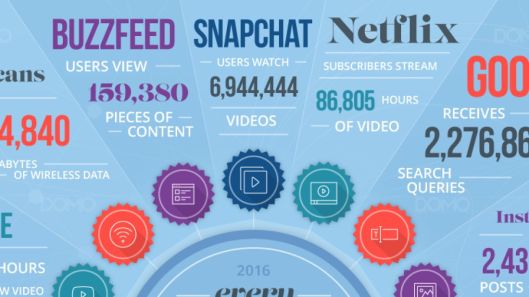
Computer software company Domo has just released its fourth annual installment of its “Data Never Sleeps” series, which breaks down our online habits and Internet activity across the biggest online media platforms. As you can imagine, our appetite for information and emojis has only gotten stronger over the course of this year.

Over 200 million people hooked up to the Internet this year, meaning that 3.6 billion of us are just a few clicks and a scroll away from each other. Pretty impressive, considering when Domo started this project in 2013 there were just 2.1 billion people online.

As the world chomps through 18,264,840 megabytes of wireless data every minute, pretty much every household name of the online world has seen a similarly salient boost, such as millennial matchmaker Tinder, which receives 972,222 “swipes” every single minute; that’s over 380,000 more than last year.

There’s also some new players to the game such as Giphy, the GIF search engine, which has risen through the ranks of the Internet giants within just three years. After integrating with Twitter and Facebook, this platform now serves up around 598,217 GIFS every single minute.

For comparison, you can check out the 2015 edition right here.


Life Is Streaming Past You – Binge Media Culture Finds a Receptive Audience in Americans

The freedom to binge on all media anytime. See a problem ahead?

Source: Binge Media Culture Finds a Receptive Audience in Americans