• About the Authors
  • Blogs and Shows
  • Journals
  • Open Invitation
  • References
  • Resources
  • Taxonomy
  • Who’s Who?

Media Psychology

~ Informing, Educating and Influencing

Media Psychology

Category Archives: Psychology

16 Basic Principles of Mass Indoctrination

28 Wednesday Sep 2016

Posted by Donna L. Roberts, PhD in Politics, Propaganda, Psychology

≈ Leave a comment

Tags

Mass Indoctrination, Propaganda, Social Psychology

Source: 16 basic principles of mass indoctrination

Aspie Savant

Sep 10, 2015


1. Start while they’re young.


2. Create the illusion of political freedom.


3. Use simplistic stereotypes to sway public opinion.

4. Mix facts with lies.


5. A big lie is more convincing than a small lie.


6. Give the masses “bread and circuses” to keep them well-fed and distracted.


7. Simplify complex issues by portraying them as dichotomies. Eliminate nuance.


8. Spread propaganda by all means possible.


9. Ostracize dissident voices through ridicule or defamation.


10. Faith in the correctness of a religion or ideology is more powerful than force.


11. Manipulate history records to support your religion or ideology.


12. Control different sides of the same debate and you control the outcome.

13. The masses are less swayed by reason than by stirring their emotions.

14. Drive the opposition in a corner. When they fight back, act like a victim.


15. Label all non-conformistic behavior as pathological and promote “cures” for them.


16. Use rituals and mass events to keep people occupied and strengthen their faith.

Share this:

  • Email a link to a friend (Opens in new window) Email
  • Print (Opens in new window) Print
  • Share on Facebook (Opens in new window) Facebook
  • Share on LinkedIn (Opens in new window) LinkedIn
  • Share on Pinterest (Opens in new window) Pinterest
  • Share on Reddit (Opens in new window) Reddit
  • Share on X (Opens in new window) X
  • Share on Tumblr (Opens in new window) Tumblr
Like Loading...

How the Brain Separates Relevant and Irrelevant Information

21 Wednesday Sep 2016

Posted by Donna L. Roberts, PhD in Psychology

≈ Comments Off on How the Brain Separates Relevant and Irrelevant Information


Researchers have developed a new theory that outlines how the brain separates relevant from irrelevant information.

Source: How the Brain Separates Relevant and Irrelevant Information


Imagine yourself sitting in a noisy café trying to read. To focus on the book at hand, you need to ignore the surrounding chatter and clattering of cups, with your brain filtering out the irrelevant stimuli coming through your ears and “gating” in the relevant ones in your vision—words on a page.

In a new paper in the journal Nature Communications, New York University researchers offer a new theory, based on a computational model, on how the brain separates relevant from irrelevant information in these and other circumstances.

“It is critical to our everyday life that our brain processes the most important information out of everything presented to us,” explains Xiao-Jing Wang, Global Professor of Neural Science at NYU and NYU Shanghai and the paper’s senior author. “Within an extremely complicated neural circuit in the brain, there must be a gating mechanism to route relevant information to the right place at the right time.”

The analysis focuses on inhibitory neurons—the brain’s traffic cops that help ensure proper neurological responses to incoming stimuli by suppressing other neurons and working to balance excitatory neurons, which aim to stimulate neuronal activity.

“Our model uses a fundamental element of the brain circuit, involving multiple types of inhibitory neurons, to achieve this goal,” Wang adds. “Our computational model shows that inhibitory neurons can enable a neural circuit to gate in specific pathways of information while filtering out the rest.”

In their analysis, led by Guangyu Robert Yang, a doctoral candidate in Wang’s lab, the researchers devised a model that maps out a more complicated role for inhibitory neurons than had previously been suggested.

Of particular interest to the team was a specific subtype of inhibitory neurons that targets the excitatory neurons’ dendrites—components of a neuron where inputs from other neurons are located. These dendrite-targeting inhibitory neurons are labeled by a biological marker called somatostatin and can be studied selectively by experimentalists. The researchers proposed that they not only control the overall inputs to a neuron, but also the inputs from individual pathways—for example, the visual or auditory pathways converging onto a neuron.

This was thought to be difficult because the connections from inhibitory neurons to excitatory neurons appeared dense and unstructured,” observes Yang. “Thus a surprising finding from our study is that the precision required for pathway-specific gating can be realized by inhibitory neurons.”

The study’s authors used computational models to show that even with the seemingly random connections, these dendrite-targeting neurons can gate individual pathways by aligning with excitatory inputs through different pathways. They showed that this alignment can be realized through synaptic plasticity—a brain mechanism for learning through experience.


ABOUT THIS NEUROSCIENCE RESEARCH ARTICLE

The study’s other co-author was John David Murray, a postdoctoral researcher at the time of the work and now an assistant professor at Yale University.

Funding: The work was supported by grants from the National Institute of Health (R01MH062349) and the Office of Naval Research (N00014-13-1-0297).

Source: James Devitt – NYU
Image Source: This NeuroscienceNews.com image is in the public domain.
Original Research:Full open access research for “A dendritic disinhibitory circuit mechanism for pathway-specific gating” by Guangyu Robert Yang, John D. Murray and Xiao-Jing Wang in Nature Communications. Published online September 20 2016 doi:10.1038/ncomms12815

Share this:

  • Email a link to a friend (Opens in new window) Email
  • Print (Opens in new window) Print
  • Share on Facebook (Opens in new window) Facebook
  • Share on LinkedIn (Opens in new window) LinkedIn
  • Share on Pinterest (Opens in new window) Pinterest
  • Share on Reddit (Opens in new window) Reddit
  • Share on X (Opens in new window) X
  • Share on Tumblr (Opens in new window) Tumblr
Like Loading...

Study: We understand that social media does not equal social interaction | PsyPost

14 Sunday Aug 2016

Posted by Donna L. Roberts, PhD in Psychology

≈ Leave a comment

Source: Study: We understand that social media does not equal social interaction | PsyPost

BY UNIVERSITY OF KANSAS ON AUGUST 11, 2016

If you worry that people today are using social media as a crutch for a real social life, a University of Kansas study will set you at ease.

Jeffrey Hall, associate professor of communication studies, found that people are actually quite adept at discerning the difference between using social media and having an honest-to-goodness social interaction. The results of his studies appear in the journal New Media & Society.

“There is a tendency to equate what we do on social media as if it is social interaction, but that does not reflect people’s actual experience using it,” Hall said. “All of this worry that we’re seeking out more and more social interaction on Facebook is not true. Most interactions are face to face, and most of what we consider social interaction is face to face.”

According to Hall, social media is more like old-fashioned people-watching. “Liking” something is similar to a head nod. It’s not social interaction, but it’s acknowledging you are sharing space with someone else.

“Keeping tabs on other people sharing our social spaces is normal and part of what it means to be human,” Hall said.

Hall is no stranger to research on social media. New Media & Society published an earlier study of his that found people can accurately detect the personality traits of strangers through Facebook activity.

In his current paper in the journal, Hall details three studies. The first demonstrates that when using social media, most of us are engaged in passive behaviors that we don’t consider social interaction, like browsing others’ profiles and reading news articles.

The second diary study demonstrates that most of what we consider social interaction with people in our close circle of friends happens face to face. When interaction with these close others is through social media, it’s not something passive like browsing or “liking” but rather using chat or instant message functions.

Here’s where it gets interesting, Hall said. The first study found that chatting and commenting — things that we would even consider social interaction — are but 3.5 percent of our time on social media.

The third study had participants contacted at random times throughout the day. This study drives home how adept we are at separating social media use with social interaction. People reported 98 percent of their social interactions took some other way than through social media.

“Although people often socially interact and use social media in the same time period, people understand they are different things,” Hall said. “People feel a sense of relatedness when they’re interacting face to face, but using social media does not make them feel connected.”

All three studies, Hall said, circle around the idea that we still value face-to-face time with close others for the purpose of talking.

“If we want to have a conversation, we’re not using social media to do it,” he said.

The findings speak to a broader anxiety that many still have regarding social media.

“There’s a worry that people are seeking out more and more social interactions on Facebook and that social media is taking over our face-to-face time,” Hall said. “I’m saying, ‘Not so fast.’ People use social media to people-watch and still seem to enjoy a good face-to-face conversation.”


Share this:

  • Email a link to a friend (Opens in new window) Email
  • Print (Opens in new window) Print
  • Share on Facebook (Opens in new window) Facebook
  • Share on LinkedIn (Opens in new window) LinkedIn
  • Share on Pinterest (Opens in new window) Pinterest
  • Share on Reddit (Opens in new window) Reddit
  • Share on X (Opens in new window) X
  • Share on Tumblr (Opens in new window) Tumblr
Like Loading...

What Is a Constant Cycle of Violent News Doing to Us?

06 Saturday Aug 2016

Posted by Donna L. Roberts, PhD in Media Effects, Media Literacy, Media Psychology, Psychology

≈ 5 Comments

Tags

Behaviorism, Cognitive, Influence, Media Effects, Media Literacy, Psychological Effects

Nothing good. Experts suggested limiting your exposure to violent imagery and social media.

Source: What Is a Constant Cycle of Violent News Doing to Us?

By KATIE ROGERS        JULY 15, 2016

It has been a rough year.

By now, our violence is down to a pattern, and there is a choreography to our reactions.

A killer seeks out a nightclub, a church, an airport, a courthouse, a protest. Someone is shot on video, sometimes by the police, and marchers fill the streets. An attack is carried out in France, America, Turkey, Bangladesh, Lebanon, Tunisia, Nigeria, and then claimed and celebrated by a radical terror group.

Our phones vibrate with news alerts. The talking heads fill air over cable news captions that shout “breaking news” in red. Rumors and misinformation abound. The comments erupt on Twitter, Facebook and news sites.

Journalists create multimedia stories that focus on videos, photos and graphic accounts from victims and witnesses. The experts give interviews, and the latest tools of immediacy are put to use. After the deadly terror attack in Nice, France, The Times invited grief counselors to be interviewed on Facebook Live. Within days, attention had turned to a shooting in Baton Rouge that left three law enforcement officers dead.

So, what is this doing to us?

It depends on the individual, but living in a digitally linked world where broadcasts of violence are instantaneous and almost commonplace means that many of us are becoming desensitized, Anita Gadhia­ Smith, a psychologist in Washington, said Friday.

“With the frequency of shootings and terror attacks there is a sense of anxiety that’s building in people,” she said, “a sense of vulnerability and powerlessness.”

Dr. Smith added: “There is a heightened alarm, but there can also be some desensitization that’s happening.”

The constant stream of news on social media can also be traumatic. A team of researchers at the University of Bradford in England told a British psychology conference last year that exposure to violent imagery on social media can cause symptoms that are similar to post-­traumatic stress disorder, defined as a persistent emotional reaction to a traumatic event that severely impairs one’s life.

In an analysis conducted by the Bradford researchers, 189 participants were shown images and provided with stories of violent events, including the Sept. 11 attacks, school shootings and suicide bombings.

The researchers’ analysis showed that 22 percent of those who participated were significantly affected by what they saw.

The study also found that people who view violent events more often were more affected than people who saw them less frequently, and that people who described themselves as extroverts with outgoing personalities were at a higher risk to be disturbed by the images.

What can we do about it?

The self­-care advice hasn’t changed. It is natural to want to follow along with incremental updates on social media and in the news. But it’s important to know that this can heighten your anxiety.

Anne Marie Albano, a clinical psychologist and the director of the Columbia University Clinic for Anxiety and Related Disorders, said in an interview after the 2015 Paris attacks that it might be a good idea to limit your exposure to social media.

Designating times to plug into the news — checking Twitter in the morning over coffee, but not listening to the radio while driving your kids to school, for instance — can help you manage anxiety if you are feeling stressed.

“This will help you balance a realistic and credible threat with information that is sensationalized,” Dr. Albano said, “or a rush to report something or talk about something that doesn’t have the impact that you would think it has.”

If you’re feeling anxiety about a possible attack, compare your fear with the facts.

When you fear the worst, it’s hard to remember that, say, a flight or a train ride has extraordinarily high odds of being safe. But you have to try.

Humans are bad at assessing risk, Martin Seif, a psychologist who specializes in treating anxiety disorders and the fear of flying, said in an interview late last year.

“Every single anxiety­ management technique is based on the premise that your reaction is out of proportion” to the likelihood of danger, Dr. Seif said.

Also, remember to take a breath.

A guide to dealing with terrorism released by the Federal Bureau of Investigation encourages closing your eyes and taking deep breaths to feel calmer.

Taking a walk or talking to a close friend can also help.

The guide also recommends avoiding alcohol and drugs, exercising regularly and eating healthy foods — basic self-­care guidelines that help reduce stress.

Make sure you have a plan to contact your family if something happens, especially if cellular networks are overloaded or transportation is disrupted, but remember that you most likely will not need it, experts say.

If you have children, the American Psychological Association recommends asking them how they are feeling about the news. Keep in mind that it is possible for children to be influenced by news reports and the adult conversations around them.

Lastly, keep your daily routine.

Dr. Albano said that a primary worry in the field of psychology is people “going out of their way to be so safe that it shrinks their world.”

“Terrorists thrive on this kind of thing,” she added. “They want to see the population change their practices.”

Going out of your way to avoid interacting with strangers — by refusing to take mass transit, for example — can stoke fear and anxiety in children, she said.

The best way to help children cope with acts of violence is to start by listening to them, Sean Rogers, a psychotherapist who works with children and teenagers, told The Times on his Facebook Live appearance.

”Listening is curative,” he said. “It is the basis of all therapies.”

Madison Mills contributed reporting.

© 2016 The New York Times Company

Additional Reading “It’s a Mean World, Or Is it?“

Share this:

  • Email a link to a friend (Opens in new window) Email
  • Print (Opens in new window) Print
  • Share on Facebook (Opens in new window) Facebook
  • Share on LinkedIn (Opens in new window) LinkedIn
  • Share on Pinterest (Opens in new window) Pinterest
  • Share on Reddit (Opens in new window) Reddit
  • Share on X (Opens in new window) X
  • Share on Tumblr (Opens in new window) Tumblr
Like Loading...

How Computers are Learning to Be Creative

29 Friday Jul 2016

Posted by Donna L. Roberts, PhD in Psychology

≈ 1 Comment

TED Talk by Blaise Aguera y Arcas

We’re on the edge of a new frontier in art and creativity — and it’s not human. Blaise Agüera y Arcas, principal scientist at Google, works with deep neural networks for machine perception and distributed learning. In this captivating demo, he shows how neural nets trained to recognize images can be run in reverse, to generate them. The results: spectacular, hallucinatory collages (and poems!) that defy categorization. “Perception and creativity are very intimately connected,” Agüera y Arcas says. “Any creature, any being that is able to do perceptual acts is also able to create.”

Share this:

  • Email a link to a friend (Opens in new window) Email
  • Print (Opens in new window) Print
  • Share on Facebook (Opens in new window) Facebook
  • Share on LinkedIn (Opens in new window) LinkedIn
  • Share on Pinterest (Opens in new window) Pinterest
  • Share on Reddit (Opens in new window) Reddit
  • Share on X (Opens in new window) X
  • Share on Tumblr (Opens in new window) Tumblr
Like Loading...

Can Neuroscience Make Your Message Stickier?

20 Wednesday Jul 2016

Posted by Donna L. Roberts, PhD in Psychology

≈ Leave a comment

A cutting edge technique pinpoints how our brains react to fear appeals in marketing.

Source: Can Neuroscience Make Your Message Stickier?

Several years ago, the Centers for Disease Control and Prevention launched a national advertising campaign highlighting the grisly dangers of smoking. “Tips From Former Smokers” featured stark, disturbing imagery of real former smokers and the toll that tobacco addiction has taken on their bodies. Some had amputated fingers; others revealed a gaping hole in their throat.

The campaign successfully reduced the number of smokers. But while such fear appeals can be effective for public health, environmental awareness, or political campaigns, the method comes with both risks and limitations.

For one, overly strong fear appeals in advertising sometimes backfire, causing viewers to mentally and emotionally withdraw from the message—a phenomenon known as the “boomerang effect.” Moreover, some of the biggest risks humans face, like climate change, are very abstract in nature—and try as we might, it is hard to get people to engage at all.

But what if there was a way to avoid the boomerang effect and also persuade your audience to engage with an abstract fear?

“Most of our brain is hidden from us. … Normally, we have no access to whatever is happening under the hood.”

New research from the Kellogg School uses a cutting-edge neuroscience technique to identify the sweet spot where fear-based campaigns have the utmost impact. It finds that people can increase the level of fear they experience while watching a piece of content if they imagine a specific scary aspect of it before they start watching. This in turn increases the likelihood that content, such as an ad’s message, will register, be remembered, and potentially affect future behavior.

“If I show you an ad against drinking and driving, will that really make you do it less? We do not know,” says Moran Cerf, an assistant professor of marketing and neuroscience at the Kellogg School.

“As a start, we decided to investigate your ability to control your own experience of fear,” he says. “We wanted to see if you yourself can identify the things that will help the message influence you the most.”

Watching Brain Cells Fire

Previous neuroscience research in the area of fear control has focused extensively on studying people’s ability to reduce negative emotions. Less attention has been paid to the opposite phenomenon, a voluntary increase in negative feelings. This is likely because fear and sadness are generally undesirable and are often intense enough as is.

However, when it comes to persuading the public, increasing fear in viewers has the potential to save lives.

Cerf collaborated with Eric Greenleaf, Tom Meyvis, and Vicki Morwitz at New York University. They recorded, in real time, how frightened a person was—not by asking them but by actually eavesdropping on the inner workings of their brain using electrodes implanted in their heads. The process, called single-neuron recording, tracks the firing activity of brain cells linked to fear.

Single-neuron recording is typically used only in animals. But the technique can be used for human studies in unique situations where the research is conducted during brain surgery for epilepsy treatment.

In such a treatment, physicians surgically remove the area of the brain where seizures originate to cure patients whose epilepsy cannot be successfully treated with medication. To find the correct region on which to operate, neurosurgeons implant thin, hollow electrodes directly into the brain. A set of even thinner wires can be inserted through these electrodes to detect firing from individual neurons. The patients can then participate in research studies while they wait in the hospital for doctors to identify the exact onset source of their seizures.

“Most of our brain is hidden from us. It operates, and we see the output. Normally, we have no access to whatever is happening under the hood,” Cerf says. “Now with single-neuron techniques, we do have access.”

Single-cell recording gathers different data than other techniques like fMRI and EEG that look at brain activity—and is particularly ideal for studying feelings, says Cerf.

“What we can see when we are using single-neuron recording is how emotions are coded in the brain,” Cerf says. “We can not only see where you feel things like sadness and anger— but can also see them as they dawn on us, sometimes even earlier than your subjective experience occurs.”

Increasing Fear

In their study, Cerf and his colleagues measured fear responses in neurosurgical patients who had undergone the brain electrodes implantation. The patients watched a number of video clips, including one from Al Gore’s “An Inconvenient Truth,” to test their emotional response. Climate change was deliberately chosen as it is an abstract and distant fear—something humans have difficulty imagining and feeling viscerally scared of.

Each patient watched the clip in two conditions: as they naturally would and again immediately after mentally focusing on the aspects of climate change that frighten them—like seeing loved ones hurt.

While watching the clip as they naturally would, fear-responsive neurons fired at a rate comparable to baseline levels. In other words, the subjects did not feel particularly scared. However, when they imagined specific aspects of climate change that were tailored to their own fears, the firing rate of these same neurons increased.

But critically, not all threats are created equal, and not all can be controlled. The researchers find that this tactic is most useful when addressing fears that are abstract rather than more instinctual or innate.

To demonstrate this, the researchers showed the patients another clip, one that was inherently terrifying—a large spider crawling towards the camera. Right off the bat, this clip elicited a much sharper fear response than the climate change video ever did—the type of response that might be expected to spur a boomerang effect. Asking the patients to imagine something even more frightening about spiders beforehand did not increase their fear.

Implications for Marketers

The results suggest that we can enhance fear response to an otherwise abstract threat by identifying an aspect of the threat that is particularly scary to us. Tailoring the experience around that threat makes the content more likely to be remembered as a threat, potentially allowing for a change in our behavior without enhancing the threat too much—which would cause us to recoil in disgust.

And if enough people are frightened by the same aspects of an abstract threat, it may be possible for marketers or those making public service announcements to tailor the original message accordingly.

“With the help of these patients, we actually learned what techniques and thoughts they triggered to enhance their climate-change fear,” Cerf says. “Now that we have identified the optimal ways to increase fear across individuals, we can calibrate the message to make sure an ad or a speech by Vice President Gore has a stronger effect.”

However, Cerf does not see single-neuron recording becoming a widespread method of measurement for market or consumer research any time soon, as it requires the participation of patients and a hospital’s neurosurgery department. But he thinks organizations and marketers can gain business insights from scientific studies that employ this and other neuroscience methodologies, perhaps by hiring a neuroscientist to interpret the often-impenetrable scientific literature.

“Leaders should read up on the latest discoveries in the popular press on fundamental topics like memory, persuasion, self-control, and emotion regulation—subjects that appeal to both neuroscientists and marketers,” Cerf says.

“The reason I’m at Kellogg is that there is a movement—a trend of neuroscientists who try to bridge this gap between neuroscience and marketing,” he says. “I think that we are in a state right now where neuroscience is answering a lot of the questions that marketing practitioners care about and were unable to fully address quantitatively for years. It was hard because of the difficulty of quantifying our psychology. Now, with the help of neuroscience, we can start looking at ways to break down complex psychological phenomena using tangible, testable metrics.”

Kellogg School of Management at Northwestern University

About the Researchers

  Moran CerfAssistant Professor of Marketing

About the Writer

Meeri Kim is a freelance science and health writer.

About the Research

Citation: Cerf, Moran, Eric Greenleaf, Tom Meyvis, and Vicki G. Morwitz. 2015. “Using Single-Neuron Recording in Marketing: Opportunities, Challenges, and an Application to Fear Enhancement in Communications.” Journal of Marketing Research. 52 No. 4: 530–545.


Share this:

  • Email a link to a friend (Opens in new window) Email
  • Print (Opens in new window) Print
  • Share on Facebook (Opens in new window) Facebook
  • Share on LinkedIn (Opens in new window) LinkedIn
  • Share on Pinterest (Opens in new window) Pinterest
  • Share on Reddit (Opens in new window) Reddit
  • Share on X (Opens in new window) X
  • Share on Tumblr (Opens in new window) Tumblr
Like Loading...

From the BBC: The Psychological Tricks Behind Pokeman Go’s Success

18 Monday Jul 2016

Posted by Ken S. Heller in Media Psychology, Psychology

≈ Leave a comment

Tags

Cognitive, GPS, Nostalgia, Pokemon, Smartphone, Social Media, Social Psychology

Nintendo’s latest video game has become an overnight sensation. What’s the appeal?

By Chris Baraniuk

11 July 2016

“Basically the reason I downloaded it is because a lot of my friends in the States have been going mad for it,” says Jon Norris. “They’re quite sensible adults but they were absolutely freaking out about it.”

Norris, head of content at Brighton-based digital agency Rocketmill, is talking about Pokemon Go. It’s a new augmented reality mobile game – and it’s taking the world by storm. The title, which has been available in the US for less than a week, has racked up millions of downloads already. The app lets players track down and “catch” virtual Pokemon that appear somewhere in the world around them.

Although not yet officially available in the UK, eager players like Norris have been able to install the app via some technical workarounds. The app has not risen to fame without controversy, though. For one thing, some have raised concerns over the fact that it can have very broad access to user data – from emails to search history and Google Drive – when users give it access to their Google accounts on iOS devices.

So what is the big attraction? And could its success have been predicted?

Admissions tests

Psychologist Andrew Przybylski at the Oxford Internet Institute has studied what attributes are essential for games to have the chance of being successful. These range from whether they are pitched at the right difficulty for players to how much they build in, or foster, social interaction with others, and he thinks one important factor is the ‘barrier of admission’ to having a good time.

A crucial feature of Pokemon Go, for example, is that it relies on technologies many people have and are already familiar with – their smartphone and GPS. Contrast this with geocaching, for example, which requires a more advanced knowledge of GPS (and even an array of physical equipment).

Many of the games that have enjoyed surprisingly broad appeal in the past – from Snake to Angry Birds and many of the original Wii titles – also married highly accessible gameplay with technology that was relatively new but easy to use, adds Przybylski.

“People have already learned how to use their phones – just like they know how to use their bodies for Wii Tennis,” he explains. “The work has already been done.”

“You can dive into it very easily,” agrees Norris.

Another factor is nostalgia. While Norris, for one, never played any of the previous Pokemon games, many Pokemon Go fans have fond memories of titles dating back to 1996, when the first instalments in the series were released. Even the very fact that people are talking about Pokemon more than usual again has prompted reminiscences among some older fans.

But for Przybylski, if a game tries to use nostalgia as part of its appeal, it must also deliver on its promise of novelty and fun. Pokemon Go, at least, certainly seems to have done so for some.

“The only way to deliver fun is to have players feel confident, give them a sense of exploration and connect them socially to others – on those three very important counts, the game looks like it’s succeeded,” he says.

Indeed, Norris immediately points out an unexpected benefit of wandering around Brighton, Pokemon Go app in hand.

“All the little Pokestops [where players collect in-game items] are associated with various pieces of street art in Brighton,” he comments. “It’s actually shown me a couple of pieces of street art I haven’t seen before.”

People have apparently been willing to wander around outside late at night in search of that elusive Squirtle or Meowth – or even make a catch while they wait for their wife to give birth. This has turned Pokemon Go into a bizarre phenomenon that has helped provide the game with its other, perhaps most important, dimension of success: it is excellent fodder for social media.

In 2013, British writer and TV presenter Charlie Brooker cited Twitter as one of his top 25 video games that changed the world. How is Twitter a video game? By Brooker’s logic, it has a graphical interface and a points-based system of competition (number of followers, for example). The idea that social media is a game, or that it can be played like one, is provocative – but with an app like Pokemon Go in mind this seems to make sense. Part of the game’s appeal, whether its makers intended this or not, seems to be the opportunity to meme-ify and share experiences about it on sites like Reddit, Snapchat and Imgur.

Thus, Pokemon Go plays out not just within the official app, but via these social networks too.

Psychologists are beginning to understand why using social media is so enjoyable, and one aspect of particular interest is the opportunity to craft and experiment with one’s sense of self. We do this offline too, but online we are offered different possibilities – and different potential rewards, such as new friends or increased levels of interaction.

Interestingly, there are many stories online of Pokemon Go players bumping into each other while on the hunt – the game clearly encourages social interaction both via the web and face-to-face, which is unusual.

Pokemon Go, then, may well be the perfect game for the social media age – we’re primed for it, argues Przybylski. Using social media has, he suggests, readied us for this sort of experience.

“The modern era has trained people for playing Pokemon Go,” he says.

Indeed, the way the game is being played and talked about online certainly seems to capture the essence of Mark Zuckerberg’s mantra that social media should enable “frictionless sharing” – activity that happens naturally and that appeals directly to the needs and desires of users.

Of course, it’s not clear how long players will remain enthralled by Pokemon Go. It’s still very new. But as with all overnight successes, this is another phenomenon that has managed to tap into some fundamental desire shared by many.

In doing so, Pokemon Go might just have revealed a little bit more about what motivates people. Whether or not you enjoy playing video games yourself, that’s certainly something worth thinking about.

—

Chris Baraniuk is a freelance science and technology writer. He Tweets as @machinestarts.

Share this:

  • Email a link to a friend (Opens in new window) Email
  • Print (Opens in new window) Print
  • Share on Facebook (Opens in new window) Facebook
  • Share on LinkedIn (Opens in new window) LinkedIn
  • Share on Pinterest (Opens in new window) Pinterest
  • Share on Reddit (Opens in new window) Reddit
  • Share on X (Opens in new window) X
  • Share on Tumblr (Opens in new window) Tumblr
Like Loading...

This Is How Much Data The Internet Gets Through In One Minute

30 Thursday Jun 2016

Posted by Donna L. Roberts, PhD in Psychology

≈ Leave a comment


Source: This Is How Much Data The Internet Gets Through In One Minute

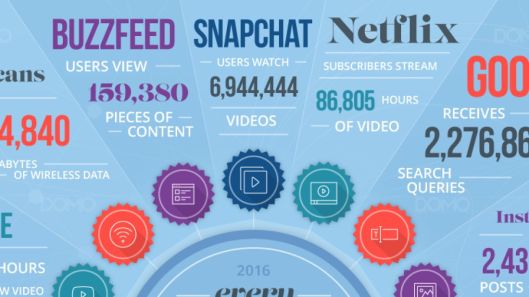
Computer software company Domo has just released its fourth annual installment of its “Data Never Sleeps” series, which breaks down our online habits and Internet activity across the biggest online media platforms. As you can imagine, our appetite for information and emojis has only gotten stronger over the course of this year.

Over 200 million people hooked up to the Internet this year, meaning that 3.6 billion of us are just a few clicks and a scroll away from each other. Pretty impressive, considering when Domo started this project in 2013 there were just 2.1 billion people online.

As the world chomps through 18,264,840 megabytes of wireless data every minute, pretty much every household name of the online world has seen a similarly salient boost, such as millennial matchmaker Tinder, which receives 972,222 “swipes” every single minute; that’s over 380,000 more than last year.

There’s also some new players to the game such as Giphy, the GIF search engine, which has risen through the ranks of the Internet giants within just three years. After integrating with Twitter and Facebook, this platform now serves up around 598,217 GIFS every single minute.

For comparison, you can check out the 2015 edition right here.


Share this:

  • Email a link to a friend (Opens in new window) Email
  • Print (Opens in new window) Print
  • Share on Facebook (Opens in new window) Facebook
  • Share on LinkedIn (Opens in new window) LinkedIn
  • Share on Pinterest (Opens in new window) Pinterest
  • Share on Reddit (Opens in new window) Reddit
  • Share on X (Opens in new window) X
  • Share on Tumblr (Opens in new window) Tumblr
Like Loading...

Life Is Streaming Past You – Binge Media Culture Finds a Receptive Audience in Americans

12 Sunday Jun 2016

Posted by Donna L. Roberts, PhD in Psychology

≈ Leave a comment

The freedom to binge on all media anytime. See a problem ahead?

Source: Binge Media Culture Finds a Receptive Audience in Americans

Future Tense

By TEDDY WAYNE           MAY 2, 2014

When Beyoncé released, without warning, 17 videos around midnight on Dec. 13, millions of fans rejoiced. As a more casual listener of Ms. Knowles, I balked at the onslaught of new material and watched a few videos before throwing in the towel.

Likewise, when Netflix, in one fell swoop, made complete seasons of “House of Cards” and “Orange Is the New Black” available for streaming, I quailed at the challenge, though countless others happily immersed themselves in their worlds of Washington intrigue and incarcerated women.

Then there is the news, to which floodgates are now fully open thanks to the Internet and cable TV: Flight 370, Putin, Chris Christie, Edward Snowden, Rob Ford, Obamacare, “Duck Dynasty,” “bossy,” #CancelColbert, conscious uncoupling. When presented with 24/7 coverage of these ongoing narratives from an assortment of channels — traditional journalism sites, my Facebook feed, the log­out screen of my email — I followed some closely and very consciously uncoupled from others.

Had these content providers released their offerings in the old­ media landscape, à la carte rather than in an all-­you-­can-­eat buffet, the prospect of a seven­ course meal might not have seemed so daunting. I could handle a steady drip of one article a day about Mr. Ford in a newspaper. But after two dozen, updated every 10 minutes, plus scores of tweets, videos and GIFs that keep on giving, I wanted to forget altogether about Toronto’s embattled mayor.

While media technology is now catching up to Americans’ penchant for overdoing it and finding plenty of willing indulgers, there are also those like me who recoil from the abundance of binge culture.

In the last decade, media entertainment has given far more freedom to consumers: watch, listen to and read anything at anytime. But Barry Schwartz’s 2004 book, “The Paradox of Choice,” argues that our surfeit of consumer choices engenders anxiety, not satisfaction, and sometimes even a kind of paralysis.

His thesis (which has its dissenters) applies mostly to the profusion of options within a single set: for instance, the challenge of picking out salad dressing from 175 varieties in a supermarket. Nevertheless, it is also germane to the concept of bingeing, when 62 episodes of “Breaking Bad” wait overwhelmingly in a row like bottles of Newman’s Own on a shelf.

Alex Quinlan, 31, a first­year Ph.D. student in poetry at Florida State University, said he used to spend at least an hour every morning reading the news and “putting off my responsibilities,” as well as binge ­watching shows. He is busier now, and last fall had trouble installing an Internet connection in his home, which effectively “rewired my media­consumption habits,” he said. “I’m a lot more disciplined. Last night I watched one episode of ‘House of Cards’ and went to bed. A year ago, I probably would’ve watched one, gotten another beer, then watched two more.”

Even shorter-­term bingeing can seem like a major commitment, because there is a distorting effect of receiving a large chunk of content at once rather than getting it piecemeal. To watch one Beyoncé video a week would eat as much time as watching all in one day, but their unified dissemination makes them seem intimidatingly movie ­length (which they are, approximately) rather than like a series of four ­minute clips.

I also experienced some first-­world anxiety last year with the release of the fourth season of “Arrested Development.” I had devoured the show’s first three seasons, parceled out in 22 ­minute weekly installments on Fox as well as on DVD, where I would watch episodes I had already seen (in pre­-streaming days, binge­ watching required renting or owning a copy, which was more like a contained feast). But when Netflix uploaded 15 new episodes totaling 8.5 hours on May 26, I was not among those queuing up for it. It took me some time to get around to the show, and once I had started, the knowledge of how many episodes stretched in front of me, at my disposal whenever I wanted, proved off-­putting.

This despite the keeping­-up-­with­-the-­Joneses quality to binge­ viewing. If everyone is quickly exhausting every new episode of a show, and writing and talking about it the next day, it’s easy to feel left out of the conversation if you haven’t kept pace. And sometimes when you’re late to the party, you decide to stay home instead.

Because we frequently gorge when left to our own Wi­Fi­ enabled devices, the antiquated methods of “scheduling our information consumption” may have been healthier, if less convenient, said Clay Johnson, 36, the author of “The Information Diet.” He recalled rushing home after choir practice when he was younger to catch “Northern Exposure” on TV.

“That idea is now preposterous,” he said. “We don’t have appointment television anymore. Just because we can watch something all the time doesn’t mean we should. Maybe we should schedule it in a way that makes sense around our daily lives.”

“It’s a lot like food,” he added. “You see some people become info­anorexic, who say the answer is to unplug and not consume anything. Much like an eating disorder, it’s just as unhealthy a decision as binge­watching the news and media. There’s a middle ground of people who are saying, ‘I need to start treating this form of input in my life like a conscious decision and to be informed in the right way.’ ”

For example, some news fanatics, Mr. Johnson said, are breaking free from reading only perspectives they agree with, a practice that can be both compulsive and unedifying — not to mention emotionally damaging, said Mr. Quinlan, the doctoral student.

“With the things that get us to really crave the news, the tenor of the story tends to have a negative impact on the way we see the world more generally,” he said, referring to the controversial and scandalous subjects that draw in chronic readers and viewers. “We become more cynical.”

Does he regard his own bingeing on these topics as escapist?

“Absolutely,” he said. “You forget about your life for 30 minutes while you read about Chris Christie’s implosion.”

Joshua Ferris’s forthcoming novel, “To Rise Again at a Decent Hour,” is about “the obsessive­-compulsive nature of your own personality emerging through these platforms, and disliking the person who is taking advantage of them,” he said. Mr. Ferris, 39, confessed to bingeing on news, TV and YouTube videos, though he recently took a six­month purgative sabbatical.

“The person who binges is the laziest and most craven version of me,” he said. “I fall down the rabbit hole and berate myself for having done so. If I have spare time, I’d like to think I would choose to spend it parenting my son. But instead it’s, ‘You watch the iPad and I’ll watch Netflix,’ and suddenly I’m not being an ideal parent.”

Bingeing is also becoming a tactic of the book industry, though only in genre fiction. It would be hard to imagine publishing new literary titles from an author at a fast enough rate to be deemed binge­-worthy, with the notable exception of Joyce Carol Oates. I’m grateful that Karl Ove Knausgaard’s “My Struggle,” six Proustian volumes of autobiographical novels sprawling out over 3,500 pages, is being translated sequentially from Norwegian into English.

As for Mr. Quinlan, the former TV binger, he’s channeled his habit to a more highbrow outlet.

“I’m now binge­reading scholarly articles on the poetry of John Ashbery,” he said.

Teddy Wayne is the author of the novels “The Love Song of Jonny Valentine” and “Kapitoil.” Future Tense appears monthly.

A version of this article appears in print on May 4, 2014, on page ST2 of the New York edition with the headline: Life Is Streaming Past You.

Share this:

  • Email a link to a friend (Opens in new window) Email
  • Print (Opens in new window) Print
  • Share on Facebook (Opens in new window) Facebook
  • Share on LinkedIn (Opens in new window) LinkedIn
  • Share on Pinterest (Opens in new window) Pinterest
  • Share on Reddit (Opens in new window) Reddit
  • Share on X (Opens in new window) X
  • Share on Tumblr (Opens in new window) Tumblr
Like Loading...

See how our brains group words by meaning in surprisingly complex semantic maps

07 Tuesday Jun 2016

Posted by Donna L. Roberts, PhD in Psychology

≈ Leave a comment

https://aeon.co/videos/see-how-our-brains-group-words-by-meaning-in-surprisingly-complex-semantic-maps

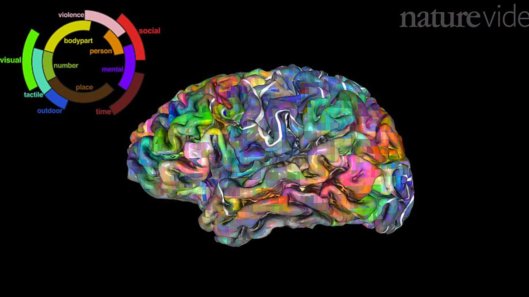
A groundbreaking new study from the Gallant Laboratory at the University of California, Berkeley is transforming how scientists understand language organisation in the brain. Published in Natureon 28 April 2016, the paper ‘Natural Speech Reveals the Semantic Maps That Tile Human Cerebral Cortex’ reveals that we use our entire brain – and not just the temporal lobe, as once believed – to group words by meaning. And while every ‘brain dictionary’ appears to be unique, they share some surprising similarities. To learn more about the research, explore the interactive map based on the study at the Gallant Laboratory’s website.

Video by Nature

Animator: Alexander Huth

Share this:

  • Email a link to a friend (Opens in new window) Email
  • Print (Opens in new window) Print
  • Share on Facebook (Opens in new window) Facebook
  • Share on LinkedIn (Opens in new window) LinkedIn
  • Share on Pinterest (Opens in new window) Pinterest
  • Share on Reddit (Opens in new window) Reddit
  • Share on X (Opens in new window) X
  • Share on Tumblr (Opens in new window) Tumblr
Like Loading...
← Older posts
Newer posts →
Ken Heller on

Enter your email address to follow this blog and receive notifications of new posts by email.

Join 4,624 other subscribers

Media Psychology

  • RSS - Posts
  • RSS - Comments

Blog Stats

  • 115,715 hits

Archives

  • December 2020 (3)
  • November 2020 (4)
  • September 2020 (1)
  • June 2020 (1)
  • April 2020 (1)
  • March 2020 (1)
  • February 2020 (3)
  • January 2020 (4)
  • December 2019 (8)
  • November 2019 (1)
  • October 2019 (5)
  • September 2019 (10)
  • August 2019 (7)
  • July 2019 (4)
  • June 2019 (3)
  • May 2019 (5)
  • April 2019 (8)
  • March 2019 (7)
  • February 2019 (4)
  • January 2019 (5)
  • December 2018 (4)
  • November 2018 (4)
  • October 2018 (5)
  • September 2018 (8)
  • August 2018 (7)
  • July 2018 (4)
  • June 2018 (3)
  • May 2018 (6)
  • April 2018 (4)
  • March 2018 (6)
  • February 2018 (6)
  • January 2018 (6)
  • December 2017 (4)
  • November 2017 (5)
  • October 2017 (5)
  • September 2017 (5)
  • August 2017 (5)
  • July 2017 (5)
  • June 2017 (5)
  • May 2017 (2)
  • April 2017 (2)
  • March 2017 (5)
  • February 2017 (4)
  • January 2017 (7)
  • December 2016 (3)
  • November 2016 (2)
  • October 2016 (4)
  • September 2016 (2)
  • August 2016 (2)
  • July 2016 (3)
  • June 2016 (5)
  • May 2016 (6)
  • April 2016 (4)
  • March 2016 (2)
  • February 2016 (1)
  • January 2016 (1)
  • December 2015 (1)
  • November 2015 (2)
  • January 2015 (1)
  • November 2014 (1)
  • September 2014 (1)
  • August 2014 (1)
  • July 2014 (4)
  • May 2014 (1)
  • April 2014 (1)
  • March 2014 (2)
  • February 2014 (2)
  • January 2014 (2)
  • December 2013 (4)
  • November 2013 (2)
  • October 2013 (1)
  • September 2013 (1)
  • August 2013 (4)
  • July 2013 (1)
  • June 2013 (1)
  • April 2013 (1)
  • March 2013 (4)
  • February 2013 (3)
  • January 2013 (5)
  • December 2012 (4)
  • November 2012 (6)

Addiction Advertising Agenda Setting Al-Jazeera Associated Press Behavioralism Bernays Cartoons Causality Cognitive Correlation Cultivation Theory Digital Immigrants Digital Natives Ellul Facebook Fallacious Arguments Film Framing Gaming Gerbner Giles Google Greenwald ICT Identity Imagery Impact of ICT Influence Ingress Internet Internet.org Journalism Marketing McCombs McLuhan Mean World Sydrome Media Media Effects Media Literacy Media Psychology Mobile Computing Mobile Phones Moscow Olympics Neural Pathways news coverage Operant Conditioning Persuasive Technology Physiological Psychology Pinterest Potter Prensky Privacy Propaganda Psychological Effects Psychological Operations Psychology Public Diplomacy Public Relations Quotes Sexism Skinner Smartphone Social Change Social Identity Social Media Social Networks Social Psychology Sports Taylor Technology The Engineering of Consent Transmedia Twitter Walking Dead

RSS The Amplifier – APA Div. 46 Newsletter

  • The Legend of Zelda: Echoes of Wisdom as a Feminist Breakthrough and Contradiction
  • Digital Mourning: Grief Expression on Social Media
  • Book Review: Black Film Through a Psychodynamic Lens
  • The History of (Media) Multitasking Research
  • AI and Mental Health: Can Chatbots and Digital Coaches Bridge the Gap for Perinatal Mental Health Support?
  • To Infinity and Beyond: Best Practices for Data-informed Telemental Intensive Outpatient Programs
  • Editor’s Column: Authentically Inclusive Representation in Film and Television
  • President’s Column: Charting the Future of Media Psychology: Division 46 at APA 2025
  • Past President’s Column: Division 46 Announcements
  • TikTok and Self-Diagnosis: What Clinicians Need to Know

RSS APA Div. 46 Media Psychology and Technology Facebook Feed – Come check it out!

  • Kids Are Using Minecraft To Design A More Sustainable World
  • Home – UsMeU
  • Huggable Robot Befriends Girl in Hospital
  • Lifelong learning is made possible by recycling of histones, study says
  • Synthetic Love: Can a Human Fall in Love With a Robot? –
  • Today’s Photo:
  • Dr. Joanne Broder Sumerson
  • Could Storytelling Be the Secret Sauce to STEM Education?
  • Google driverless cars were in 11 accidents, but officer, it wasn’t their fault
  • All-But-Dissertation Survival Guide

RSS Changing Minds

  • An error has occurred; the feed is probably down. Try again later.

RSS Media Smarts

  • Outcome Chart – Manitoba – Senior Years Graphic Communication Technology 12
  • Outcome Chart – Manitoba – Senior Years Graphic Communication Technology 11
  • Outcome Chart – Manitoba – Senior Years Graphic Communication Technology 10
  • Outcome Chart – Manitoba – Senior Years Graphic Communication Technology 9
  • How technology helps holiday planning
  • Our history
  • Support our work
  • Share your story
  • Outcome Chart – Newfoundland and Labrador – Science K
  • Outcome Chart – Newfoundland and Labrador – Mathematics 3202

RSS Adam Curtis

  • HYPERNORMALISATION
  • TRAILER TRASH
  • HAPPIDROME - Part One
  • THE VEGETABLES OF TRUTH
  • NOW THEN
  • SUSPICIOUS MINDS
  • ONE'S PRIVATE LIFE
  • WHAT THE FLUCK!
  • THE BABY AND THE BAATH WATER
  • BUGGER

RSS Media Psychology Blog

  • does resurge work : Resurge weight reduction supplement is a...

RSS The Psych Files

  • The Psych Files – Most Popular Episodes
  • Psych Files Episodes on Youtube

RSS The Media Zone

  • And He Knew All the Words
  • Sexy, Dangerous Women Are Everywhere
  • In Praise of Older Women
  • "Commercial Creep"—I Hate Commercials and You Should Too
  • How A Laundry Detergent Commercial Saved the World
  • Jodie Foster: To Come Out Lesbian Or Let Sleeping Rumors Lie
  • Why No Photos of the Slaughtered Newtown Children?
  • HBO's "The Newsroom": Sorkin Talks Truth To Stupid
  • Dorothy Sandusky: A Woman Who Saw Nothing
  • Celebrity - The Incest of Actors, Politicians, and Journalists.

RSS The Media Psychology Effect

  • The Importance of Synesthesia in Artificial Intelligence
  • Media and Communications Psychology in the 21st Century
  • Media Psychology Is a New-Collar Profession
  • The Psychology of Crowds
  • AI Is Reshaping Workers as Well as Work
  • Understanding the Eye in AI
  • Where's Smokey the Bear When You Need Him?
  • Personalized AI and the Future of Teaching and Learning
  • The Future of Learning and Education Is Already in Your Pocket
  • Psychology and the Importance of Perfect Practice

RSS On The Media

  • An error has occurred; the feed is probably down. Try again later.

Blog at WordPress.com.

Privacy & Cookies: This site uses cookies. By continuing to use this website, you agree to their use.
To find out more, including how to control cookies, see here: Cookie Policy
  • Subscribe Subscribed
    • Media Psychology
    • Join 555 other subscribers
    • Already have a WordPress.com account? Log in now.
    • Media Psychology
    • Subscribe Subscribed
    • Sign up
    • Log in
    • Report this content
    • View site in Reader
    • Manage subscriptions
    • Collapse this bar
%d