• About the Authors
  • Blogs and Shows
  • Journals
  • Open Invitation
  • References
  • Resources
  • Taxonomy
  • Who’s Who?

Media Psychology

~ Informing, Educating and Influencing

Media Psychology

Tag Archives: Psychology

Media Psychology and ‘Call of Duty’ Video Game Impact, Part 1

05 Tuesday Feb 2013

Posted by Ken S. Heller in Media Effects, Psychology

≈ Leave a comment

Tags

Gaming, Influence, Journalism, Media Effects, Propaganda, Psychological Operations, Psychology, War

The influence of popular violent video games, such as the Call of Duty series, has penetrated into the global consciousness and culture as an example of the media psychology. Last year Call of Duty: Black Ops 2 grossed $1 billion dollars in sales within 15 days of its release and $500 million dollars in the first 24 hours (LeJacq, 2012). Averaging $60 per game, that’s more than 1.5 million copies sold in 15 days. Its predecessor, Call of Duty: Modern Warfare, sold 8.8 million units in the United States alone in its first month (LeJacq, 2012). Two recent examples seem to point to it becoming a cross-cultural phenomenon. The first example being of an Agence France-Presse (AFP) photo of a French soldier during combat operations sporting a facemask that resembles a character in the game known as “Ghost” to protect himself from dust. Continue reading →

Share this:

  • Click to email a link to a friend (Opens in new window) Email
  • Click to print (Opens in new window) Print
  • Click to share on Facebook (Opens in new window) Facebook
  • Click to share on LinkedIn (Opens in new window) LinkedIn
  • Click to share on Pinterest (Opens in new window) Pinterest
  • Click to share on Reddit (Opens in new window) Reddit
  • Click to share on X (Opens in new window) X
  • Click to share on Tumblr (Opens in new window) Tumblr
Like Loading...

Anytime, Anywhere Access – Psychological Use of the Media

16 Sunday Dec 2012

Posted by Ken S. Heller in Psychology

≈ Leave a comment

Tags

Influence, Military Information Support Operations, MISO, Mobile Phones, Propaganda, Psychological Operations, Psychology, PSYOPs

Army Col. (ret) Lawrence Dietz, a former Psychological Operations officer (now called Military Information Support Operations, or MISO), recently observed that no matter where a military operation was taking place in the world, the military could leverage mobile phones to communicate directly to a host population, more so than any other communication medium.

“IO (Information Operations) tools are never fixed. One AO (Area of Operations) demands TV, while another can hardly read…//…Which brings me to the only constant, regardless of AO – the mobile phone. It appears that no matter where you go, whether urban or rural, developed or not, the cell phone is an important, if not the most import means of communication – the way people get or give information. To be effective the IO needs to know how to use mobile phones as a medium, but also how to deny individuals the use of their phones at certain times, or perhaps to alter the messages they receive” (Dietz, 2012).

ITU

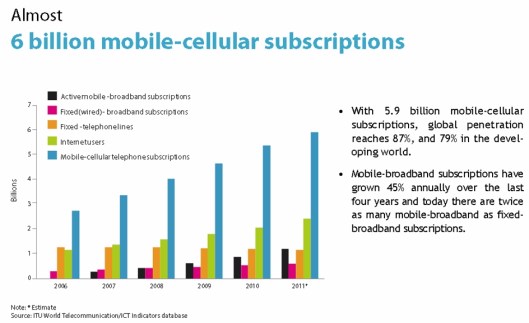
There are almost six billion mobile cell phone subscriptions which is a global penetration of 87 percent (ITU, 2011). Srivastava notes that the rapid expansion of the internet was quickly overtaken by the development of mobile phones, both the analog varieties and Smartphones. In a three year period, twice as many people decided on cellular subscriptions instead of on home internet subscriptions (Srivastava, 2008). The majority of this growth can be attributed to personnel convenience. Six years ago there was more than one analog mobile phone for every three people on earth, while as of 2011 one third of the earth’s population was using the internet (Srivastava, 2008; ITU, 2011). Obviously the potential for using this medium to communicate messages to mass audiences for more than military applicatons is almost indescribable, if service providers cooperate.

References

Dietz, L. (2012, Dec 13). IO Refined in New Version of JP 3-13. Retrieved Dec 14, 2012, from PSYOP Regimental Blog: http://psyopregiment.blogspot.com/2012/12/io-refined-in-new-version-of-jp-3-13.html

ITU. (2011). ICT Facts and Figures. Retrieved Dec 8, 2012, from ITU: Commited to Connecting the World: http://www.itu.int/ITU-D/ict/facts/2011/material/ICTFactsFigures2011.pdf

Srivastava, L. (2008). The Mobile Makes Its Mark. In J. E. Katz, Mobile Communications Studies (pp. 15-27). Cambridge: MIT.

Related articles
  • Cell phone subscriptions to hit 5 billion globally (reviews.cnet.com)
  • Mobile phone subscriptions number six billion globally (misco.co.uk)

Share this:

  • Click to email a link to a friend (Opens in new window) Email
  • Click to print (Opens in new window) Print
  • Click to share on Facebook (Opens in new window) Facebook
  • Click to share on LinkedIn (Opens in new window) LinkedIn
  • Click to share on Pinterest (Opens in new window) Pinterest
  • Click to share on Reddit (Opens in new window) Reddit
  • Click to share on X (Opens in new window) X
  • Click to share on Tumblr (Opens in new window) Tumblr
Like Loading...

Unintended Media Effects and Media Literacy

14 Wednesday Nov 2012

Posted by Ken S. Heller in Media Effects, Media Literacy, Psychology

≈ 5 Comments

Tags

Agenda Setting, Framing, Journalism, Media Effects, Media Literacy, Psychology

Being in the media, purposefully or otherwise, can have unintended effects, many of which the media will never stop and apologize for. Such is the case for Neda Soltani, a professor of English literature, whose Facebook picture was downloaded and disseminated among Iranian protesters – en masse. According to the New York Times article In a Death Seen Around the World, a Symbol of Iranian Protests Neda Agha-Soltan, notice there is no “i” at the end of her name, was shot in the chest and died when she went to witness a protest in Tehran shortly after the conclusion of the elections that reinstated President Ahmadinejad. Her death was caught on video and subsequently went viral.

Agha-Soltan

Shortly afterward the media published a photo of Soltani claiming it was Soltan – a mistake that Soltani has had to live with ever since. In an article for the BBC, Neda Soltani: ‘The media mix-up that ruined my life’, Soltani discusses the repercussions she has had to deal with to include becoming a martyr for a protest she did not participate in, government persecution, accusations of being a CIA spy, and becoming a political refugee.

Neda Soltani (left) and Neda Agha-Soltan (right)

Neda Soltani (left) and Neda Agha-Soltan (right)

There are a couple of things at work here. The first is media and journalistic responsibility – or lack thereof. Because of the speed at which news travels across the internet, media outlets feel more and more pressure to release information as fast as possible, without taking the appropriate amount of time to verify the facts, or allow the complete story to play out before reporting on it. This is all part of the cycle to bring in a larger audience, in order to attract more advertisers and increased revenue for which the media competes with other outlets. As Ahmadinejad is not a popular foreign leader here in the United States, the media rushed to publicize the fallout that followed.  Soltani and Soltan were both used as pawns to frame the protests. Second, few members of the media have attempted to correct the record, which is part of what makes the BBC’s coverage important as a model for reporting. For a typical American media outlet, their is an old adage that “if it bleeds, it leads” which basically means that violence will always be covered right up front, especially political violence that can incorporate a pretty face as a victim. What is reprehensible is the lack of responsibility to correct the record in the aftermath — but that’s not what audiences will stop to see, or advertisers will pay for, as a result. Cognitively, people are conditioned and drawn to stop and witness violence or tragedy. It’s a part of our innate nature to be curious as to the fate of others. We learn through observation. The media plays upon this to garner attention and profit repeatedly. Increasing one’s media literacy in regard to the economic agenda of the media is the first step to understanding how audiences are told what to think about, and how to think about it, and to freeing one’s own mind from their effects.

References

BBC News Magazine. (2012, Nov 14). Neda Soltani: ‘The media mix-up that ruined my life’. Retrieved Nov 14, 2012, from BBC News Magazine: http://www.bbc.co.uk/news/magazine-20267989

Fathi, N. (2009, June 22). In a Death Seen Around the World, a Symbol of Iranian Protests. Retrieved Nov 14, 2012, from The New York Times: http://www.nytimes.com/2009/06/23/world/middleeast/23neda.html?_r=0

Wikipedia. (2012, Nov 14). Death of Neda Agha-Soltan. Retrieved Nov 14, 2012, from Wikipedia: http://en.wikipedia.org/wiki/Death_of_Neda_Agha-Soltan

Share this:

  • Click to email a link to a friend (Opens in new window) Email
  • Click to print (Opens in new window) Print
  • Click to share on Facebook (Opens in new window) Facebook
  • Click to share on LinkedIn (Opens in new window) LinkedIn
  • Click to share on Pinterest (Opens in new window) Pinterest
  • Click to share on Reddit (Opens in new window) Reddit
  • Click to share on X (Opens in new window) X
  • Click to share on Tumblr (Opens in new window) Tumblr
Like Loading...
Ken Heller on

Enter your email address to follow this blog and receive notifications of new posts by email.

Join 4,624 other subscribers

Media Psychology

  • RSS - Posts
  • RSS - Comments

Blog Stats

  • 114,411 hits

Archives

  • December 2020 (3)
  • November 2020 (4)
  • September 2020 (1)
  • June 2020 (1)
  • April 2020 (1)
  • March 2020 (1)
  • February 2020 (3)
  • January 2020 (4)
  • December 2019 (8)
  • November 2019 (1)
  • October 2019 (5)
  • September 2019 (10)
  • August 2019 (7)
  • July 2019 (4)
  • June 2019 (3)
  • May 2019 (5)
  • April 2019 (8)
  • March 2019 (7)
  • February 2019 (4)
  • January 2019 (5)
  • December 2018 (4)
  • November 2018 (4)
  • October 2018 (5)
  • September 2018 (8)
  • August 2018 (7)
  • July 2018 (4)
  • June 2018 (3)
  • May 2018 (6)
  • April 2018 (4)
  • March 2018 (6)
  • February 2018 (6)
  • January 2018 (6)
  • December 2017 (4)
  • November 2017 (5)
  • October 2017 (5)
  • September 2017 (5)
  • August 2017 (5)
  • July 2017 (5)
  • June 2017 (5)
  • May 2017 (2)
  • April 2017 (2)
  • March 2017 (5)
  • February 2017 (4)
  • January 2017 (7)
  • December 2016 (3)
  • November 2016 (2)
  • October 2016 (4)
  • September 2016 (2)
  • August 2016 (2)
  • July 2016 (3)
  • June 2016 (5)
  • May 2016 (6)
  • April 2016 (4)
  • March 2016 (2)
  • February 2016 (1)
  • January 2016 (1)
  • December 2015 (1)
  • November 2015 (2)
  • January 2015 (1)
  • November 2014 (1)
  • September 2014 (1)
  • August 2014 (1)
  • July 2014 (4)
  • May 2014 (1)
  • April 2014 (1)
  • March 2014 (2)
  • February 2014 (2)
  • January 2014 (2)
  • December 2013 (4)
  • November 2013 (2)
  • October 2013 (1)
  • September 2013 (1)
  • August 2013 (4)
  • July 2013 (1)
  • June 2013 (1)
  • April 2013 (1)
  • March 2013 (4)
  • February 2013 (3)
  • January 2013 (5)
  • December 2012 (4)
  • November 2012 (6)

Addiction Advertising Agenda Setting Al-Jazeera Associated Press Behavioralism Bernays Cartoons Causality Cognitive Correlation Cultivation Theory Digital Immigrants Digital Natives Ellul Facebook Fallacious Arguments Film Framing Gaming Gerbner Giles Google Greenwald ICT Identity Imagery Impact of ICT Influence Ingress Internet Internet.org Journalism Marketing McCombs McLuhan Mean World Sydrome Media Media Effects Media Literacy Media Psychology Mobile Computing Mobile Phones Moscow Olympics Neural Pathways news coverage Operant Conditioning Persuasive Technology Physiological Psychology Pinterest Potter Prensky Privacy Propaganda Psychological Effects Psychological Operations Psychology Public Diplomacy Public Relations Quotes Sexism Skinner Smartphone Social Change Social Identity Social Media Social Networks Social Psychology Sports Taylor Technology The Engineering of Consent Transmedia Twitter Walking Dead

RSS The Amplifier – APA Div. 46 Newsletter

  • The Legend of Zelda: Echoes of Wisdom as a Feminist Breakthrough and Contradiction
  • Digital Mourning: Grief Expression on Social Media
  • Book Review: Black Film Through a Psychodynamic Lens
  • The History of (Media) Multitasking Research
  • AI and Mental Health: Can Chatbots and Digital Coaches Bridge the Gap for Perinatal Mental Health Support?
  • To Infinity and Beyond: Best Practices for Data-informed Telemental Intensive Outpatient Programs
  • Editor’s Column: Authentically Inclusive Representation in Film and Television
  • President’s Column: Charting the Future of Media Psychology: Division 46 at APA 2025
  • Past President’s Column: Division 46 Announcements
  • TikTok and Self-Diagnosis: What Clinicians Need to Know

RSS APA Div. 46 Media Psychology and Technology Facebook Feed – Come check it out!

  • Kids Are Using Minecraft To Design A More Sustainable World
  • Home – UsMeU
  • Huggable Robot Befriends Girl in Hospital
  • Lifelong learning is made possible by recycling of histones, study says
  • Synthetic Love: Can a Human Fall in Love With a Robot? –
  • Today’s Photo:
  • Dr. Joanne Broder Sumerson
  • Could Storytelling Be the Secret Sauce to STEM Education?
  • Google driverless cars were in 11 accidents, but officer, it wasn’t their fault
  • All-But-Dissertation Survival Guide

RSS Changing Minds

  • An error has occurred; the feed is probably down. Try again later.

RSS Media Smarts

  • Outcome Chart – Newfoundland and Labrador – Science K
  • Outcome Chart – Newfoundland and Labrador – Mathematics 3202
  • Outcome Chart - Newfoundland and Labrador - Mathematics 2202
  • Resources for Teachers - Video Media
  • Resources for Parents - Video Media
  • Resources for Teachers - Comics
  • Resources for Parents - Comics
  • The comics industry
  • Expression and storytelling in comics
  • Resources for Teachers - Visual Media

RSS Adam Curtis

  • HYPERNORMALISATION
  • TRAILER TRASH
  • HAPPIDROME - Part One
  • THE VEGETABLES OF TRUTH
  • NOW THEN
  • SUSPICIOUS MINDS
  • ONE'S PRIVATE LIFE
  • WHAT THE FLUCK!
  • THE BABY AND THE BAATH WATER
  • BUGGER

RSS Media Psychology Blog

  • does resurge work : Resurge weight reduction supplement is a...

RSS The Psych Files

  • The Psych Files – Most Popular Episodes
  • Psych Files Episodes on Youtube

RSS The Media Zone

  • And He Knew All the Words
  • Sexy, Dangerous Women Are Everywhere
  • In Praise of Older Women
  • "Commercial Creep"—I Hate Commercials and You Should Too
  • How A Laundry Detergent Commercial Saved the World
  • Jodie Foster: To Come Out Lesbian Or Let Sleeping Rumors Lie
  • Why No Photos of the Slaughtered Newtown Children?
  • HBO's "The Newsroom": Sorkin Talks Truth To Stupid
  • Dorothy Sandusky: A Woman Who Saw Nothing
  • Celebrity - The Incest of Actors, Politicians, and Journalists.

RSS The Media Psychology Effect

  • The Importance of Synesthesia in Artificial Intelligence
  • Media and Communications Psychology in the 21st Century
  • Media Psychology Is a New-Collar Profession
  • The Psychology of Crowds
  • AI Is Reshaping Workers as Well as Work
  • Understanding the Eye in AI
  • Where's Smokey the Bear When You Need Him?
  • Personalized AI and the Future of Teaching and Learning
  • The Future of Learning and Education Is Already in Your Pocket
  • Psychology and the Importance of Perfect Practice

RSS On The Media

  • An error has occurred; the feed is probably down. Try again later.

Create a free website or blog at WordPress.com.

Privacy & Cookies: This site uses cookies. By continuing to use this website, you agree to their use.
To find out more, including how to control cookies, see here: Cookie Policy
  • Subscribe Subscribed
    • Media Psychology
    • Join 555 other subscribers
    • Already have a WordPress.com account? Log in now.
    • Media Psychology
    • Subscribe Subscribed
    • Sign up
    • Log in
    • Report this content
    • View site in Reader
    • Manage subscriptions
    • Collapse this bar
 

Loading Comments...
 

    %d