From “The Chinwag”
14 Saturday Jan 2017
Posted in Media Psychology, Psychology, Reaction Videos, Social Psychology

14 Saturday Jan 2017
Posted in Media Psychology, Psychology, Reaction Videos, Social Psychology
06 Saturday Aug 2016
Posted in Media Effects, Media Literacy, Media Psychology, Psychology
 Nothing good. Experts suggested limiting your exposure to violent imagery and social media.
Source: What Is a Constant Cycle of Violent News Doing to Us?
18 Monday Jul 2016
Posted in Media Psychology, Psychology
By Chris Baraniuk
“Basically the reason I downloaded it is because a lot of my friends in the States have been going mad for it,” says Jon Norris. “They’re quite sensible adults but they were absolutely freaking out about it.”
Norris, head of content at Brighton-based digital agency Rocketmill, is talking about Pokemon Go. It’s a new augmented reality mobile game – and it’s taking the world by storm. The title, which has been available in the US for less than a week, has racked up millions of downloads already. The app lets players track down and “catch” virtual Pokemon that appear somewhere in the world around them.
Although not yet officially available in the UK, eager players like Norris have been able to install the app via some technical workarounds. The app has not risen to fame without controversy, though. For one thing, some have raised concerns over the fact that it can have very broad access to user data – from emails to search history and Google Drive – when users give it access to their Google accounts on iOS devices.
So what is the big attraction? And could its success have been predicted?
Admissions tests
Psychologist Andrew Przybylski at the Oxford Internet Institute has studied what attributes are essential for games to have the chance of being successful. These range from whether they are pitched at the right difficulty for players to how much they build in, or foster, social interaction with others, and he thinks one important factor is the ‘barrier of admission’ to having a good time.
A crucial feature of Pokemon Go, for example, is that it relies on technologies many people have and are already familiar with – their smartphone and GPS. Contrast this with geocaching, for example, which requires a more advanced knowledge of GPS (and even an array of physical equipment).
Many of the games that have enjoyed surprisingly broad appeal in the past – from Snake to Angry Birds and many of the original Wii titles – also married highly accessible gameplay with technology that was relatively new but easy to use, adds Przybylski.
“People have already learned how to use their phones – just like they know how to use their bodies for Wii Tennis,” he explains. “The work has already been done.”
“You can dive into it very easily,” agrees Norris.
Another factor is nostalgia. While Norris, for one, never played any of the previous Pokemon games, many Pokemon Go fans have fond memories of titles dating back to 1996, when the first instalments in the series were released. Even the very fact that people are talking about Pokemon more than usual again has prompted reminiscences among some older fans.
But for Przybylski, if a game tries to use nostalgia as part of its appeal, it must also deliver on its promise of novelty and fun. Pokemon Go, at least, certainly seems to have done so for some.
“The only way to deliver fun is to have players feel confident, give them a sense of exploration and connect them socially to others – on those three very important counts, the game looks like it’s succeeded,” he says.
Indeed, Norris immediately points out an unexpected benefit of wandering around Brighton, Pokemon Go app in hand.
“All the little Pokestops [where players collect in-game items] are associated with various pieces of street art in Brighton,” he comments. “It’s actually shown me a couple of pieces of street art I haven’t seen before.”
People have apparently been willing to wander around outside late at night in search of that elusive Squirtle or Meowth – or even make a catch while they wait for their wife to give birth. This has turned Pokemon Go into a bizarre phenomenon that has helped provide the game with its other, perhaps most important, dimension of success: it is excellent fodder for social media.
In 2013, British writer and TV presenter Charlie Brooker cited Twitter as one of his top 25 video games that changed the world. How is Twitter a video game? By Brooker’s logic, it has a graphical interface and a points-based system of competition (number of followers, for example). The idea that social media is a game, or that it can be played like one, is provocative – but with an app like Pokemon Go in mind this seems to make sense. Part of the game’s appeal, whether its makers intended this or not, seems to be the opportunity to meme-ify and share experiences about it on sites like Reddit, Snapchat and Imgur.
Thus, Pokemon Go plays out not just within the official app, but via these social networks too.
Psychologists are beginning to understand why using social media is so enjoyable, and one aspect of particular interest is the opportunity to craft and experiment with one’s sense of self. We do this offline too, but online we are offered different possibilities – and different potential rewards, such as new friends or increased levels of interaction.
Interestingly, there are many stories online of Pokemon Go players bumping into each other while on the hunt – the game clearly encourages social interaction both via the web and face-to-face, which is unusual.
Pokemon Go, then, may well be the perfect game for the social media age – we’re primed for it, argues Przybylski. Using social media has, he suggests, readied us for this sort of experience.
“The modern era has trained people for playing Pokemon Go,” he says.
Indeed, the way the game is being played and talked about online certainly seems to capture the essence of Mark Zuckerberg’s mantra that social media should enable “frictionless sharing” – activity that happens naturally and that appeals directly to the needs and desires of users.
Of course, it’s not clear how long players will remain enthralled by Pokemon Go. It’s still very new. But as with all overnight successes, this is another phenomenon that has managed to tap into some fundamental desire shared by many.
In doing so, Pokemon Go might just have revealed a little bit more about what motivates people. Whether or not you enjoy playing video games yourself, that’s certainly something worth thinking about.
—
Chris Baraniuk is a freelance science and technology writer. He Tweets as @machinestarts.
05 Sunday Jun 2016
Posted in Media Effects, Media Psychology, Psychology
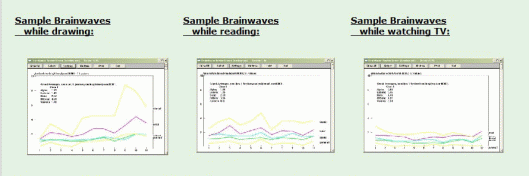
Nice clip from TVSmarter’s Terry Severson and worth understanding.
Here’s an excerpt from my new brainwave page.
Please let me know if you have any questions, suggestions for improvements, etc…
Also, this is just an excerpt, for more complete information please go to:
http://www.tvsmarter.com/documents/brainwaves.html
How Does TV Affect Brainwaves?
View original post 766 more words
08 Sunday May 2016
Posted in Media Effects, Media Psychology, Psychology

Researchers Pam Mueller and Daniel M. Oppenheimer found that students remember more via taking notes longhand rather than on a laptop. It has to do with what happens when you’re forced to slow down.
Source: Attention, Students: Put Your Laptops Away
As laptops become smaller and more ubiquitous, and with the advent of tablets, the idea of taking notes by hand just seems old-fashioned to many students today. Typing your notes is faster — which comes in handy when there’s a lot of information to take down. But it turns out there are still advantages to doing things the old-fashioned way.
For one thing, research shows that laptops and tablets have a tendency to be distracting — it’s so easy to click over to Facebook in that dull lecture. And a study has shown that the fact that you have to be slower when you take notes by hand is what makes it more useful in the long run.
In the study published in Psychological Science, Pam A. Mueller of Princeton University and Daniel M. Oppenheimer of the University of California, Los Angeles sought to test how note-taking by hand or by computer affects learning.
“When people type their notes, they have this tendency to try to take verbatim notes and write down as much of the lecture as they can,” Mueller tells NPR’s Rachel Martin. “The students who were taking longhand notes in our studies were forced to be more selective — because you can’t write as fast as you can type. And that extra processing of the material that they were doing benefited them.”
Mueller and Oppenheimer cited that note-taking can be categorized two ways: generative and nongenerative. Generative note-taking pertains to “summarizing, paraphrasing, concept mapping,” while nongenerative note-taking involves copying something verbatim.
And there are two hypotheses to why note-taking is beneficial in the first place. The first idea is called the encoding hypothesis, which says that when a person is taking notes, “the processing that occurs” will improve “learning and retention.” The second, called the external-storage hypothesis, is that you learn by being able to look back at your notes, or even the notes of other people.
Because people can type faster than they write, using a laptop will make people more likely to try to transcribe everything they’re hearing. So on the one hand, Mueller and Oppenheimer were faced with the question of whether the benefits of being able to look at your more complete, transcribed notes on a laptop outweigh the drawbacks of not processing that information. On the other hand, when writing longhand, you process the information better but have less to look back at.
For their first study, they took university students (the standard guinea pig of psychology) and showed them TED talks about various topics. Afterward, they found that the students who used laptops typed significantly more words than those who took notes by hand. When testing how well the students remembered information, the researchers found a key point of divergence in the type of question. For questions that asked students to simply remember facts, like dates, both groups did equally well. But for “conceptual-application” questions, such as, “How do Japan and Sweden differ in their approaches to equality within their societies?” the laptop users did “significantly worse.”
The same thing happened in the second study, even when they specifically told students using laptops to try to avoid writing things down verbatim. “Even when we told people they shouldn’t be taking these verbatim notes, they were not able to overcome that instinct,” Mueller says. The more words the students copied verbatim, the worse they performed on recall tests.
And to test the external-storage hypothesis, for the third study they gave students the opportunity to review their notes in between the lecture and test. The thinking is, if students have time to study their notes from their laptops, the fact that they typed more extensive notes than their longhand-writing peers could possibly help them perform better.
But the students taking notes by hand still performed better. “This is suggestive evidence that longhand notes may have superior external storage as well as superior encoding functions,” Mueller and Oppenheimer write.
Do studies like these mean wise college students will start migrating back to notebooks?
“I think it is a hard sell to get people to go back to pen and paper,” Mueller says. “But they are developing lots of technologies now like Livescribe and various stylus and tablet technologies that are getting better and better. And I think that will be sort of an easier sell to college students and people of that generation.”
30 Saturday Apr 2016
Posted in Media Effects, Media Psychology, Psychology

Research sometimes suggests that movies and other media are a negative influence to rein in. But new studies highlight their potential to spread goodness on a wide scale.
Source: How Positive Media Can Make Us Better People
Deadpool is the highest-grossing film in the United States so far this year—and one of the most controversial. Though the film has scored points with critics and audiences for its irreverent take on the superhero genre, its extreme gore has raised some familiar questions and objections about the role of violence in films.
But look at the highest-grossing film of 2016 internationally, and you’ll find a different type of movie:Zootopia, a family-friendly animated film that has been praised for its positive messages about the harm of stereotypes and prejudice.
How does consuming these different types of films impact us as individuals and as a society?
For a long time, media researchers focused almost entirely on the harmful effects of media, including the effects of media violence on aggression, the media’s role in increasing racial and gender stereotypes, and its potential to shape people’s perception of the world as a dangerous place. Indeed, since the dawn of talking movies in the 1930s, debates have raged about the potential anti-social effects of media.
However, more recently, scholarship in media psychology is starting to look at the flip side: the positive effects media can have when it’s more uplifting and inspiring. In the last few years, studies have illustrated how, just as some films, TV shows, and other media can foster anti-social behavior, media with positive images and messages can make us want to become better people and help others—to become more “prosocial,” as we researchers put it. I’ve conducted several of these studies myself, and I think the implications of this research are very exciting: Rather than simply seeing media as a negative influence to rein in, we’re beginning to understand its potential to spread goodness on a wide scale.
For example, a 2012 study by one of the seminal scholars in the field, Mary Beth Oliver of Penn State University, identified the power of films that elicit “elevation,” the warm, uplifting feeling we get when we watch someone perform deeply moral acts, such as acts of gratitude, generosity, or loyalty. In this study, Oliver and her colleagues asked 483 students to recall either a particularly meaningful or a particularly pleasurable movie they watched recently and to indicate the degree to which they felt joyful or elevated from watching it. When the researchers analyzed the content of these movies, they found that, sure enough, the meaningful movies depicted altruistic values, such as social justice and care for the weak, significantly more often than the pleasurable movies did.
They also found that the meaningful movies elicited greater feelings of elevation among respondents, which was expressed in a distinct set of emotional and physical sensations: feeling happy and sad at the same time, a lump in one’s throat, tearing up, a rising or opening of the chest, and chills.
What’s more, these feelings of elevation, in turn, were associated with a greater motivation to become a better person and do good things for others; the pleasurable movies, by contrast, motivated people to enjoy themselves and seek popularity.
Research also suggests that movies can influence not only our desire to do good but also the way we perceive the world as a whole. This research builds on earlier findings that the amount of TV people watch correlates with the degree to which they will see the world as a dangerous place, also known as “mean-world syndrome.” Research on inspiring media, by contrast, suggests that exposure to elevating media may have the potential to shift our perception of the world toward a “kind-world syndrome.”
For example, a 2011 study led by Karl Aquino of the University of British Columbia found that people who experienced elevation from reading a story about uncommon goodness became more likely to believe that there is good in the world. The more people experienced elevation, the more they perceived the world to be full of generosity and kindness. And research suggests there might be concrete benefits to this mental shift: Studies indicate that holding a cynical worldview—to only expect the worst of people—is actually bad for your health; however, seeing humanity’s positive potential can make us feel good (we experience positive emotions), which, in turn, can lead to anupward spiral of well-being.
Research that my colleagues and I have conducted points to social benefits of meaningful films as well. We asked 266 students to identify films that are meaningful to them; their responses generated a long list of movies, with the most popular ones being Remember the Titans, Forrest Gump, andEternal Sunshine of the Spotless Mind.
We found that these films are more likely than pleasurable films to depict values of love, kindness, and connectedness, and to elicit elevation. In addition, experiencing elevation from such movies made the participants feel more connected to dear friends and family, as well as to the transcendent, spiritual aspects of life—which, in turn, inspired a host of prosocial motivations. Specifically, watching a movie such as A Walk To Remember or The Blindside made them feel a general sense of compassionate love for people, made them want to help people less fortunate than themselves, and generally made them want to be kind and good to fellow human beings, even strangers.
Our findings highlight that elevation not only makes us feel more connected toward people we know but also makes us feel compassionate toward people we don’t—even to the point that we’re motivated to make sacrifices for strangers. The study suggests that the elevation we get from films can help us transcend our egocentric bias and forge more compassionate connections to others.
Of course, making these positive changes stick is not something that happens overnight. Nor is it enough to see portrayals of moral beauty, kindness, and generosity only every once in a while. For positive media to have strong, lasting effects on us individually or collectively, I believe we need to consume it consistently, over time, just as eating right only once a week does not make us healthier.
But it is encouraging to see that these effects are possible, and that our media consumption patterns can be a force for good in the world, not just a way to make media companies rich. The research on positive media is still evolving (and I will be covering more of it in future Greater Good articles). But so far, it suggests that when we select inspiring content on TV, in films, or through social media, we’re not just making ourselves feel good in the moment. We’re nurturing our instincts for compassion and kindness.
23 Friday Jan 2015
Posted in Advertising, Media Psychology, Psychology, Public Relations
By Liza Persson
The American department store chain J.C. Penney is bringing back its’ mail order catalogue to increase its customer engagement (Reuters, 2014). My first thought was that mail order catalogues seem so quaint these days.
My second one was: it’s smart to bring it back. Without it, a swipe of customers would be lost, because for them the purchase is just one step in a much longer process preceding and following that transaction for which having an actual, physical, mail order book is indispensable, a process far more important than the product one ends up buying.
23 Sunday Nov 2014
Posted in Media Psychology, Psychology
Stuart Fischoff, Ph.D., Professor Emeritus, Media Psychologist, American Psychological Association Fellow, writer, award-winning screenwriter, consultant, commentator and maybe the only person on the planet (besides Sondheim) who knew all of the words to all of the songs in Sondheim’s stage musical Company, including the ones cut from the show —
Stuart Fischoff, Stuart has died.
Stuart was born in New York City: he often tussled with the neighborhood toughs who beat on him because he was born Jewish; they learned it was in their best interest to curb that behavior.
He loved his parents; his sister hated him, he merely disliked her. Stuart did not care for high school and was a lousy student, but he loved going to Penn State, loved getting his Masters and Doctorate at The New School for Social Research and became what he wanted to become: an intellectual who used really big words and pronounced them correctly — which is why I married him. I can’t pronounce anything over two syllables.
Breaking ranks with tweedy, clean-fingernail intellectuals, Stuart liked woodworking and built furniture for our home, he also crafted bird homes, squirrel homes, dining room tables for mice and big, outdoor wood sculptures in the mode of “rustic impulsive,” the name he made-up for his artistic style.
10 Wednesday Sep 2014
Posted in Media Psychology, Psychology, Social Psychology
On the eve of this September 11th, I can’t help but pause and reflect on the day that changed the course of American history (therein changing world history). I remember many of the details, most with strong emotion attached to them – calling my husband to make sure he was all right, waking my brother to watch the news with me, gathering with my friends and colleagues to continue to collect any and all information we could. There was a near-palpable collective confusion, fear, anger and sadness that pervaded my personal environment, as well as throughout the nation. There are some memories from that day that are crystalline in their clarity. This memory acuity is known as a flashbulb memory – a memory created from intense emotional arousal at the moment of a significant and, often times, traumatic event. Do you have a flashbulb memory of that day? If so, you’re not alone. Continue reading
02 Saturday Aug 2014
Posted in Media Psychology, Psychology, Social Psychology
Tags
Recently I was introduced to the first season of the A&E television show, Longmire, which is currently streaming on Netflix. I have only had the privilege of watching several episodes (I’m afraid my schedule just doesn’t allow for regular television viewing) and what I’ve seen so far is quite compelling. Alas- although the show is excellent, I’m not writing today to provide a program review but rather to revisit a segment I wrote and presented at the Western States Humanities Conference last year.
One of the more notable elements of the show is the immersive depiction of modern American Indians (the show is specific to the Cheyenne). This leads me to consider media’s influence portraying marginalized, indigenous communities. Interestingly, Marshall McLuhan, the visionary educator of communications, media, technology and humanity provided a powerful framework in which to analyze media. He wrote on media’s influence in constructing a “global village” and of the powerful process of “retribalization.” This post briefly defines McLuhan’s retribalization, while posing additional questions of the concept’s application. Continue reading

 Media Psychology