• About the Authors
  • Blogs and Shows
  • Journals
  • Open Invitation
  • References
  • Resources
  • Taxonomy
  • Who’s Who?

Media Psychology

~ Informing, Educating and Influencing

Media Psychology

Category Archives: Psychology

Media Psychology Irony

28 Friday Dec 2012

Posted by Ken S. Heller in Media Effects, Psychology

≈ 2 Comments

Tags

Advertising, Cognitive, Desensitization, Ellul, Gaming, Propaganda, Video Game Violence

A late Christmas gift appeared at the house today which was wrapped in a bit of media psychology irony. Jacques Elull’s “Propaganda, The Formation of Men’s Attitudes” arrived in an Amazon wrapper emblazoned with a bold advertisement for the militeristic action video game “Call of Duty, Black Ops II.” Somehow the juxtiposition between “The Formation of Men’s Attitudes” and the media content in “Call of Duty” struck me in regard to the amount of militainment Americans consume on a regular basis these days, wether they choose to or not. It’s no wonder that at a cognitive level we are so “accepting” of so many of the activities we witness taking place in the world today. What’s a little desensitization matter in the long run (the diminished emotional responsiveness to a negative or aversive stimulus after repeated exposure)?

Amazon's wrapper for Call of Duty.

Amazon’s wrapper for Call of Duty.

Share this:

  • Email a link to a friend (Opens in new window) Email
  • Print (Opens in new window) Print
  • Share on Facebook (Opens in new window) Facebook
  • Share on LinkedIn (Opens in new window) LinkedIn
  • Share on Pinterest (Opens in new window) Pinterest
  • Share on Reddit (Opens in new window) Reddit
  • Share on X (Opens in new window) X
  • Share on Tumblr (Opens in new window) Tumblr
Like Loading...

Anytime, Anywhere Access – Psychological Use of the Media

16 Sunday Dec 2012

Posted by Ken S. Heller in Psychology

≈ Leave a comment

Tags

Influence, Military Information Support Operations, MISO, Mobile Phones, Propaganda, Psychological Operations, Psychology, PSYOPs

Army Col. (ret) Lawrence Dietz, a former Psychological Operations officer (now called Military Information Support Operations, or MISO), recently observed that no matter where a military operation was taking place in the world, the military could leverage mobile phones to communicate directly to a host population, more so than any other communication medium.

“IO (Information Operations) tools are never fixed. One AO (Area of Operations) demands TV, while another can hardly read…//…Which brings me to the only constant, regardless of AO – the mobile phone. It appears that no matter where you go, whether urban or rural, developed or not, the cell phone is an important, if not the most import means of communication – the way people get or give information. To be effective the IO needs to know how to use mobile phones as a medium, but also how to deny individuals the use of their phones at certain times, or perhaps to alter the messages they receive” (Dietz, 2012).

ITU

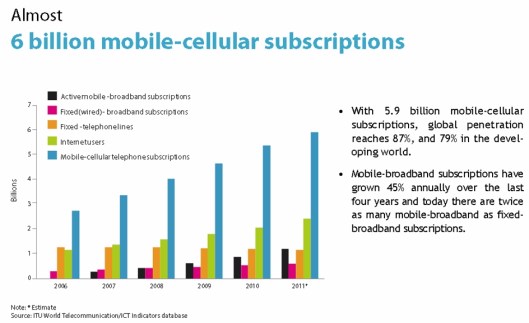
There are almost six billion mobile cell phone subscriptions which is a global penetration of 87 percent (ITU, 2011). Srivastava notes that the rapid expansion of the internet was quickly overtaken by the development of mobile phones, both the analog varieties and Smartphones. In a three year period, twice as many people decided on cellular subscriptions instead of on home internet subscriptions (Srivastava, 2008). The majority of this growth can be attributed to personnel convenience. Six years ago there was more than one analog mobile phone for every three people on earth, while as of 2011 one third of the earth’s population was using the internet (Srivastava, 2008; ITU, 2011). Obviously the potential for using this medium to communicate messages to mass audiences for more than military applicatons is almost indescribable, if service providers cooperate.

References

Dietz, L. (2012, Dec 13). IO Refined in New Version of JP 3-13. Retrieved Dec 14, 2012, from PSYOP Regimental Blog: http://psyopregiment.blogspot.com/2012/12/io-refined-in-new-version-of-jp-3-13.html

ITU. (2011). ICT Facts and Figures. Retrieved Dec 8, 2012, from ITU: Commited to Connecting the World: http://www.itu.int/ITU-D/ict/facts/2011/material/ICTFactsFigures2011.pdf

Srivastava, L. (2008). The Mobile Makes Its Mark. In J. E. Katz, Mobile Communications Studies (pp. 15-27). Cambridge: MIT.

Related articles
  • Cell phone subscriptions to hit 5 billion globally (reviews.cnet.com)
  • Mobile phone subscriptions number six billion globally (misco.co.uk)

Share this:

  • Email a link to a friend (Opens in new window) Email
  • Print (Opens in new window) Print
  • Share on Facebook (Opens in new window) Facebook
  • Share on LinkedIn (Opens in new window) LinkedIn
  • Share on Pinterest (Opens in new window) Pinterest
  • Share on Reddit (Opens in new window) Reddit
  • Share on X (Opens in new window) X
  • Share on Tumblr (Opens in new window) Tumblr
Like Loading...

Making the Case for War in the Media

15 Saturday Dec 2012

Posted by Ken S. Heller in Media Effects, Media Literacy, Psychology

≈ Leave a comment

Tags

Agenda Setting, Associated Press, Cognitive, Greenwald, Influence, Iran, Journalism, McCombs, Mean World Sydrome, Media Effects, Media Literacy, Nuclear Weapons, Propaganda

Late last month the world, and Americans in particular, were subject to an ongoing propaganda campaign designed to further the cause for war against Iran using the media. On November 27th, Associated Press (AP) correspondent and bureau chief George Jahn authored AP: Diagram Suggests Iran Working on Nuclear Bomb which was published with an accompanying graphic “leaked by officials from a country critical of Iran’s atomic program to bolster their arguments that Iran’s nuclear program must be halted before it produces a weapon. The officials provided the diagram only on condition that they and their country not be named” (Jahn, 2012).

AP exclusive

Examination of the graphic has shown that it can be found in common text books and on the internet, and further, that it’s flawed in its calculations (Greenwald, 2012). Greenwald interviews a number of different authorities on the topic who conclusively disprove the alleged authority of the graphic.
Therefore it appears as though the credibility of the reporter comes into question as well as “this isn’t the first time George Jahn has regurgitated dubious claims from diplomats critical of Iran. On September 11 of this year a nearly identical “exclusive” was published by AP…under Mr. Jahn’s byline, despite the fact that all the information contained within came from the November 2011 report, issued nearly a year prior. The article asserted that new ‘intelligence shows that Iran has advanced its work on calculating the destructive power of an atomic warhead through a series of computer models that it ran sometime within the past three years” (Business Insider, 2012).

Jahn could appear to be using his position as an AP bureau chief to facilitate the agenda of a foreign nation, a similar agenda that has led to great losses internationally over the past 10 years. A quick Google Scholar search using the terms “George+Jahn+Iran” show that Jahn has been key author on many AP Iranian related stories going at least 10 years back, most of them focused on the issue of nuclear weapons. In his position at AP he has the potential of placing influential news on the dining roomtable, on the television, on the radio, or on the World Wide Web for global consumption. As a result, he also has an obligation to check the facts provided for him by a third party. The AP was founded in 1846 as a non-profit cooperative to share news between media organizations. As of 2005 it provides material to more than 1,400 newspapers, and 5,001 television and radio broadcasters. It operates 243 news bureaus globally and serves at least 120 countries (Wikipedia, 2012; Associated Press, 2012). In an establishment such as this, an agenda can shape or reinforce opinions worldwide via a single impactful, credible story or through the continuous drip of subtle messaging, thus telling a population what to think about.

McCombs observed that much of what people know about the world comes from various media sources, which is reinforced in direct proportion to the amount of emphasis the media place on a topic (McCombs & Shaw, 1972). Cognitively that means people are exposed to biased information designed to reinforce fear and shape attitudes. As discussed in the previous post, It’s a Mean World! Or is it?, the use of fear can easily manipulate and control a population, which makes them more susceptible to hard-line actions taken on their “behalf” (Associated Press, 2006; Associated Press, 2006; Heller, 2012). Jahn’s unquestioned facilitation of this agenda without checking his sources calls his credibility and professionalism as a journalist into question, regardless of how well established he may be. Indeed, it also reflects poorly on the AP as an organization that should be double and triple checking its facts before publishing them. Greenwald agrees that journalists have an obligation to protect their sources – to a point. That “anonymity ends when the ‘sources’ use them to disseminate falsehoods. Indeed, the obligation to protect these sources not only ends, but a different obligation arises: to tell the public who fed them the hoax” (Greenwald, 2012).

References

Associated Press. (2012). FAQs. Retrieved Dec 14, 2012, from Associated Press: http://www.ap.org/company/FAQs

Associated Press. (2006, Jan 3). George Gerbner, 86, Researcher Who Studied Violence on TV, Is Dead. Retrieved Dec 9, 2012, from The New York Times: http://www.nytimes.com/2006/01/03/obituaries/03gerbner.html?_r=1&

Associated Press. (2006, Jan 2). George Gerbner; Studied TV Culture. Retrieved Dec 9, 2012, from The Washington Post: http://www.washingtonpost.com/wp-dyn/content/article/2006/01/02/AR2006010200577.html

Business Insider. (2012, Dec 4). Iran Disinfo Watch: The AP Gets Thrown Another Curveball. Retrieved Dec 8, 2012, from Business Insider: http://www.businessinsider.com/iran-disinfo-watch-the-ap-gets-thrown-another-curveball-2012-12

Greenwald, G. (2012, Nov 29). AP’s dangerous Iran hoax demands an accounting and explanation. Retrieved Dec 8, 2012, from The Guardian: http://www.guardian.co.uk/commentisfree/2012/nov/29/ap-iran-nuclear-program-graph-explanation

Heller, K. (2012, Dec 9). It’s a Mean World! Or Is It? Retrieved Dec 14, 2012, from Media Psychology – Informing, Educating and Influencing: https://mediapsychology101.wordpress.com/2012/12/09/its-a-mean-world-or-is-it/

Jahn, G. (2012, Nov 27). AP: Diagram suggests Iran working on nuclear bomb. Retrieved Dec 7, 2012, from CBS News: http://www.cbsnews.com/8301-202_162-57554866/ap-diagram-suggests-iran-working-on-nuclear-bomb/

McCombs, M. E., & Shaw, D. L. (1972). The Agenda-setting Function of Mass Media. Public Opinion Quarterly , 36 (2), 176–187.
Wikipedia. (2012, Dec 14). Associated Press. Retrieved Ded 14, 2012, from Wikipedia: http://en.wikipedia.org/wiki/Associated_Press#History

Share this:

  • Email a link to a friend (Opens in new window) Email
  • Print (Opens in new window) Print
  • Share on Facebook (Opens in new window) Facebook
  • Share on LinkedIn (Opens in new window) LinkedIn
  • Share on Pinterest (Opens in new window) Pinterest
  • Share on Reddit (Opens in new window) Reddit
  • Share on X (Opens in new window) X
  • Share on Tumblr (Opens in new window) Tumblr
Like Loading...

It’s a Mean World! Or Is It?

09 Sunday Dec 2012

Posted by Ken S. Heller in Media Effects, Media Literacy, Psychology

≈ 5 Comments

Tags

Behavioralism, Cartoons, Cognitive, Cultivation Theory, Gerbner, Influence, Mean World Sydrome, Media Effects, Media Literacy

Anybody who has ever watched television or films knows that both mediums are replete with violent entertainment – from cartoons and children’s programs, to horror “porn” such as the Hostel film series that “grossed” $80 million, worldwide.  If one takes in enough of the stuff they may believe it is a mean world indeed.

George Gerbner (August 8, 1919 – December 24, 2005) was dean emeritus of the Annenberg School for Communications at the University of Pennsylvania and a World War II veteran of the Office of Strategic Services (the predecessor of the Central Intelligence Agency). He founded the Cultural Indicators Research Project in 1968 which tracks television content (especially that of a violent nature) and how that content affects viewers’ perceptions of the world. Its database has information on more than 3,000 television programs and 35,000 characters (Associated Press, 2006). By its estimates, American children witness more than 8,000 murders and 100,000 other violent acts on television by the time they leave elementary school (Stossel, 1997). This study led to Gerbner’s formation of cultivation theory which states “the more time people spend “living” in the television world, the more likely they are to believe social reality portrayed on television…//… effects occur only after long-term, cumulative exposure to television” (Cohen & Weimann, 2000). This cognitive bias is known as mean world syndrome and may be comprised of up to four different recurring attitudes to include the beliefs in:

  1. Increased chances of involvement with violence
  2. Fear of walking alone at night
  3. Perceived activity of police
  4. General mistrust of people (Miller, 2013; Griffin, 2011)

In the following six minute clip provided by the Media Education Foundation Gerbner discusses how this culture of violence has come about and how it translates easily in films and television programming around the world directly stereotyping minorities. Additionally he observes that violent film sequels typically double the level of violence when compared to their predecessors.


Further, Gerbner testified to a congressional subcommittee that “Fearful people are more dependent, more easily manipulated and controlled, more susceptible to deceptively simple, strong, tough measures and hard-line measures. They may accept and even welcome repression if it promises to relieve their insecurities. That is the deeper problem of violence-laden television” (Associated Press, 2006).

Interested in more proof? Scott Stossel of the The Atlantic Online had the following independent studies to offer which appear to backup Gerbner’s hypothesis:

  • A 1956 study compared the behavior of twelve four-year-olds who watched a Woody Woodpecker cartoon containing many violent episodes with that of twelve other four-year-olds who watched “The Little Red Hen,” a nonviolent cartoon. The Woody watchers were much more likely than the Hen watchers to hit other children, break toys, and be generally destructive during playtime.
  • In 1981, Brandon Centerwall, a professor of epidemiology at the University of Washington, hypothesized that the sharp increase in the murder rate in North America beginning in 1955 was the product of television viewing. Television sets had been common household appliances for about eight years by that point — enough time, he theorized, to have inculcated violent tendencies in a generation of viewers. He tested his hypothesis by studying the effects of television in South Africa, where the Afrikaaner-dominated regime had banned it until 1975. He found that twelve years after television was introduced there, murder rates skyrocketed.
  • In 1960 Leonard Eron, a professor of psychology at the University of Michigan’s Institute for Social Research, studied third-graders in Columbia County in semi-rural New York. He observed that the more violent television these eight-year-olds watched at home, the more aggressive they were in school. Eron returned to Columbia County in 1971, when the children from his sample were nineteen. He found that the boys who had watched a lot of violent television when they were eight were more likely to get in trouble with the law when older. Eron returned to Columbia County a third time in 1982, when his subjects were thirty. He discovered that those who had watched the most television violence at age eight inflicted more violent punishments on their children, were convicted of more serious crimes, and were reported more aggressive by their spouses than those who had watched less violent television. In 1993, at a conference of the National Council for Families & Television, Eron estimated that 10 percent of the violence in the United States can be attributed to television.

References

Associated Press. (2006, Jan 3). George Gerbner, 86, Researcher Who Studied Violence on TV, Is Dead. Retrieved Dec 9, 2012, from The New York Times: http://www.nytimes.com/2006/01/03/obituaries/03gerbner.html?_r=1&

Associated Press. (2006, Jan 2). George Gerbner; Studied TV Culture. Retrieved Dec 9, 2012, from The Washington Post: http://www.washingtonpost.com/wp-dyn/content/article/2006/01/02/AR2006010200577.html

Cohen, J., & Weimann, G. (2000). Cultivation Revisited: Some Genres Have Some Effects on Some Viewers. Communication Reports , 99-114.

Griffin, E. (2011). A First Look At Communication Theory. New York: McGraw-Hill.

Miller, J. (2013, July 18). Cultivation…Farming? or Media? Retrieved from Applied Social Psychology: http://www.personal.psu.edu/bfr3/blogs/asp/2013/07/cultivationfarming-or-media.html

Stossel, S. (1997, May). The Man Who Counts Killings. Retrieved Dec 9, 2012, from The Atlantic: http://www.theatlantic.com/past/docs/issues/97may/gerbner.htm

Share this:

  • Email a link to a friend (Opens in new window) Email
  • Print (Opens in new window) Print
  • Share on Facebook (Opens in new window) Facebook
  • Share on LinkedIn (Opens in new window) LinkedIn
  • Share on Pinterest (Opens in new window) Pinterest
  • Share on Reddit (Opens in new window) Reddit
  • Share on X (Opens in new window) X
  • Share on Tumblr (Opens in new window) Tumblr
Like Loading...

Advertising’s Holy Grail and Media Psychology

28 Wednesday Nov 2012

Posted by Ken S. Heller in Psychology

≈ Leave a comment

Tags

Advertising, Gaming, Google, Influence, Ingress, Mobile Computing, The Engineering of Consent

The Holy Grail for advertising may be being that provider that can give a brand the ability to seamlessly interact with individuals while in both an offline, and online environment – a rich media psychology topic. In this way, messaging may become more personal and interactive, comprised of a single narrative that crosses between worlds – real and imagined. For the provider, it also enables the ability to offer market players, and other interested parties, the highly attractive proposition that individuals can be steered toward certain locations and behaviors that benefit the market player’s business (or at the very least, generate more data for some such as Google). By doing such, the provider establishes one narrative, like a game scenario, mapped onto the real world where the membrane of hyper reality can include any and all brands – as merely a name, all the way to personifications, or icons of brands, or causes that a player can interact with. Edward Bernays could only have dreamed of such ability while writing The Engineering of Consent which describes how to psychologically manipulate a population to want things they do not need (Bernays, 1947).

Once a player accepts the game, he or she may find themselves within a world created by the advertiser which unfolds a hyper reality composed of any number of cues and stimulus, incentives and directions, all benefits which on one hand keep users interested, and on the other ensure revenue for clients. Google’s new mobile platform offering, Ingress, may be just the start of such a behavioral “soft control” endeavor which can envelope a user in an augmented reality game designed to move the player around to key locations within actual cities, similar to geocaching.

“What’s also interesting, if Ingress and similar games gain traction, is the potential for subtle content delivery…//…Advertising takes minimal effort – an energy hotspot appearing in a large retail store, for example, or in-game events that include industries or companies dealing with the effects of this new energy source. Businesses could even appear as “sponsors” of one game faction or the other, lending their good name to the virtual cause. It’s not hard to imagine a situation where consumer goods purchased outside of the game world confer bonuses inside; this already happens with the release of popular titles like Call of Duty and Halo 4″ (Bonderud, 2012).

References

Bernays, E. (1947). The Engineering of Consent. The Annals of the American Academy, 113-120.

Bonderud, D. (2012, Nov 19). Google’s Ingress: Game, Reality – Marketing Opportunity? Retrieved Nov 19, 2012, from The Content Standard: http://www.contentstandard.com/business/googles-ingress-game-reality-marketing-opportunity/

Google. (2012). Retrieved Nov 19, 2012, from Ingress: http://www.ingress.com/

Ravenscraft, E. (2012, Nov 20). [Review] Ingress Is, By Far, The Best Augmented Reality Game A Curious Explorer In The City Can Play. Retrieved Nov 19, 2012, from Android Police: http://www.androidpolice.com/2012/11/20/ingress-is-by-far-the-best-augmented-reality-game-a-curious-explorer-in-the-city-can-play/

Rula, J., & Bustamante, F. E. (2012). Crowd (Soft) Control. Retrieved Nov 28, 2012, from HotMobile: http://www.hotmobile.org/2012/papers/HotMobile12-final75.pdf

Share this:

  • Email a link to a friend (Opens in new window) Email
  • Print (Opens in new window) Print
  • Share on Facebook (Opens in new window) Facebook
  • Share on LinkedIn (Opens in new window) LinkedIn
  • Share on Pinterest (Opens in new window) Pinterest
  • Share on Reddit (Opens in new window) Reddit
  • Share on X (Opens in new window) X
  • Share on Tumblr (Opens in new window) Tumblr
Like Loading...

Improving Personal Media Literacy

22 Thursday Nov 2012

Posted by Ken S. Heller in Media Literacy, Psychology

≈ 2 Comments

Tags

Agenda Setting, Fallacious Arguments, Influence, Media Literacy, Potter

Media literacy involves becoming aware of the ways in which the media attempt to influence an audience through messaging, be it verbal or otherwise. W. James Potter provides 12 guidelines to increase personal media literacy in his book Media Literacy, 6th edition which include:

  1. Strengthening one’s personal locus
  2. Focusing on usefulness as a goal when exposing oneself to the media
  3. Developing an accurate awareness of one’s media exposure
  4. Acquiring a broad base of useful knowledge
  5. Taking in consideration the Reality-Fantasy Continuum
  6. Examining one’s mental codes
  7. Examining one’s opinions
  8. Changing behaviors, as appropriate
  9. Making cross-channel comparisons
  10. Becoming skilled at designing messages
  11. Not taking one’s privacy for granted
  12. Taking more personal responsibility

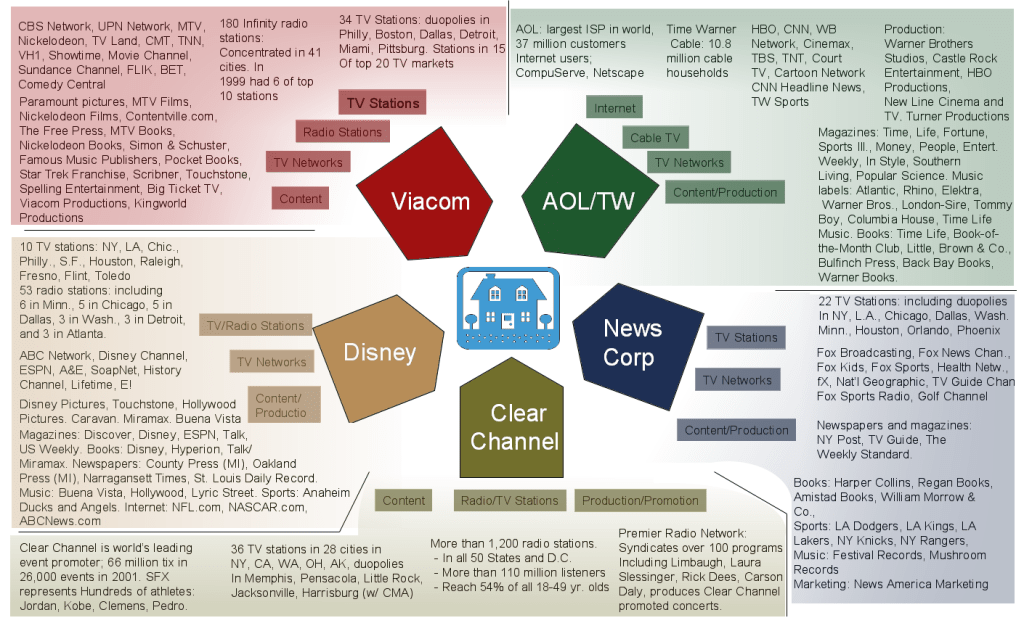
These are well thought out guidelines to which I would include a couple of thoughts.  In regard to item nine, while making cross-channel comparisons may increase the depth of knowledge surrounding a topic, but one must realize that many channels of information are owned by the same conglomerates (graphic from Mondo Times).

Who Owns the Media

For example, Columbia Broadcasting System (CBS) is one of the top six producers and owners of content from an American perspective. It controls television channels, for which it is primarily known, as well as film, radio, publishing, and various other “online properties.” News Corporation, a competitor of CBS, owns many of the same types of media that CBS does, but News Corporation adds newspapers and magazines to its portfolio AND maintains a global focus with its properties (Columbia Journalism Review, 2011; Mondo Times, 2012). The point is: checking information from a source on TV (channel 1) to a source in print (channel 2) may not be advantageous if the sources are owned by the same corporation (which may not be immediately evident). People tend to seek out information that supports their existing world views and, as a result, they reinforce what they believe and rarely understand counter viewpoints, or the entire picture.

To be knowledgeable on a topic means to thoroughly understand the arguments for and against it – having a broad base of knowledge (number four on Potter’s list). In order to accomplish that, one must take the time to consume the messaging from the other “side” – a cross-party comparison. This may mean watching content that may not be in one’s comfort zone while maintaining a neutral attitude and keeping an open mind about a topic. A technique I have developed for myself, having worked with the media extensively, is to listen to what is presented in the national news media and then compare that information with what is being discussed in the international media – a cross cultural comparison. American’s tend to live inside of what I like to refer to as a “media bubble” that echoes much of the same messaging from channel to channel. Comparing information from international sources tends to deflate that bubble, or add to the breadth of knowledge on a topic. Content providers such as the BBC, Al Jazeera English and Russia Today present different perspectives which can be quite informing.

Last, one should understand what fallacious arguments are (errors in reasoning resulting in a misconception which can be used purposefully), and that there are more than 90 types of them. An example would be the ad hominem argument that attacks an individual’s credibility, vice a topic of discussion (Lindsay, 2012). Another type of fallacious argument that is frequently seen in news commentary is the failure to state technique. This technique allows the user to “attack” the subject matter and control the discourse by continually questioning it, vice stating one’s own position. Understanding and recognizing these techniques can prime a person to seek other sources of information, or to personally conduct research.

References

Columbia Journalism Review. (2011, Aug 7). Who Owns What? Retrieved Nov 21, 2012, from Columbia Journalism Review: http://www.cjr.org/resources/?c=cbs

Lindsay, D. (2012, Aug 18). A List Of Fallacious Arguments. Retrieved Nov 22, 2012, from Don Lindsay Archive: http://www.don-lindsay-archive.org/skeptic/arguments.html

Mondo Times. (2012). Who Owns The Media. Retrieved Nov 22, 2012, from Mondo Times: http://www.mondotimes.com/

Potter, W. J. (2013). Media Literacy. Thousand Oaks: Sage.

Share this:

  • Email a link to a friend (Opens in new window) Email
  • Print (Opens in new window) Print
  • Share on Facebook (Opens in new window) Facebook
  • Share on LinkedIn (Opens in new window) LinkedIn
  • Share on Pinterest (Opens in new window) Pinterest
  • Share on Reddit (Opens in new window) Reddit
  • Share on X (Opens in new window) X
  • Share on Tumblr (Opens in new window) Tumblr
Like Loading...

A Study of the Walking Dead

17 Saturday Nov 2012

Posted by Ken S. Heller in Media Psychology, Psychology

≈ 2 Comments

Tags

Cognitive, Influence, Social Media, Twitter, Walking Dead

Here’s some interesting work in Media Psychology. I’d like to see the Twitter data and how it was segregated into categories, but I’m sure that will be thoroughly discussed when the study is published. The team at the Harmony Institute, a research center dedicated to revealing the influence of entertainment, provide a little more insight here. Check out the three minute video explanation on that page.

Dr. Pam Rutledge's avatarDr. Pam: Digital Brains & Behavior

Neal Ungerleider:  “A study of “Walking Dead” viewers looks at what happens to the mind while watching a zombie apocalypse… and what happens when viewers don’t share emotionally wrenching scenes on social media.“

See on www.fastcocreate.com

View original post

Share this:

  • Email a link to a friend (Opens in new window) Email
  • Print (Opens in new window) Print
  • Share on Facebook (Opens in new window) Facebook
  • Share on LinkedIn (Opens in new window) LinkedIn
  • Share on Pinterest (Opens in new window) Pinterest
  • Share on Reddit (Opens in new window) Reddit
  • Share on X (Opens in new window) X
  • Share on Tumblr (Opens in new window) Tumblr
Like Loading...

Unintended Media Effects and Media Literacy

14 Wednesday Nov 2012

Posted by Ken S. Heller in Media Effects, Media Literacy, Psychology

≈ 5 Comments

Tags

Agenda Setting, Framing, Journalism, Media Effects, Media Literacy, Psychology

Being in the media, purposefully or otherwise, can have unintended effects, many of which the media will never stop and apologize for. Such is the case for Neda Soltani, a professor of English literature, whose Facebook picture was downloaded and disseminated among Iranian protesters – en masse. According to the New York Times article In a Death Seen Around the World, a Symbol of Iranian Protests Neda Agha-Soltan, notice there is no “i” at the end of her name, was shot in the chest and died when she went to witness a protest in Tehran shortly after the conclusion of the elections that reinstated President Ahmadinejad. Her death was caught on video and subsequently went viral.

Agha-Soltan

Shortly afterward the media published a photo of Soltani claiming it was Soltan – a mistake that Soltani has had to live with ever since. In an article for the BBC, Neda Soltani: ‘The media mix-up that ruined my life’, Soltani discusses the repercussions she has had to deal with to include becoming a martyr for a protest she did not participate in, government persecution, accusations of being a CIA spy, and becoming a political refugee.

Neda Soltani (left) and Neda Agha-Soltan (right)

Neda Soltani (left) and Neda Agha-Soltan (right)

There are a couple of things at work here. The first is media and journalistic responsibility – or lack thereof. Because of the speed at which news travels across the internet, media outlets feel more and more pressure to release information as fast as possible, without taking the appropriate amount of time to verify the facts, or allow the complete story to play out before reporting on it. This is all part of the cycle to bring in a larger audience, in order to attract more advertisers and increased revenue for which the media competes with other outlets. As Ahmadinejad is not a popular foreign leader here in the United States, the media rushed to publicize the fallout that followed.  Soltani and Soltan were both used as pawns to frame the protests. Second, few members of the media have attempted to correct the record, which is part of what makes the BBC’s coverage important as a model for reporting. For a typical American media outlet, their is an old adage that “if it bleeds, it leads” which basically means that violence will always be covered right up front, especially political violence that can incorporate a pretty face as a victim. What is reprehensible is the lack of responsibility to correct the record in the aftermath — but that’s not what audiences will stop to see, or advertisers will pay for, as a result. Cognitively, people are conditioned and drawn to stop and witness violence or tragedy. It’s a part of our innate nature to be curious as to the fate of others. We learn through observation. The media plays upon this to garner attention and profit repeatedly. Increasing one’s media literacy in regard to the economic agenda of the media is the first step to understanding how audiences are told what to think about, and how to think about it, and to freeing one’s own mind from their effects.

References

BBC News Magazine. (2012, Nov 14). Neda Soltani: ‘The media mix-up that ruined my life’. Retrieved Nov 14, 2012, from BBC News Magazine: http://www.bbc.co.uk/news/magazine-20267989

Fathi, N. (2009, June 22). In a Death Seen Around the World, a Symbol of Iranian Protests. Retrieved Nov 14, 2012, from The New York Times: http://www.nytimes.com/2009/06/23/world/middleeast/23neda.html?_r=0

Wikipedia. (2012, Nov 14). Death of Neda Agha-Soltan. Retrieved Nov 14, 2012, from Wikipedia: http://en.wikipedia.org/wiki/Death_of_Neda_Agha-Soltan

Share this:

  • Email a link to a friend (Opens in new window) Email
  • Print (Opens in new window) Print
  • Share on Facebook (Opens in new window) Facebook
  • Share on LinkedIn (Opens in new window) LinkedIn
  • Share on Pinterest (Opens in new window) Pinterest
  • Share on Reddit (Opens in new window) Reddit
  • Share on X (Opens in new window) X
  • Share on Tumblr (Opens in new window) Tumblr
Like Loading...

In 1961, Bugs Bunny May Have Saved a Life (His Own)

07 Wednesday Nov 2012

Posted by Ken S. Heller in Psychology

≈ Leave a comment

Tags

Behavioralism, Cartoons, Cognitive, Identity, Neural Pathways, Social Identity

For those of you who don’t know him, Mel Blanc (May 30, 1908 – July 10, 1989) was a voice actor fondly known as the “The Man of a Thousand Voices.” His more popular characterizations included Bugs Bunny, Daffy Duck, Porky Pig,  Yosemite Sam, Foghorn Leghorn, Marvin the Martian, Speedy Gonzales, and many, many others. The podcast below examines Mel’s near death experience in 1961, and the events around his death in 1989. It leaves a lot of questions as to how it may be possible that the characterizations brought to life by a man may have preserved his life in 1961, and were a part of his final moments. In this case media appears to have become a part of the man.

“Cognitive cues are strategies that help the individual remember the sequence of steps, as well as content …  They are especially important to those who can’t seem to retain, or follow multi-step, or multi-element situations” (Packer, 2009).  These cues can activate neurological networks associated with them that affect the way a subject behaviorally executes their self-concept.

Discrete social identities, such as those formed based on relational roles and positions with other people and social groups, may correlate to specific neural pathways, which when cued, would lead to certain typical behavioral responses associated with them (such as specific way of talking, walking, thinking, relating to oneself and others etc.).  These discrete identities are normally not experienced as such, as the mind instantaneously re-creates a sense of a singular, continuous, unchanged, overarching self that encompasses them all – unless damaged.  Thus, while the observed behavior might change from one situation to another, a different identity may be cued when prescribed situations come into play – or possibly when another can’t respond.  Neurologically, there is interconnectedness between these circuits, and a higher order organizational principle – the sense of a unified self – that maintains continuity, and creates enough consistency in observable behavior for others to witness an underlying singular personality that changes minimally throughout many different situations. Blanc, as discussed, easily slipped in and out of various characters all of his life, and any number of times throughout a single day over the course of more than 60 years, therefore the range of possible cognitive cues for his various discrete personalities would have been exceptional. Which leads to the possibility that when his singular self could no longer respond due to physical stress or trauma, his characterizations still could.

Podcast by the group at Radiolab, with analytical contributions from my wife, Liza Persson.

Packer, L. E. (2009, Jan). Environmental Cues, Supports, and Strategies. Retrieved Nov 7, 2012, from Tourette Syndrome “Plus”: http://www.tourettesyndrome.net/disorders/executive-dysfunction/environmental-cues-supports-and-strategies/

Share this:

  • Email a link to a friend (Opens in new window) Email
  • Print (Opens in new window) Print
  • Share on Facebook (Opens in new window) Facebook
  • Share on LinkedIn (Opens in new window) LinkedIn
  • Share on Pinterest (Opens in new window) Pinterest
  • Share on Reddit (Opens in new window) Reddit
  • Share on X (Opens in new window) X
  • Share on Tumblr (Opens in new window) Tumblr
Like Loading...

Facebook (Internet) Psychology

03 Saturday Nov 2012

Posted by Ken S. Heller in Media Literacy, Psychology

≈ 3 Comments

Tags

Addiction, Internet, Media Literacy, Operant Conditioning, Skinner

Although titled “Facebook Psychology,” the team at Best Masters in Psychology have put together a great graphic discussing internet addiction, how it works – to include Skinners’ Operant Conditioning in the form of rewards and for proper behavior – and its possible effects, such as decreased attention span and the rise of ADHD. In an article on Forbes website, Alice Walton points out that studies are already being conducted to try and reduce internet addiction using cognitive behavioral therapy.

What to do:

The internet can be an incredible distraction with its multitude of links and topics. Nicolas Carr observes in his 2011 book How the Internet is Changing the Way We Think, Read and Remember that linear thought of the past is “giving way to short, disjointed, often overlapping bursts – the faster, the better.” Because of our growing awareness of these issues, apps and programs, such as Freedom© and Self Control©, have been created to help limit our access to the internet, and supposedly make us more productive – if we can shut the television off too.

Facebook Psychology

References

Antonius J. van Rooij, M. F. (2012). Treating Internet Addiction With Cognitive-Behavioral Therapy: A Thematic Analysis of the Experiences of Therapists. International Journal of Mental Health and Addiction, 10 (1), 69-82.

Best Masters In Psychology. (2012). Internet Addiction. Retrieved Nov 3, 2012, from Best Masters In Psychology: http://www.bestmastersinpsychology.com/internet-addiction/

McLeod, S. (n.d.). Skinner: Operant Conditioning. Retrieved May 1, 2011, from Simply Psychology: http://www.simplypsychology.org/operant-conditioning.html

Salvador, M. (2013, March 28). Internet Addiction: The Facts. Retrieved from Megan Salvador: http://megsalva.wordpress.com/2013/03/28/internet-addiction-the-facts/

Walton, A. G. (2012, Oct 2). Internet Addiction Is The New Mental Health Disorder. Retrieved Nov 3, 2012, from Forbes: http://www.forbes.com/sites/alicegwalton/2012/10/02/the-new-mental-health-disorder-internet-addiction/

Wilkinson, C. (2012, Sept 6). Shutting Out a World of Digital Distraction. Retrieved Nov 3, 2012, from The Telegraph: http://www.telegraph.co.uk/culture/books/9522845/Shutting-out-a-world-of-digital-distraction.html

Share this:

  • Email a link to a friend (Opens in new window) Email
  • Print (Opens in new window) Print
  • Share on Facebook (Opens in new window) Facebook
  • Share on LinkedIn (Opens in new window) LinkedIn
  • Share on Pinterest (Opens in new window) Pinterest
  • Share on Reddit (Opens in new window) Reddit
  • Share on X (Opens in new window) X
  • Share on Tumblr (Opens in new window) Tumblr
Like Loading...
Newer posts →
Ken Heller on

Enter your email address to follow this blog and receive notifications of new posts by email.

Join 4,624 other subscribers

Media Psychology

  • RSS - Posts
  • RSS - Comments

Blog Stats

  • 115,719 hits

Archives

  • December 2020 (3)
  • November 2020 (4)
  • September 2020 (1)
  • June 2020 (1)
  • April 2020 (1)
  • March 2020 (1)
  • February 2020 (3)
  • January 2020 (4)
  • December 2019 (8)
  • November 2019 (1)
  • October 2019 (5)
  • September 2019 (10)
  • August 2019 (7)
  • July 2019 (4)
  • June 2019 (3)
  • May 2019 (5)
  • April 2019 (8)
  • March 2019 (7)
  • February 2019 (4)
  • January 2019 (5)
  • December 2018 (4)
  • November 2018 (4)
  • October 2018 (5)
  • September 2018 (8)
  • August 2018 (7)
  • July 2018 (4)
  • June 2018 (3)
  • May 2018 (6)
  • April 2018 (4)
  • March 2018 (6)
  • February 2018 (6)
  • January 2018 (6)
  • December 2017 (4)
  • November 2017 (5)
  • October 2017 (5)
  • September 2017 (5)
  • August 2017 (5)
  • July 2017 (5)
  • June 2017 (5)
  • May 2017 (2)
  • April 2017 (2)
  • March 2017 (5)
  • February 2017 (4)
  • January 2017 (7)
  • December 2016 (3)
  • November 2016 (2)
  • October 2016 (4)
  • September 2016 (2)
  • August 2016 (2)
  • July 2016 (3)
  • June 2016 (5)
  • May 2016 (6)
  • April 2016 (4)
  • March 2016 (2)
  • February 2016 (1)
  • January 2016 (1)
  • December 2015 (1)
  • November 2015 (2)
  • January 2015 (1)
  • November 2014 (1)
  • September 2014 (1)
  • August 2014 (1)
  • July 2014 (4)
  • May 2014 (1)
  • April 2014 (1)
  • March 2014 (2)
  • February 2014 (2)
  • January 2014 (2)
  • December 2013 (4)
  • November 2013 (2)
  • October 2013 (1)
  • September 2013 (1)
  • August 2013 (4)
  • July 2013 (1)
  • June 2013 (1)
  • April 2013 (1)
  • March 2013 (4)
  • February 2013 (3)
  • January 2013 (5)
  • December 2012 (4)
  • November 2012 (6)

Addiction Advertising Agenda Setting Al-Jazeera Associated Press Behavioralism Bernays Cartoons Causality Cognitive Correlation Cultivation Theory Digital Immigrants Digital Natives Ellul Facebook Fallacious Arguments Film Framing Gaming Gerbner Giles Google Greenwald ICT Identity Imagery Impact of ICT Influence Ingress Internet Internet.org Journalism Marketing McCombs McLuhan Mean World Sydrome Media Media Effects Media Literacy Media Psychology Mobile Computing Mobile Phones Moscow Olympics Neural Pathways news coverage Operant Conditioning Persuasive Technology Physiological Psychology Pinterest Potter Prensky Privacy Propaganda Psychological Effects Psychological Operations Psychology Public Diplomacy Public Relations Quotes Sexism Skinner Smartphone Social Change Social Identity Social Media Social Networks Social Psychology Sports Taylor Technology The Engineering of Consent Transmedia Twitter Walking Dead

RSS The Amplifier – APA Div. 46 Newsletter

  • The Legend of Zelda: Echoes of Wisdom as a Feminist Breakthrough and Contradiction
  • Digital Mourning: Grief Expression on Social Media
  • Book Review: Black Film Through a Psychodynamic Lens
  • The History of (Media) Multitasking Research
  • AI and Mental Health: Can Chatbots and Digital Coaches Bridge the Gap for Perinatal Mental Health Support?
  • To Infinity and Beyond: Best Practices for Data-informed Telemental Intensive Outpatient Programs
  • Editor’s Column: Authentically Inclusive Representation in Film and Television
  • President’s Column: Charting the Future of Media Psychology: Division 46 at APA 2025
  • Past President’s Column: Division 46 Announcements
  • TikTok and Self-Diagnosis: What Clinicians Need to Know

RSS APA Div. 46 Media Psychology and Technology Facebook Feed – Come check it out!

  • Kids Are Using Minecraft To Design A More Sustainable World
  • Home – UsMeU
  • Huggable Robot Befriends Girl in Hospital
  • Lifelong learning is made possible by recycling of histones, study says
  • Synthetic Love: Can a Human Fall in Love With a Robot? –
  • Today’s Photo:
  • Dr. Joanne Broder Sumerson
  • Could Storytelling Be the Secret Sauce to STEM Education?
  • Google driverless cars were in 11 accidents, but officer, it wasn’t their fault
  • All-But-Dissertation Survival Guide

RSS Changing Minds

  • An error has occurred; the feed is probably down. Try again later.

RSS Media Smarts

  • Outcome Chart – Manitoba – Senior Years Graphic Communication Technology 12
  • Outcome Chart – Manitoba – Senior Years Graphic Communication Technology 11
  • Outcome Chart – Manitoba – Senior Years Graphic Communication Technology 10
  • Outcome Chart – Manitoba – Senior Years Graphic Communication Technology 9
  • How technology helps holiday planning
  • Our history
  • Support our work
  • Share your story
  • Outcome Chart – Newfoundland and Labrador – Science K
  • Outcome Chart – Newfoundland and Labrador – Mathematics 3202

RSS Adam Curtis

  • HYPERNORMALISATION
  • TRAILER TRASH
  • HAPPIDROME - Part One
  • THE VEGETABLES OF TRUTH
  • NOW THEN
  • SUSPICIOUS MINDS
  • ONE'S PRIVATE LIFE
  • WHAT THE FLUCK!
  • THE BABY AND THE BAATH WATER
  • BUGGER

RSS Media Psychology Blog

  • does resurge work : Resurge weight reduction supplement is a...

RSS The Psych Files

  • The Psych Files – Most Popular Episodes
  • Psych Files Episodes on Youtube

RSS The Media Zone

  • And He Knew All the Words
  • Sexy, Dangerous Women Are Everywhere
  • In Praise of Older Women
  • "Commercial Creep"—I Hate Commercials and You Should Too
  • How A Laundry Detergent Commercial Saved the World
  • Jodie Foster: To Come Out Lesbian Or Let Sleeping Rumors Lie
  • Why No Photos of the Slaughtered Newtown Children?
  • HBO's "The Newsroom": Sorkin Talks Truth To Stupid
  • Dorothy Sandusky: A Woman Who Saw Nothing
  • Celebrity - The Incest of Actors, Politicians, and Journalists.

RSS The Media Psychology Effect

  • The Importance of Synesthesia in Artificial Intelligence
  • Media and Communications Psychology in the 21st Century
  • Media Psychology Is a New-Collar Profession
  • The Psychology of Crowds
  • AI Is Reshaping Workers as Well as Work
  • Understanding the Eye in AI
  • Where's Smokey the Bear When You Need Him?
  • Personalized AI and the Future of Teaching and Learning
  • The Future of Learning and Education Is Already in Your Pocket
  • Psychology and the Importance of Perfect Practice

RSS On The Media

  • An error has occurred; the feed is probably down. Try again later.

Blog at WordPress.com.

Privacy & Cookies: This site uses cookies. By continuing to use this website, you agree to their use.
To find out more, including how to control cookies, see here: Cookie Policy
  • Subscribe Subscribed
    • Media Psychology
    • Join 555 other subscribers
    • Already have a WordPress.com account? Log in now.
    • Media Psychology
    • Subscribe Subscribed
    • Sign up
    • Log in
    • Report this content
    • View site in Reader
    • Manage subscriptions
    • Collapse this bar
 

Loading Comments...
 

    %d