• About the Authors
  • Blogs and Shows
  • Journals
  • Open Invitation
  • References
  • Resources
  • Taxonomy
  • Who’s Who?

Media Psychology

~ Informing, Educating and Influencing

Media Psychology

Monthly Archives: February 2013

Al-Jazeera America – Coming to a Cable Channel Near You, Part Two

16 Saturday Feb 2013

Posted by Ken S. Heller in Psychology, Public Diplomacy

≈ Leave a comment

Tags

Agenda Setting, Al-Jazeera, Influence, Journalism, Propaganda, Public Diplomacy

Media channel Al Jazeera has an unprecedented chance to increase its psychological impact on Americans, if it doesn’t appear to be just another partisan outlet, but that chance may be floundering. In 2011 Wadah Khanfar, Director General of the Al Jazeera Network, left the channel after having built it up to represent an independent and fairly objective news resource in the Middle East. He was replaced by Qatari royal family member Sheikh Ahmed Bin Jassim Al Thani, an engineer specializing in gas and oil projects, as the royal family owns the channel which has resulted in further internal changes. This article in Germany’s Der Spiegel captures some of those issues and the hemorrhaging of talent while also keeping in mind that Al Jazeera is about to gain a foothold in America through its recent purchase of Current TV (Kühn, Reuter, & Schmitz, 2013).
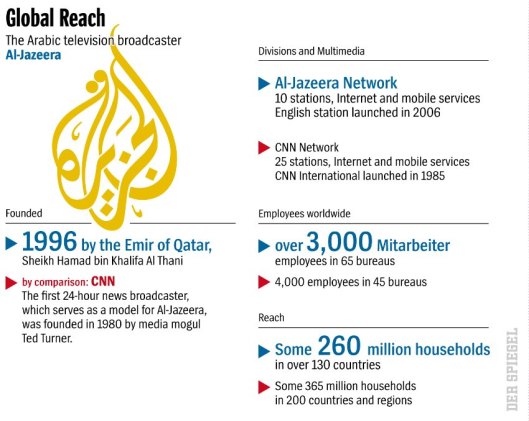
Al Jazeera's Global Reach

Der Spiegel

Never before has another countries’ attempts at statecraft and influence had such an opportunity to communicate with Americans through media in their own homes. Even Britain’s BBC Network has found that challenging. Former Secretary of State Hillary Clinton gave the station a huge plug when she stated that the United States was losing the international information war. Al Jazeera, she said, was “literally changing people’s minds and attitudes” and, like it or hate it, “it is really effective … In fact viewership of Al Jazeera is going up in the United States because it’s real news” (Gornall, 2011).

References

Gornall, J. (2011, June 24). Arab Spring Brings   Al Jazeera to Full Bloom. Retrieved Jan 12, 2013, from The National:   http://www.thenational.ae/news/world/middle-east/arab-spring-brings-al-jazeera-to-full-bloom

Kühn, A., Reuter, C., & Schmitz, G. P. (2013,   Feb 15). After the Arab Spring: Al-Jazeera Losing Battle for Independence.   Retrieved Feb 16, 2013, from Spiegel Online:   http://www.spiegel.de/international/world/al-jazeera-criticized-for-lack-of-independence-after-arab-spring-a-883343.html#ref=rss

Share this:

  • Click to email a link to a friend (Opens in new window) Email
  • Click to print (Opens in new window) Print
  • Click to share on Facebook (Opens in new window) Facebook
  • Click to share on LinkedIn (Opens in new window) LinkedIn
  • Click to share on Pinterest (Opens in new window) Pinterest
  • Click to share on Reddit (Opens in new window) Reddit
  • Click to share on X (Opens in new window) X
  • Click to share on Tumblr (Opens in new window) Tumblr
Like Loading...

10 Sunday Feb 2013

Posted by Ken S. Heller in Psychology

≈ 1 Comment

Tags

Cognitive, Fallacious Arguments, Propaganda, Psychological Effects

An interesting and insightful read which examines a fallacious technique of propaganda known as the straw man. Psychologically, the straw man concept breaks things down to a simplistic level in which context is lost and decisions are relegated to “yes/no” choices, or extremes, which are more difficult to defend. This technique can be refuted by clarifying one’s original position.

P.O.P.'s avatarThe Propaganda Professor

straw man

Once upon a time when I was a teenager and didn’t know any better, I got into a discussion (i.e. argument) with a relative on a topic that he had strong beliefs about. That topic was the hazards posed by certain chemicals used in growing and processing food — a hazard which, he was convinced, was nonexistent, but was merely a fraud concocted by devious scientists, or the government, or some other “them” who couldn’t be trusted. At one point, he said to me, ” if it wasn’t for chemicals, you couldn’t live.” Although I wasn’t even familiar with the term at the time, this was my first real awareness of the straw man tactic, which is the sixth in our series of propaganda techniques.

A straw man is an oversimplified substitute for an actual issue or another person’s actual position on an issue.  Although the term’s origins are unclear…

View original post 1,284 more words

Share this:

  • Click to email a link to a friend (Opens in new window) Email
  • Click to print (Opens in new window) Print
  • Click to share on Facebook (Opens in new window) Facebook
  • Click to share on LinkedIn (Opens in new window) LinkedIn
  • Click to share on Pinterest (Opens in new window) Pinterest
  • Click to share on Reddit (Opens in new window) Reddit
  • Click to share on X (Opens in new window) X
  • Click to share on Tumblr (Opens in new window) Tumblr
Like Loading...

Media Psychology and ‘Call of Duty’ Video Game Impact, Part 1

05 Tuesday Feb 2013

Posted by Ken S. Heller in Media Effects, Psychology

≈ Leave a comment

Tags

Gaming, Influence, Journalism, Media Effects, Propaganda, Psychological Operations, Psychology, War

The influence of popular violent video games, such as the Call of Duty series, has penetrated into the global consciousness and culture as an example of the media psychology. Last year Call of Duty: Black Ops 2 grossed $1 billion dollars in sales within 15 days of its release and $500 million dollars in the first 24 hours (LeJacq, 2012). Averaging $60 per game, that’s more than 1.5 million copies sold in 15 days. Its predecessor, Call of Duty: Modern Warfare, sold 8.8 million units in the United States alone in its first month (LeJacq, 2012). Two recent examples seem to point to it becoming a cross-cultural phenomenon. The first example being of an Agence France-Presse (AFP) photo of a French soldier during combat operations sporting a facemask that resembles a character in the game known as “Ghost” to protect himself from dust. Continue reading →

Share this:

  • Click to email a link to a friend (Opens in new window) Email
  • Click to print (Opens in new window) Print
  • Click to share on Facebook (Opens in new window) Facebook
  • Click to share on LinkedIn (Opens in new window) LinkedIn
  • Click to share on Pinterest (Opens in new window) Pinterest
  • Click to share on Reddit (Opens in new window) Reddit
  • Click to share on X (Opens in new window) X
  • Click to share on Tumblr (Opens in new window) Tumblr
Like Loading...
Ken Heller on

Enter your email address to follow this blog and receive notifications of new posts by email.

Join 4,624 other subscribers

Media Psychology

  • RSS - Posts
  • RSS - Comments

Blog Stats

  • 114,411 hits

Archives

  • December 2020 (3)
  • November 2020 (4)
  • September 2020 (1)
  • June 2020 (1)
  • April 2020 (1)
  • March 2020 (1)
  • February 2020 (3)
  • January 2020 (4)
  • December 2019 (8)
  • November 2019 (1)
  • October 2019 (5)
  • September 2019 (10)
  • August 2019 (7)
  • July 2019 (4)
  • June 2019 (3)
  • May 2019 (5)
  • April 2019 (8)
  • March 2019 (7)
  • February 2019 (4)
  • January 2019 (5)
  • December 2018 (4)
  • November 2018 (4)
  • October 2018 (5)
  • September 2018 (8)
  • August 2018 (7)
  • July 2018 (4)
  • June 2018 (3)
  • May 2018 (6)
  • April 2018 (4)
  • March 2018 (6)
  • February 2018 (6)
  • January 2018 (6)
  • December 2017 (4)
  • November 2017 (5)
  • October 2017 (5)
  • September 2017 (5)
  • August 2017 (5)
  • July 2017 (5)
  • June 2017 (5)
  • May 2017 (2)
  • April 2017 (2)
  • March 2017 (5)
  • February 2017 (4)
  • January 2017 (7)
  • December 2016 (3)
  • November 2016 (2)
  • October 2016 (4)
  • September 2016 (2)
  • August 2016 (2)
  • July 2016 (3)
  • June 2016 (5)
  • May 2016 (6)
  • April 2016 (4)
  • March 2016 (2)
  • February 2016 (1)
  • January 2016 (1)
  • December 2015 (1)
  • November 2015 (2)
  • January 2015 (1)
  • November 2014 (1)
  • September 2014 (1)
  • August 2014 (1)
  • July 2014 (4)
  • May 2014 (1)
  • April 2014 (1)
  • March 2014 (2)
  • February 2014 (2)
  • January 2014 (2)
  • December 2013 (4)
  • November 2013 (2)
  • October 2013 (1)
  • September 2013 (1)
  • August 2013 (4)
  • July 2013 (1)
  • June 2013 (1)
  • April 2013 (1)
  • March 2013 (4)
  • February 2013 (3)
  • January 2013 (5)
  • December 2012 (4)
  • November 2012 (6)

Addiction Advertising Agenda Setting Al-Jazeera Associated Press Behavioralism Bernays Cartoons Causality Cognitive Correlation Cultivation Theory Digital Immigrants Digital Natives Ellul Facebook Fallacious Arguments Film Framing Gaming Gerbner Giles Google Greenwald ICT Identity Imagery Impact of ICT Influence Ingress Internet Internet.org Journalism Marketing McCombs McLuhan Mean World Sydrome Media Media Effects Media Literacy Media Psychology Mobile Computing Mobile Phones Moscow Olympics Neural Pathways news coverage Operant Conditioning Persuasive Technology Physiological Psychology Pinterest Potter Prensky Privacy Propaganda Psychological Effects Psychological Operations Psychology Public Diplomacy Public Relations Quotes Sexism Skinner Smartphone Social Change Social Identity Social Media Social Networks Social Psychology Sports Taylor Technology The Engineering of Consent Transmedia Twitter Walking Dead

RSS The Amplifier – APA Div. 46 Newsletter

  • The Legend of Zelda: Echoes of Wisdom as a Feminist Breakthrough and Contradiction
  • Digital Mourning: Grief Expression on Social Media
  • Book Review: Black Film Through a Psychodynamic Lens
  • The History of (Media) Multitasking Research
  • AI and Mental Health: Can Chatbots and Digital Coaches Bridge the Gap for Perinatal Mental Health Support?
  • To Infinity and Beyond: Best Practices for Data-informed Telemental Intensive Outpatient Programs
  • Editor’s Column: Authentically Inclusive Representation in Film and Television
  • President’s Column: Charting the Future of Media Psychology: Division 46 at APA 2025
  • Past President’s Column: Division 46 Announcements
  • TikTok and Self-Diagnosis: What Clinicians Need to Know

RSS APA Div. 46 Media Psychology and Technology Facebook Feed – Come check it out!

  • Kids Are Using Minecraft To Design A More Sustainable World
  • Home – UsMeU
  • Huggable Robot Befriends Girl in Hospital
  • Lifelong learning is made possible by recycling of histones, study says
  • Synthetic Love: Can a Human Fall in Love With a Robot? –
  • Today’s Photo:
  • Dr. Joanne Broder Sumerson
  • Could Storytelling Be the Secret Sauce to STEM Education?
  • Google driverless cars were in 11 accidents, but officer, it wasn’t their fault
  • All-But-Dissertation Survival Guide

RSS Changing Minds

  • An error has occurred; the feed is probably down. Try again later.

RSS Media Smarts

  • Outcome Chart – Newfoundland and Labrador – Science K
  • Outcome Chart – Newfoundland and Labrador – Mathematics 3202
  • Outcome Chart - Newfoundland and Labrador - Mathematics 2202
  • Resources for Teachers - Video Media
  • Resources for Parents - Video Media
  • Resources for Teachers - Comics
  • Resources for Parents - Comics
  • The comics industry
  • Expression and storytelling in comics
  • Resources for Teachers - Visual Media

RSS Adam Curtis

  • HYPERNORMALISATION
  • TRAILER TRASH
  • HAPPIDROME - Part One
  • THE VEGETABLES OF TRUTH
  • NOW THEN
  • SUSPICIOUS MINDS
  • ONE'S PRIVATE LIFE
  • WHAT THE FLUCK!
  • THE BABY AND THE BAATH WATER
  • BUGGER

RSS Media Psychology Blog

  • does resurge work : Resurge weight reduction supplement is a...

RSS The Psych Files

  • The Psych Files – Most Popular Episodes
  • Psych Files Episodes on Youtube

RSS The Media Zone

  • And He Knew All the Words
  • Sexy, Dangerous Women Are Everywhere
  • In Praise of Older Women
  • "Commercial Creep"—I Hate Commercials and You Should Too
  • How A Laundry Detergent Commercial Saved the World
  • Jodie Foster: To Come Out Lesbian Or Let Sleeping Rumors Lie
  • Why No Photos of the Slaughtered Newtown Children?
  • HBO's "The Newsroom": Sorkin Talks Truth To Stupid
  • Dorothy Sandusky: A Woman Who Saw Nothing
  • Celebrity - The Incest of Actors, Politicians, and Journalists.

RSS The Media Psychology Effect

  • The Importance of Synesthesia in Artificial Intelligence
  • Media and Communications Psychology in the 21st Century
  • Media Psychology Is a New-Collar Profession
  • The Psychology of Crowds
  • AI Is Reshaping Workers as Well as Work
  • Understanding the Eye in AI
  • Where's Smokey the Bear When You Need Him?
  • Personalized AI and the Future of Teaching and Learning
  • The Future of Learning and Education Is Already in Your Pocket
  • Psychology and the Importance of Perfect Practice

RSS On The Media

  • An error has occurred; the feed is probably down. Try again later.

Create a free website or blog at WordPress.com.

Privacy & Cookies: This site uses cookies. By continuing to use this website, you agree to their use.
To find out more, including how to control cookies, see here: Cookie Policy
  • Subscribe Subscribed
    • Media Psychology
    • Join 555 other subscribers
    • Already have a WordPress.com account? Log in now.
    • Media Psychology
    • Subscribe Subscribed
    • Sign up
    • Log in
    • Report this content
    • View site in Reader
    • Manage subscriptions
    • Collapse this bar
 

Loading Comments...
 

    %d