Unintended Media Effects and Media Literacy

Tags

, , , , ,

Being in the media, purposefully or otherwise, can have unintended effects, many of which the media will never stop and apologize for. Such is the case for Neda Soltani, a professor of English literature, whose Facebook picture was downloaded and disseminated among Iranian protesters – en masse. According to the New York Times article In a Death Seen Around the World, a Symbol of Iranian Protests Neda Agha-Soltan, notice there is no “i” at the end of her name, was shot in the chest and died when she went to witness a protest in Tehran shortly after the conclusion of the elections that reinstated President Ahmadinejad. Her death was caught on video and subsequently went viral.

Agha-Soltan

Shortly afterward the media published a photo of Soltani claiming it was Soltan – a mistake that Soltani has had to live with ever since. In an article for the BBC, Neda Soltani: ‘The media mix-up that ruined my life’, Soltani discusses the repercussions she has had to deal with to include becoming a martyr for a protest she did not participate in, government persecution, accusations of being a CIA spy, and becoming a political refugee.

Neda Soltani (left) and Neda Agha-Soltan (right)

Neda Soltani (left) and Neda Agha-Soltan (right)

There are a couple of things at work here. The first is media and journalistic responsibility – or lack thereof. Because of the speed at which news travels across the internet, media outlets feel more and more pressure to release information as fast as possible, without taking the appropriate amount of time to verify the facts, or allow the complete story to play out before reporting on it. This is all part of the cycle to bring in a larger audience, in order to attract more advertisers and increased revenue for which the media competes with other outlets. As Ahmadinejad is not a popular foreign leader here in the United States, the media rushed to publicize the fallout that followed.  Soltani and Soltan were both used as pawns to frame the protests. Second, few members of the media have attempted to correct the record, which is part of what makes the BBC’s coverage important as a model for reporting. For a typical American media outlet, their is an old adage that “if it bleeds, it leads” which basically means that violence will always be covered right up front, especially political violence that can incorporate a pretty face as a victim. What is reprehensible is the lack of responsibility to correct the record in the aftermath — but that’s not what audiences will stop to see, or advertisers will pay for, as a result. Cognitively, people are conditioned and drawn to stop and witness violence or tragedy. It’s a part of our innate nature to be curious as to the fate of others. We learn through observation. The media plays upon this to garner attention and profit repeatedly. Increasing one’s media literacy in regard to the economic agenda of the media is the first step to understanding how audiences are told what to think about, and how to think about it, and to freeing one’s own mind from their effects.

References

BBC News Magazine. (2012, Nov 14). Neda Soltani: ‘The media mix-up that ruined my life’. Retrieved Nov 14, 2012, from BBC News Magazine: http://www.bbc.co.uk/news/magazine-20267989

Fathi, N. (2009, June 22). In a Death Seen Around the World, a Symbol of Iranian Protests. Retrieved Nov 14, 2012, from The New York Times: http://www.nytimes.com/2009/06/23/world/middleeast/23neda.html?_r=0

Wikipedia. (2012, Nov 14). Death of Neda Agha-Soltan. Retrieved Nov 14, 2012, from Wikipedia: http://en.wikipedia.org/wiki/Death_of_Neda_Agha-Soltan

In 1961, Bugs Bunny May Have Saved a Life (His Own)

Tags

, , , , ,

For those of you who don’t know him, Mel Blanc (May 30, 1908 – July 10, 1989) was a voice actor fondly known as the “The Man of a Thousand Voices.” His more popular characterizations included Bugs Bunny, Daffy Duck, Porky PigYosemite Sam, Foghorn Leghorn, Marvin the MartianSpeedy Gonzales, and many, many others. The podcast below examines Mel’s near death experience in 1961, and the events around his death in 1989. It leaves a lot of questions as to how it may be possible that the characterizations brought to life by a man may have preserved his life in 1961, and were a part of his final moments. In this case media appears to have become a part of the man.

“Cognitive cues are strategies that help the individual remember the sequence of steps, as well as content …  They are especially important to those who can’t seem to retain, or follow multi-step, or multi-element situations” (Packer, 2009).  These cues can activate neurological networks associated with them that affect the way a subject behaviorally executes their self-concept.

Discrete social identities, such as those formed based on relational roles and positions with other people and social groups, may correlate to specific neural pathways, which when cued, would lead to certain typical behavioral responses associated with them (such as specific way of talking, walking, thinking, relating to oneself and others etc.).  These discrete identities are normally not experienced as such, as the mind instantaneously re-creates a sense of a singular, continuous, unchanged, overarching self that encompasses them all – unless damaged.  Thus, while the observed behavior might change from one situation to another, a different identity may be cued when prescribed situations come into play – or possibly when another can’t respond.  Neurologically, there is interconnectedness between these circuits, and a higher order organizational principle – the sense of a unified self – that maintains continuity, and creates enough consistency in observable behavior for others to witness an underlying singular personality that changes minimally throughout many different situations. Blanc, as discussed, easily slipped in and out of various characters all of his life, and any number of times throughout a single day over the course of more than 60 years, therefore the range of possible cognitive cues for his various discrete personalities would have been exceptional. Which leads to the possibility that when his singular self could no longer respond due to physical stress or trauma, his characterizations still could.

Podcast by the group at Radiolab, with analytical contributions from my wife, Liza Persson.

Packer, L. E. (2009, Jan). Environmental Cues, Supports, and Strategies. Retrieved Nov 7, 2012, from Tourette Syndrome “Plus”: http://www.tourettesyndrome.net/disorders/executive-dysfunction/environmental-cues-supports-and-strategies/
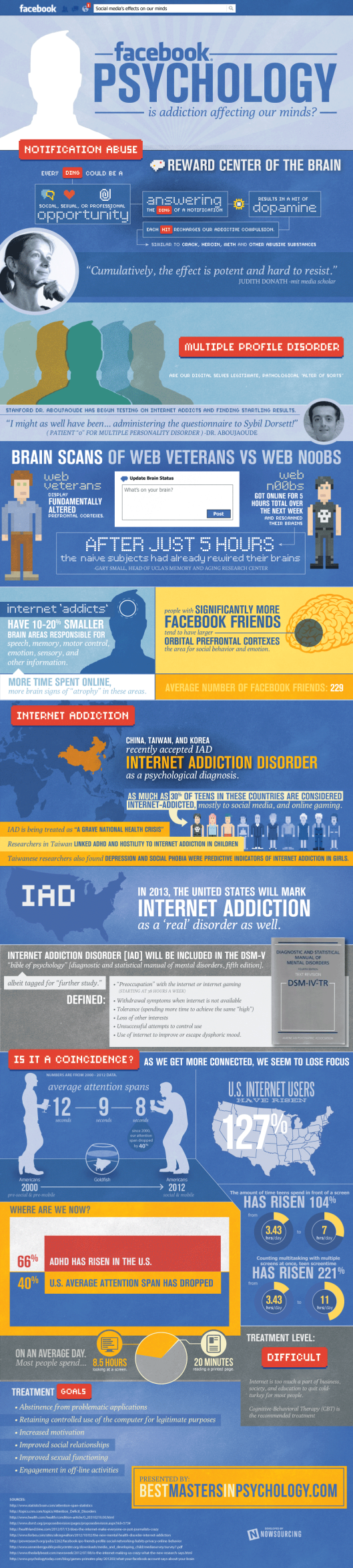
Facebook (Internet) Psychology

Tags

, , , ,

Although titled “Facebook Psychology,” the team at Best Masters in Psychology have put together a great graphic discussing internet addiction, how it works – to include Skinners’ Operant Conditioning in the form of rewards and for proper behavior – and its possible effects, such as decreased attention span and the rise of ADHD. In an article on Forbes website, Alice Walton points out that studies are already being conducted to try and reduce internet addiction using cognitive behavioral therapy.

What to do:

The internet can be an incredible distraction with its multitude of links and topics. Nicolas Carr observes in his 2011 book How the Internet is Changing the Way We Think, Read and Remember that linear thought of the past is “giving way to short, disjointed, often overlapping bursts – the faster, the better.” Because of our growing awareness of these issues, apps and programs, such as Freedom© and Self Control©, have been created to help limit our access to the internet, and supposedly make us more productive – if we can shut the television off too.

Facebook Psychology

References

Antonius J. van Rooij, M. F. (2012). Treating Internet Addiction With Cognitive-Behavioral Therapy: A Thematic Analysis of the Experiences of Therapists. International Journal of Mental Health and Addiction, 10 (1), 69-82.

Best Masters In Psychology. (2012). Internet Addiction. Retrieved Nov 3, 2012, from Best Masters In Psychology: http://www.bestmastersinpsychology.com/internet-addiction/

McLeod, S. (n.d.). Skinner: Operant Conditioning. Retrieved May 1, 2011, from Simply Psychology: http://www.simplypsychology.org/operant-conditioning.html

Salvador, M. (2013, March 28). Internet Addiction: The Facts. Retrieved from Megan Salvador: http://megsalva.wordpress.com/2013/03/28/internet-addiction-the-facts/

Walton, A. G. (2012, Oct 2). Internet Addiction Is The New Mental Health Disorder. Retrieved Nov 3, 2012, from Forbes: http://www.forbes.com/sites/alicegwalton/2012/10/02/the-new-mental-health-disorder-internet-addiction/

Wilkinson, C. (2012, Sept 6). Shutting Out a World of Digital Distraction. Retrieved Nov 3, 2012, from The Telegraph: http://www.telegraph.co.uk/culture/books/9522845/Shutting-out-a-world-of-digital-distraction.html