• About the Authors
  • Blogs and Shows
  • Journals
  • Open Invitation
  • References
  • Resources
  • Taxonomy
  • Who’s Who?

Media Psychology

~ Informing, Educating and Influencing

Media Psychology

Author Archives: Donna L. Roberts, PhD

Misinformation and biases infect social media, both intentionally and accidentally

04 Monday Feb 2019

Posted by Donna L. Roberts, PhD in Psychology

≈ Comments Off on Misinformation and biases infect social media, both intentionally and accidentally

Information on social media can be misleading because of biases in three places – the brain, society and algorithms. Scholars are developing ways to identify and display the effects of these biases.

People who share potential misinformation on Twitter (in purple) rarely get to see corrections or fact-checking (in orange). Shao et al., CC BY-ND

Source: Misinformation and biases infect social media, both intentionally and accidentally

Giovanni Luca Ciampaglia   Assistant Research Scientist, Indiana University Network Science Institute, Indiana University

Filippo Menczer  Professor of Computer Science and Informatics; Director of the Center for Complex Networks and Systems Research, Indiana University

Social media are among the primary sources of news in the U.S. and across the world. Yet users are exposed to content of questionable accuracy, including conspiracy theories, clickbait, hyperpartisan content, pseudo science and even fabricated “fake news” reports.

It’s not surprising that there’s so much disinformation published: Spam and online fraud are lucrative for criminals, and government and political propaganda yield both partisan and financial benefits. But the fact that low-credibility content spreads so quickly and easily suggests that people and the algorithms behind social media platforms are vulnerable to manipulation.

Explaining the tools developed at the Observatory on Social Media.

Our research has identified three types of bias that make the social media ecosystem vulnerable to both intentional and accidental misinformation. That is why our Observatory on Social Media at Indiana University is building tools to help people become aware of these biases and protect themselves from outside influences designed to exploit them.

Bias in the brain

Cognitive biases originate in the way the brain processes the information that every person encounters every day. The brain can deal with only a finite amount of information, and too many incoming stimuli can cause information overload. That in itself has serious implications for the quality of information on social media. We have found that steep competition for users’ limited attention means that some ideas go viral despite their low quality – even when people prefer to share high-quality content.

To avoid getting overwhelmed, the brain uses a number of tricks. These methods are usually effective, but may also become biases when applied in the wrong contexts.

One cognitive shortcut happens when a person is deciding whether to share a story that appears on their social media feed. People are very affected by the emotional connotations of a headline, even though that’s not a good indicator of an article’s accuracy. Much more important is who wrote the piece.

To counter this bias, and help people pay more attention to the source of a claim before sharing it, we developed Fakey, a mobile news literacy game (free on Android and iOS) simulating a typical social media news feed, with a mix of news articles from mainstream and low-credibility sources. Players get more points for sharing news from reliable sources and flagging suspicious content for fact-checking. In the process, they learn to recognize signals of source credibility, such as hyperpartisan claims and emotionally charged headlines.
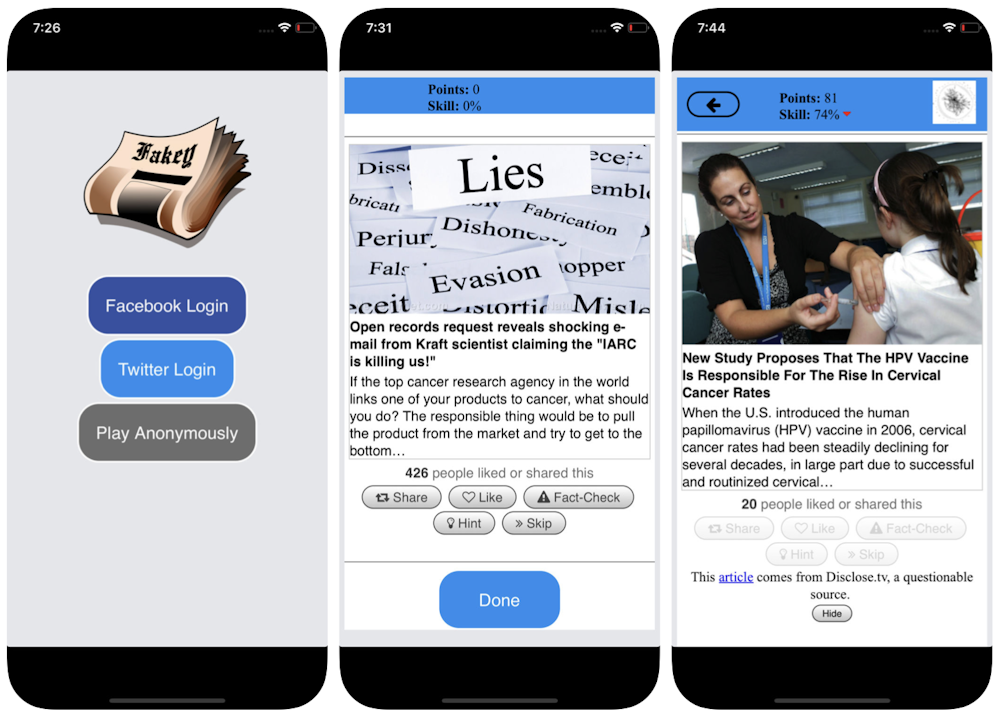
Screenshots of the Fakey game. Mihai Avram and Filippo Menczer

Bias in society

Another source of bias comes from society. When people connect directly with their peers, the social biases that guide their selection of friends come to influence the information they see.

In fact, in our research we have found that it is possible to determine the political leanings of a Twitter user by simply looking at the partisan preferences of their friends. Our analysis of the structure of these partisan communication networks found social networks are particularly efficient at disseminating information – accurate or not – when they are closely tied together and disconnected from other parts of society.

The tendency to evaluate information more favorably if it comes from within their own social circles creates “echo chambers” that are ripe for manipulation, either consciously or unintentionally. This helps explain why so many online conversations devolve into “us versus them” confrontations.

To study how the structure of online social networks makes users vulnerable to disinformation, we built Hoaxy, a system that tracks and visualizes the spread of content from low-credibility sources, and how it competes with fact-checking content. Our analysis of the data collected by Hoaxy during the 2016 U.S. presidential elections shows that Twitter accounts that shared misinformation were almost completely cut offfrom the corrections made by the fact-checkers.

When we drilled down on the misinformation-spreading accounts, we found a very dense core group of accounts retweeting each other almost exclusively – including several bots. The only times that fact-checking organizations were ever quoted or mentioned by the users in the misinformed group were when questioning their legitimacy or claiming the opposite of what they wrote.
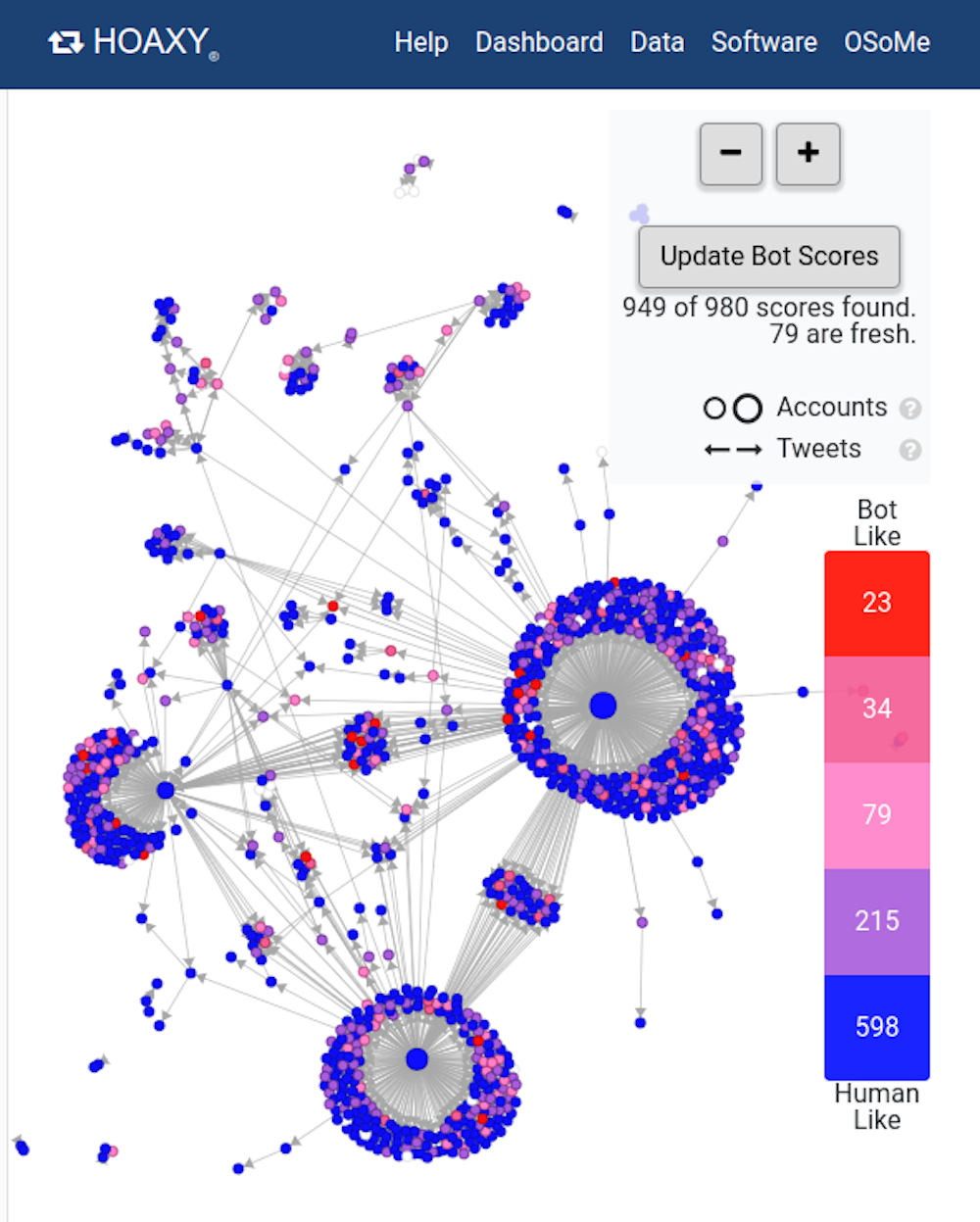
A screenshot of a Hoaxy search shows how common bots – in red and dark pink – are spreading a false story on Twitter. Hoaxy

Bias in the machine

The third group of biases arises directly from the algorithms used to determine what people see online. Both social media platforms and search engines employ them. These personalization technologies are designed to select only the most engaging and relevant content for each individual user. But in doing so, it may end up reinforcing the cognitive and social biases of users, thus making them even more vulnerable to manipulation.

For instance, the detailed advertising tools built into many social media platforms let disinformation campaigners exploit confirmation bias by tailoring messages to people who are already inclined to believe them.

Also, if a user often clicks on Facebook links from a particular news source, Facebook will tend to show that person more of that site’s content. This so-called “filter bubble” effect may isolate people from diverse perspectives, strengthening confirmation bias.

Our own research shows that social media platforms expose users to a less diverse set of sources than do non-social media sites like Wikipedia. Because this is at the level of a whole platform, not of a single user, we call this the homogeneity bias.

Another important ingredient of social media is information that is trending on the platform, according to what is getting the most clicks. We call this popularity bias, because we have found that an algorithm designed to promote popular content may negatively affect the overall quality of information on the platform. This also feeds into existing cognitive bias, reinforcing what appears to be popular irrespective of its quality.

All these algorithmic biases can be manipulated by social bots, computer programs that interact with humans through social media accounts. Most social bots, like Twitter’s Big Ben, are harmless. However, some conceal their real nature and are used for malicious intents, such as boosting disinformation or falsely creating the appearance of a grassroots movement, also called “astroturfing.” We found evidence of this type of manipulation in the run-up to the 2010 U.S. midterm election.
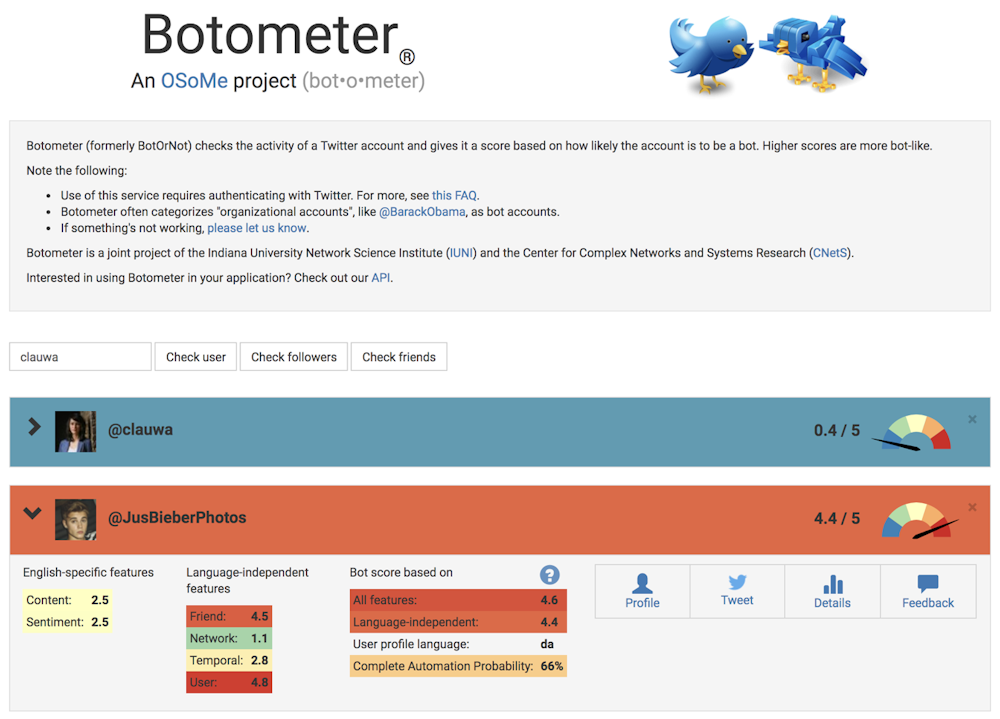
A screenshot of the Botometer website, showing one human and one bot account.Botometer

To study these manipulation strategies, we developed a tool to detect social bots called Botometer. Botometer uses machine learning to detect bot accounts, by inspecting thousands of different features of Twitter accounts, like the times of its posts, how often it tweets, and the accounts it follows and retweets. It is not perfect, but it has revealed that as many as 15 percent of Twitter accounts show signs of being bots.

Using Botometer in conjunction with Hoaxy, we analyzed the core of the misinformation network during the 2016 U.S. presidential campaign. We found many bots exploiting both the cognitive, confirmation and popularity biases of their victims and Twitter’s algorithmic biases.

These bots are able to construct filter bubbles around vulnerable users, feeding them false claims and misinformation. First, they can attract the attention of human users who support a particular candidate by tweeting that candidate’s hashtags or by mentioning and retweeting the person. Then the bots can amplify false claims smearing opponents by retweeting articles from low-credibility sources that match certain keywords. This activity also makes the algorithm highlight for other users false stories that are being shared widely.

Understanding complex vulnerabilities

Even as our research, and others’, shows how individuals, institutions and even entire societies can be manipulated on social media, there are many questions left to answer. It’s especially important to discover how these different biases interact with each other, potentially creating more complex vulnerabilities.

Tools like ours offer internet users more information about disinformation, and therefore some degree of protection from its harms. The solutions will not likely be only technological, though there will probably be some technical aspects to them. But they must take into account the cognitive and social aspects of the problem.

Share this:

  • Email a link to a friend (Opens in new window) Email
  • Print (Opens in new window) Print
  • Share on Facebook (Opens in new window) Facebook
  • Share on LinkedIn (Opens in new window) LinkedIn
  • Share on Pinterest (Opens in new window) Pinterest
  • Share on Reddit (Opens in new window) Reddit
  • Share on X (Opens in new window) X
  • Share on Tumblr (Opens in new window) Tumblr
Like Loading...

Even a few bots can shift public opinion in big ways

28 Monday Jan 2019

Posted by Donna L. Roberts, PhD in Psychology

≈ Comments Off on Even a few bots can shift public opinion in big ways

Measuring Twitter bots’ effects on the opinions of real people can yield surprising results about what makes them influential.

Adding bots into an online discussion can definitely affect the views of real people. Tatiana Shepeleva/Shutterstock.com

Source: Even a few bots can shift public opinion in big ways

Tauhid Zaman  Associate Professor of Operations Management, MIT Sloan School of Management

Nearly two-thirds of the social media bots with political activity on Twitter before the 2016 U.S. presidential election supported Donald Trump. But all those Trump bots were far less effective at shifting people’s opinions than the smaller proportion of bots backing Hillary Clinton. As my recent research shows, a small number of highly active bots can significantly change people’s political opinions. The main factor was not how many bots there were – but rather, how many tweets each set of bots issued.

My work focuses on military and national security aspects of social networks, so naturally I was intrigued by concerns that bots might affect the outcome of the upcoming 2018 midterm elections. I began investigating what exactly bots did in 2016. There was plenty of rhetoric– but only one basic factual principle: If information warfare effortsusing bots had succeeded, then voters’ opinions would have shifted.

I wanted to measure how much bots were – or weren’t – responsible for changes in humans’ political views. I had to find a way to identify social media bots and evaluate their activity. Then I needed to measure the opinions of social media users. Lastly, I had to find a way to estimate what those people’s opinions would have been if the bots had never existed.

Finding tweeters and bots

To narrow the research a bit, my students and I focused our analysis on the Twitter discussion around one event in the lead-up to the election: the second debate between Clinton and Trump. We collected 2.3 million tweets that contained keywords and hashtags related to the debate.

Then we made a list of the roughly 78,000 Twitter users who posted those tweets and constructed the network of who followed whom among those users. To identify the bots among them, we used an algorithm based on our observation that bots often retweeted humans but were not themselves frequently retweeted.

This method found 396 bots – or less than 1 percent of the active Twitter users. And just 10 percent of the accounts followed them. I felt good about that: It seemed unlikely that such a small number of relatively disconnected bots could have a major effect on people’s opinions.

A closer look at the people

Next we set out to measure the opinions of the people in our data set. We did this with a type of machine learning algorithm called a neural network, which in this case we set up to evaluate the content of each tweet, determining the extent to which it supported Clinton or Trump. Individuals’ opinions were calculated as the average of their tweets’ opinions.

Once we had assigned each human Twitter user in our data a score representing how strong a Clinton or Trump backer they were, the challenge was to measure how much the bots shifted people’s opinions – which meant calculating what their opinions would have been if the bots hadn’t existed.

Fortunately, a model from as far back as the 1970s had established a way to gauge people’s sentiments in a social network based on connections between them. In this network-based model, individuals’ opinions tend to align with the people connected to them. After slightly modifying the model to apply it to Twitter, we used it to calculate people’s opinions based on who followed whom on Twitter – rather than looking at their tweets. We found that the opinions we calculated from the network model matched well with opinions measured from the content of their tweets.

Life without the bots

So far we had shown that the follower network structure in Twitter could accurately predict people’s opinions. This now allowed to us to ask questions such as: What would their opinions have been if the network were different? The different network we were interested in was one that contained no bots. So for our last step, we removed the bots from the network and recalculated the network model, to see what real people’s opinions would have been without bots. Sure enough, bots had shifted human users’ opinions – but in a surprising way.

Given much of the news reporting, we were expecting the bots to help Trump – but they didn’t. In a network without bots, the average human user had a pro-Clinton score of 42 out of 100. With the bots, though, we had found the average human had a pro-Clinton score of 58. That shift was a far larger effect than we had anticipated, given how few and unconnected the bots were. The network structure had amplified the bots’ power.

We wondered what had made the Clinton bots more effective than the Trump bots. Closer inspection showed that the 260 bots supporting Trump posted a combined 113,498 tweets, or 437 tweets per bot. However, the 150 bots supporting Clinton posted 96,298 tweets, or 708 tweets per bot. It appeared that the power of the Clinton bots came not from their numbers, but from how often they tweeted. We found that most of what the bots posted were retweets of the candidates or other influential individuals. So they were not really crafting original tweets, but sharing existing ones.

It’s worth noting that our analysis looked at a relatively small number of users, especially when compared to the voting population. And it was only during a relatively short period of time around a specific event in the campaign. Therefore, they don’t suggest anything about the overall election results. But they do show the potential effect bots can have on people’s opinions.

A small number of very active bots can actually significantly shift public opinion – and despite social media companies’ efforts, there are still large numbers of bots out there, constantly tweeting and retweeting, trying to influence real people who vote.

It’s a reminder to be careful about what you read – and what you believe – on social media. We recommend double-checking that you are following people you know and trust – and keeping an eye on who is tweeting what on your favorite hashtags.

Share this:

  • Email a link to a friend (Opens in new window) Email
  • Print (Opens in new window) Print
  • Share on Facebook (Opens in new window) Facebook
  • Share on LinkedIn (Opens in new window) LinkedIn
  • Share on Pinterest (Opens in new window) Pinterest
  • Share on Reddit (Opens in new window) Reddit
  • Share on X (Opens in new window) X
  • Share on Tumblr (Opens in new window) Tumblr
Like Loading...

Why our screens make us less happy – Adam Alter

21 Monday Jan 2019

Posted by Donna L. Roberts, PhD in Psychology

≈ Comments Off on Why our screens make us less happy – Adam Alter

What are our screens and devices doing to us? Psychologist Adam Alter has spent the last five years studying how much time screens steal from us and how they’re getting away with it. He shares why all those hours you spend staring at your smartphone, tablet or computer might be making you miserable — and what you can do about it.

Share this:

  • Email a link to a friend (Opens in new window) Email
  • Print (Opens in new window) Print
  • Share on Facebook (Opens in new window) Facebook
  • Share on LinkedIn (Opens in new window) LinkedIn
  • Share on Pinterest (Opens in new window) Pinterest
  • Share on Reddit (Opens in new window) Reddit
  • Share on X (Opens in new window) X
  • Share on Tumblr (Opens in new window) Tumblr
Like Loading...

Scientists Link ‪Selfies‬ To Narcissism, ‪Addiction‬ & Mental Illness

14 Monday Jan 2019

Posted by Donna L. Roberts, PhD in Psychology

≈ Comments Off on Scientists Link ‪Selfies‬ To Narcissism, ‪Addiction‬ & Mental Illness

The growing trend of taking smartphone selfies is linked to mental health conditions that focus on a person’s obsession with looks.

Source: Scientists Link ‪Selfies‬ To Narcissism, ‪Addiction‬ & Mental Illness

According to psychiatrist Dr David Veal: “Two out of three of all the patients who come to see me with Body Dysmorphic Disorder since the rise of camera phones have a compulsion to repeatedly take and post selfies on social media sites.”

“Cognitive behavioral therapy is used to help a patient to recognize the reasons for his or her compulsive behavior and then to learn how to moderate it,” he told the Sunday Mirror.

Is it possible that taking selfies causes mental illness, addiction, narcissism and suicide? Many psychologists say yes, and warn parents to pay close attention to what kids are doing online to avoid any future cases like what happened to Bowman.

A British male teenager tried to commit suicide after he failed to take the perfect selfie. Danny Bowman became so obsessed with capturing the perfect shot that he spent 10 hours a day taking up to 200 selfies. The 19-year-old lost nearly 30 pounds, dropped out of school and did not leave the house for six months in his quest to get the right picture. He would take 10 pictures immediately after waking up. Frustrated at his attempts to take the one image he wanted, Bowman eventually tried to take his own life by overdosing, but was saved by his mom.

“I was constantly in search of taking the perfect selfie and when I realized I couldn’t, I wanted to die. I lost my friends, my education, my health and almost my life,” he told The Mirror.

The teenager is believed to be the UK’s first selfie addict and has had therapy to treat his technology addiction as well as OCD and Body Dysmorphic Disorder.

Part of his treatment at the Maudsley Hospital in London included taking away his iPhone for intervals of 10 minutes, which increased to 30 minutes and then an hour.

“It was excruciating to begin with but I knew I had to do it if I wanted to go on living,” he told the Sunday Mirror.

Public health officials in the UK announced that addiction to social media such as Facebook and Twitter is an illness and more than 100 patients sought treatment every year.

“Selfies frequently trigger perceptions of self-indulgence or attention-seeking social dependence that raises the damned-if-you-do and damned-if-you-don’t spectre of either narcissism or very low self-esteem,” said Pamela Rutledge in Psychology Today.

The big problem with the rise of digital narcissism is that it puts enormous pressure on people to achieve unfeasible goals, without making them hungrier. Wanting to be Beyoncé, Jay Z or a model is hard enough already, but when you are not prepared to work hard to achieve it, you are better off just lowering your aspirations. Few things are more self-destructive than a combination of high entitlement and a lazy work ethic. Ultimately, online manifestations of narcissism may be little more than a self-presentational strategy to compensate for a very low and fragile self-esteem. Yet when these efforts are reinforced and rewarded by others, they perpetuate the distortion of reality and consolidate narcissistic delusions.

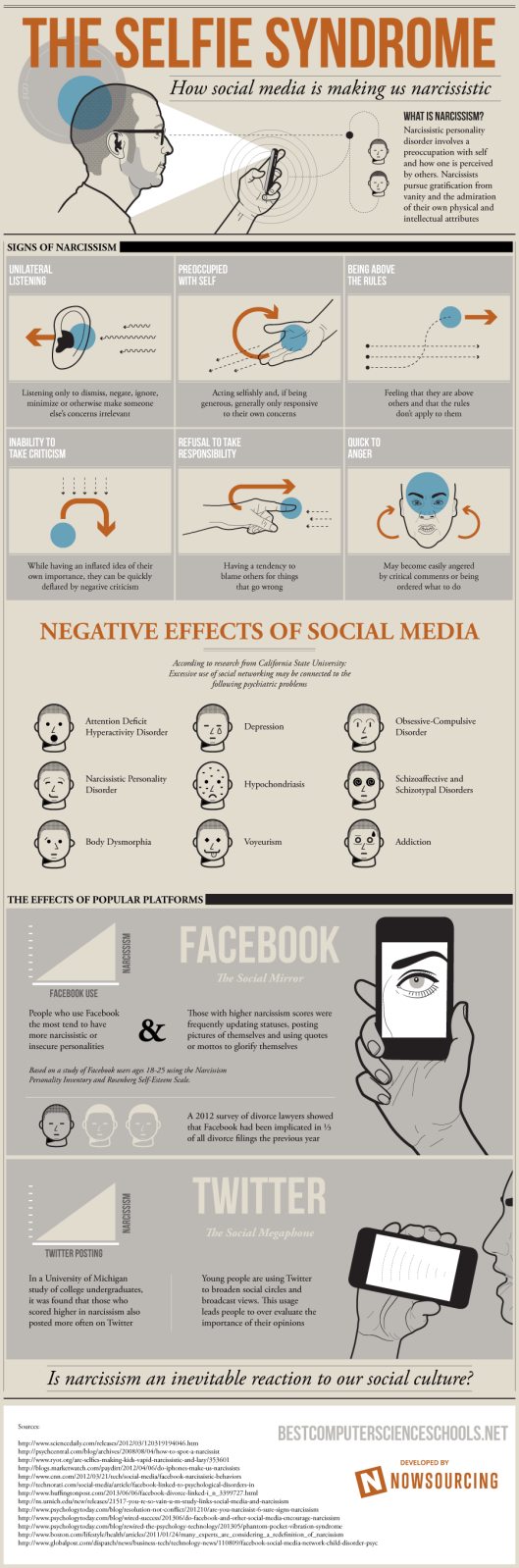
Check the infographic below for all the details, which comes courtesy of The Best Computer Science Schools.

READ Scientists Link Selfies To Narcissism, Addiction & Mental Illness

selfie-syndrome

Healthy Holistic Living

Healthy Holistic Living brings you alternative health news from all over the web. These articles are sourced and shared with permission so you get all the news that’s fit to keep you in good physical and mental health. Stay happy, stay hungry, and stay on Healthy Holistic Living.

Share this:

  • Email a link to a friend (Opens in new window) Email
  • Print (Opens in new window) Print
  • Share on Facebook (Opens in new window) Facebook
  • Share on LinkedIn (Opens in new window) LinkedIn
  • Share on Pinterest (Opens in new window) Pinterest
  • Share on Reddit (Opens in new window) Reddit
  • Share on X (Opens in new window) X
  • Share on Tumblr (Opens in new window) Tumblr
Like Loading...

Want to Be a Nicer Person? Read a Novel

07 Monday Jan 2019

Posted by Donna L. Roberts, PhD in Psychology

≈ Comments Off on Want to Be a Nicer Person? Read a Novel

You are what you read.

Source: Want to Be a Nicer Person? Read a Novel

Photo by Natalia Y on Unsplash

Kristine Anthis Ph.D.

If one of your New Year’s resolutions is to be a nicer person who is more sensitive and aware of other people’s feelings, read more novels. Really.

Once you are absorbed in the world of Anthony Doerr’s All the Light We Cannot See and other popular novels, you might find yourself a more empathetic person. Researchers who study how reading literature affects us have found that just like anything else, we get better at a subject the more we practice it; the more fiction we read, the more we understand how and what other people think (Djikic & Oatley, 2014).

It may be that in the process of appreciating others’ lives, we incorporate these experiences into our own personality, resulting in a new and reconfigured self. Readers often experience emotions similar to those of fictional characters, which increases our empathy for them. In doing so, “Literature can help us navigate our self-development by transcending our current self while at the same time making available to us a multitude of potential future selves” (Djikic & Oatley, 2014, p. 503). So the more we read, the more we expose ourselves to other ways of being, and other potential identities.

If you are wondering whether or not television or film have the same effect, the answer is unclear, given more research is needed. But television and film provide audiovisual information that novels do not, so literature likely requires more cognitive effort unless the television show or film is complex and challenging (and many contemporary media are).

Novels therefore provide ideal opportunities to practice our emotional intelligence skills such as empathy, as well as the awareness and monitoring of our emotions (Mar, Oatley, Djikic, & Mullin, 2011). And what we read matters, suspense and romance novels seem to foster greater interpersonal sensitivity than do science fiction novels (Fong, Mullin, & Mar, 2013). There are subtle distinctions within genres though. As a fan of Margaret Atwood’s speculative fiction, I look forward to more research on the differences among various genres and sub-genres of literature.

Regardless, the next time you are running errands and waiting in line, consider dipping into that novel you started rather than texting mindlessly or zoning out with a game — if you do so regularly, you will likely become a more sensitive and thoughtful person.

References

Djikic, M. & Oatley, K. (2014). The art in fiction: From indirect communication to changes of the self. Psychology of Aesthetics, Creativity, and the Arts, 8(4), 498-505.

Fong, K., Mullin, J. B., & Mar, R. A. (2013). What you read matters: The role of fiction genre in predicting interpersonal sensitivity. Psychology of Aesthetics, Creativity, and the Arts, 7(4), 370-376.

Mar, R. A., Oatley, K., Djikic, M., & Mullin, J. (2011). Emotion and narrative fiction: Interactive influences before, during, and after reading. Cognition and Emotion, 25(5), 818-833.

Share this:

  • Email a link to a friend (Opens in new window) Email
  • Print (Opens in new window) Print
  • Share on Facebook (Opens in new window) Facebook
  • Share on LinkedIn (Opens in new window) LinkedIn
  • Share on Pinterest (Opens in new window) Pinterest
  • Share on Reddit (Opens in new window) Reddit
  • Share on X (Opens in new window) X
  • Share on Tumblr (Opens in new window) Tumblr
Like Loading...

New book reveals hidden details in world’s most famous paintings

31 Monday Dec 2018

Posted by Donna L. Roberts, PhD in Psychology

≈ Comments Off on New book reveals hidden details in world’s most famous paintings

The art secrets hiding in plain sight: Expert reveals the easy-to-miss details that are key to unlocking the meaning of some of the world’s most famous paintings (so did YOU spot them?)

  • Kelly Grovier’s book, A New Way of Seeing, examines the secrets hiding within famous works across time
  • Reveals an Easter egg hidden in Hieronymus Bosch’s famous The Garden of Earthly Delights from 1505-10
  • Also points out a tiny symbolic rabbit in J. M. W. Turner’s Rain Steam, and Speed – The Great Western Railway

Cultural critic Kelly Grovier, who was born in California but now lives in Ireland, has explored every element of 57 different works of art to discover their secrets for his seventh book.

Source: New book reveals hidden details in world’s most famous paintings

By KELLY GROVIER FOR THE MAILONLINE

A new book has revealed the crucial hidden details you have missed in some of the world’s most well-known paintings.

A New Way of Seeing: The History of Art in 57 Works hopes to change the way people view these incredible pieces forever through recognising their hidden meanings.

From Sandro Botticelli’s The Birth of Venus to Edvard Munch’s The Scream, the book helps guide viewers to seemingly innocuous details that are actually bursting with meaning. 

‘I wrote A New Way of Seeing because I wanted to understand what makes great art great,’ Kelly said. 

‘I sensed there were hidden mysteries and strange depths to the paintings and sculptures that we all know by heart but never really look at. I wanted to help readers reconnect with those masterpieces that have the power to enrich our experience of the world.’ 

Here, Kelly reveals the details you might have missed in some very recognisable paintings… 

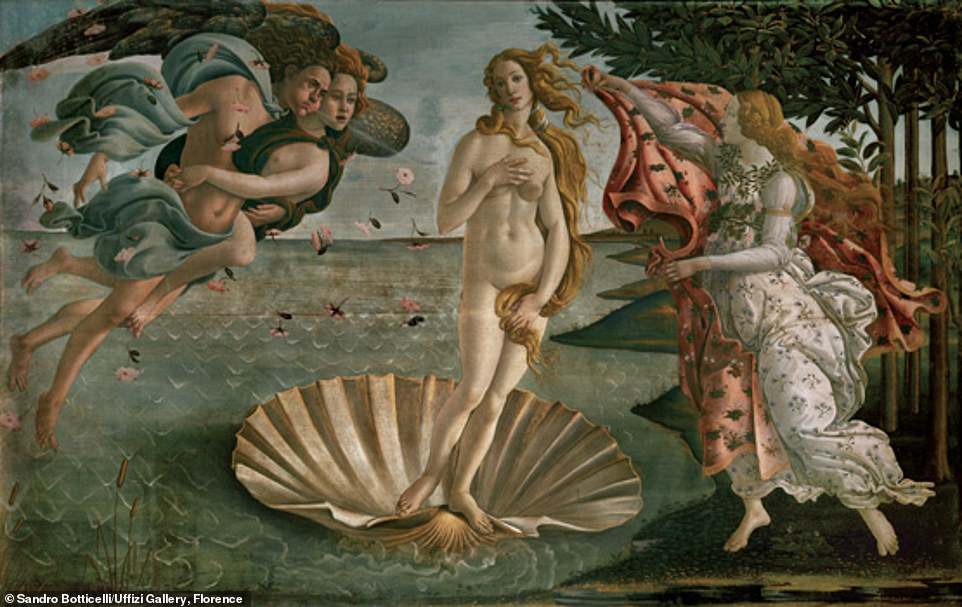
Sandro Botticelli, The Birth of Venus 

Sandro Botticelli, The Birth of Venus, c. 1482-85, tempura on canvas, 172.5 x 278.9 cm: Kelly said: 'In Botticelli’s famous painting, Venus windsurfs to shore on a supersized scallop shell. Striking a pose, she gently tilts her head towards a curlicue of golden hair that has miraculously spun itself into a perfect logarithmic spiral on her right shoulder. Too precise to be an accident of brushwork, this seashell-shaped curl whispers sweet nothings in the ear of the goddess who listens intently'

Sandro Botticelli, The Birth of Venus, c. 1482-85, tempura on canvas, 172.5 x 278.9 cm: Kelly said: ‘In Botticelli’s famous painting, Venus windsurfs to shore on a supersized scallop shell. Striking a pose, she gently tilts her head towards a curlicue of golden hair that has miraculously spun itself into a perfect logarithmic spiral on her right shoulder. Too precise to be an accident of brushwork, this seashell-shaped curl whispers sweet nothings in the ear of the goddess who listens intently’

Kelly said: 'Since antiquity, this same spiral has mesmerised mathematicians as an intriguing twist of natural grace - observable in everything from flowers to cyclones, the swoop of raptors to the whorl of galaxies. It will eventually be christened Spira mirabilis ('the marvellous spiral') by a Swiss thinker, Jacob Bernoulli, at the end of the 17th century. And what, exactly, is the spiral murmuring to Venus in Botticelli’s masterpiece? Nothing much: just the secret to timeless beauty'

Kelly said: ‘Since antiquity, this same spiral has mesmerized mathematicians as an intriguing twist of natural grace – observable in everything from flowers to cyclones, the swoop of raptors to the whorl of galaxies. It will eventually be christened Spira mirabilis (‘the marvelous spiral’) by a Swiss thinker, Jacob Bernoulli, at the end of the 17th century. And what, exactly, is the spiral murmuring to Venus in Botticelli’s masterpiece? Nothing much: just the secret to timeless beauty’

J. M. W. Turner, Rain Steam, and Speed – The Great Western Railway 

J. M. W. Turner, Rain Steam, and Speed - The Great Western Railway, 1844, oil on canvas: Kelly said: 'Turner is famous for going big. Big skies. Big storms. Big ships. All painted with a big brush. But going big sometimes means going small. When Turner’s famous Rain, Steam, and Speed – The Great Western Railway was exhibited in 1844, a tragedy that occurred two and a half years earlier, on Christmas Eve in 1841, was still fresh in visitors’ minds'

J. M. W. Turner, Rain Steam, and Speed – The Great Western Railway, 1844, oil on canvas: Kelly said: ‘Turner is famous for going big. Big skies. Big storms. Big ships. All painted with a big brush. But going big sometimes means going small. When Turner’s famous Rain, Steam, and Speed – The Great Western Railway was exhibited in 1844, a tragedy that occurred two and a half years earlier, on Christmas Eve in 1841, was still fresh in visitors’ minds’

Kelly said: 'Ten miles from the bridge depicted in the painting, a train derailed and nine third-class commuters were killed and another sixteen disfigured. With a tender painterly touch, Turner pays tribute to the wrenching loss. Dashing out ahead of the locomotive is a deftly enunciated hare – since antiquity a symbol in art of rebirth and hope. The tiny hare, easily lost in the mire of shadow and tracks, alone rescues the work from being an abstract statement on the collision of technology and nature to something more intimate and heartfelt'

Kelly said: ‘Ten miles from the bridge depicted in the painting, a train derailed and nine third-class commuters were killed and another sixteen disfigured. With a tender painterly touch, Turner pays tribute to the wrenching loss. Dashing out ahead of the locomotive is a deftly enunciated hare – since antiquity a symbol in art of rebirth and hope. The tiny hare, easily lost in the mire of shadow and tracks, alone rescues the work from being an abstract statement on the collision of technology and nature to something more intimate and heartfelt’

Édouard Manet, A Bar at The Folies-Bergère 

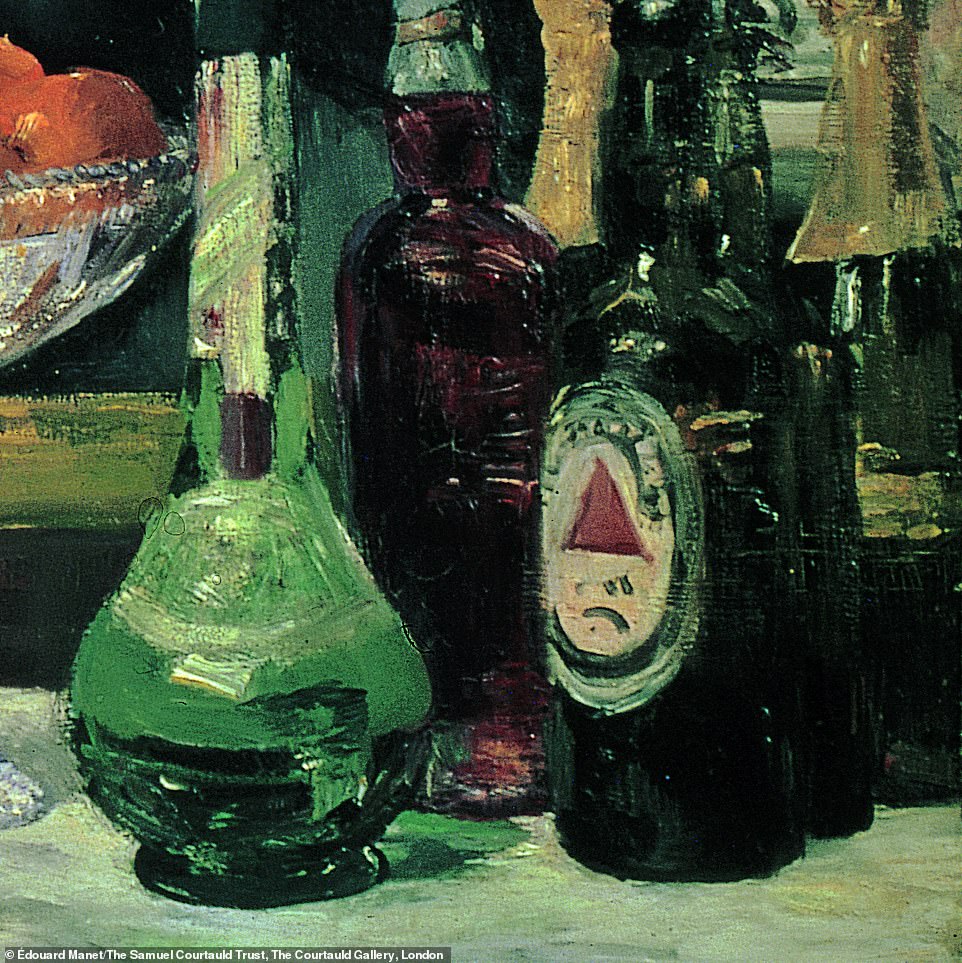
Édouard Manet, A Bar at The Folies-Bergère, 1882: Kelly said: 'On either side of the barmaid in Édouard Manet’s famous depiction of a raucous cabaret in Paris, bottles of a British beer manufactured by the Bass Brewery call attention to themselves by the distinctive, red triangle printed on their label. The very first officially protected trademark in the United Kingdom, the Bass logo may seem a strange product placement in a proto-Impressionist masterpiece; yet it is key to unlocking the work’s meaning and poignant power'

Édouard Manet, A Bar at The Folies-Bergère, 1882: Kelly said: ‘On either side of the barmaid in Édouard Manet’s famous depiction of a raucous cabaret in Paris, bottles of a British beer manufactured by the Bass Brewery call attention to themselves by the distinctive, red triangle printed on their label. The very first officially protected trademark in the United Kingdom, the Bass logo may seem a strange product placement in a proto-Impressionist masterpiece; yet it is key to unlocking the work’s meaning and poignant power’

Kelly said: 'Seen in the context of the commercial label, the spray of roses across the barmaid’s cleavage, which takes the organic shape of a red triangle, marks her out as a product to be purchased and consumed – a woman to be bought and sold. The Folies-Bergère was well-known as a place where barmaid’s moonlighted as prostitutes. Suddenly, the shadowy man we see approaching her from the right in the mirror behind her is a trader in souls, and we, standing precisely where he is, are implicated in the transaction'

Kelly said: ‘Seen in the context of the commercial label, the spray of roses across the barmaid’s cleavage, which takes the organic shape of a red triangle, marks her out as a product to be purchased and consumed – a woman to be bought and sold. The Folies-Bergère was well-known as a place where barmaid’s moonlighted as prostitutes. Suddenly, the shadowy man we see approaching her from the right in the mirror behind her is a trader in souls, and we, standing precisely where he is, are implicated in the transaction’

Gustav Klimt, The Kiss 

Gustav Klimt, The Kiss, 1907, oil and gold leaf on canvas: Kelly said: 'Look closely at the woman’s resplendent frock in Gustav Klimt’s much-adored portrait of passion, The Kiss, and it appears decorated with round Petri-dish-like slides teeming with pulsing cells. In 1907, the year Klimt painted his iconic work, the air in Vienna was abuzz with talk of platelets and plasma, red blood cells and white'

Gustav Klimt, The Kiss, 1907, oil and gold leaf on canvas: Kelly said: ‘Look closely at the woman’s resplendent frock in Gustav Klimt’s much-adored portrait of passion, The Kiss, and it appears decorated with round Petri-dish-like slides teeming with pulsing cells. In 1907, the year Klimt painted his iconic work, the air in Vienna was abuzz with talk of platelets and plasma, red blood cells and white’

Kelly said: 'At the University of Vienna (where Klimt himself had been commissioned to create some paintings based on medical themes), Karl Landsteiner, a pioneering immunologist who was the first to distinguish blood groups, was busy investigating how to make blood transfusions work. Within each of the opulent ovoid slides that Klimt has stitched into the woman’s frock, vibrant platelets and agglutinating blood cells judder and throb, as if a microscopic glimpse into her cellular constitution has just been obtained – as if the artist has glimpsed a luminous biopsy of never-ending love'

Kelly said: ‘At the University of Vienna (where Klimt himself had been commissioned to create some paintings based on medical themes), Karl Landsteiner, a pioneering immunologist who was the first to distinguish blood groups, was busy investigating how to make blood transfusions work. Within each of the opulent ovoid slides that Klimt has stitched into the woman’s frock, vibrant platelets and agglutinating blood cells judder and throb, as if a microscopic glimpse into her cellular constitution has just been obtained – as if the artist has glimpsed a luminous biopsy of never-ending love’

Hieronymus Bosch, The Garden of Earthly Delights 

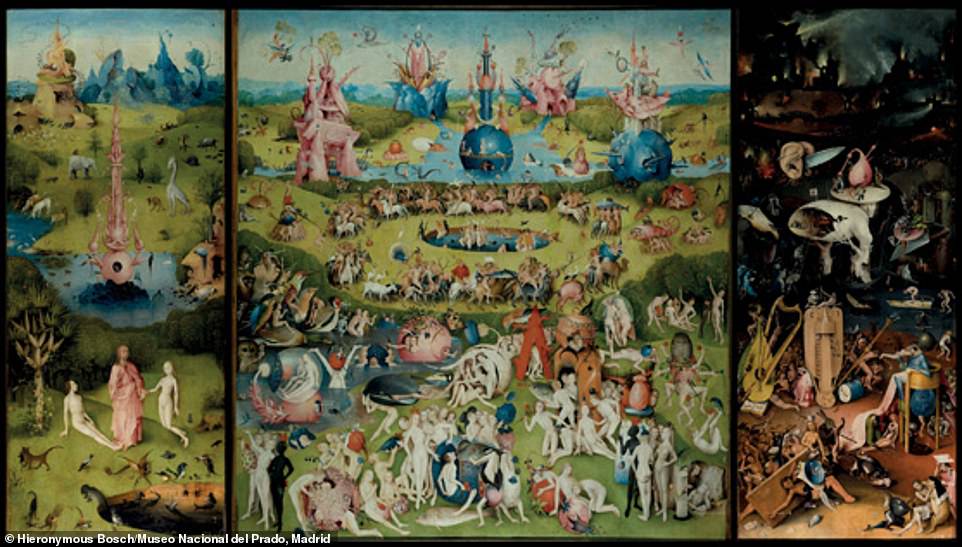
Hieronymus Bosch, The Garden of Earthly Delights (triptych open), 1505-10, oil on panel: Kelly said: 'To crack the code of Hieronymus Bosch’s famously cryptic vision of fleshly shenanigans, you must first find the Easter egg he’s hidden for us in his carnal garden. To locate it, all you have to do is draw a cross: imagine tracing a line down the very middle of the work vertically and one across its equator horizontally and, voilà, 'egg' marks the spot at the dead centre of the masterpiece'

Hieronymus Bosch, The Garden of Earthly Delights (triptych open), 1505-10, oil on panel: Kelly said: ‘To crack the code of Hieronymus Bosch’s famously cryptic vision of fleshly shenanigans, you must first find the Easter egg he’s hidden for us in his carnal garden. To locate it, all you have to do is draw a cross: imagine tracing a line down the very middle of the work vertically and one across its equator horizontally and, voilà, ‘egg’ marks the spot at the dead centre of the masterpiece’

Hoisted onto the head of a traveller, a breakable but, as yet, still unbroken eggshell stares back at us like a piercing pupil-less eye, reminding us how precarious the soul’s journey is through this world and the next. When Bosch’s triptych is closed, it reveals a cosmic depiction of the world floating in space: a ghostly egg we endlessly crack open every time we swing the work’s hinges wide

Hoisted onto the head of a traveller, a breakable but, as yet, still unbroken eggshell stares back at us like a piercing pupil-less eye, reminding us how precarious the soul’s journey is through this world and the next. When Bosch’s triptych is closed, it reveals a cosmic depiction of the world floating in space: a ghostly egg we endlessly crack open every time we swing the work’s hinges wide

Edvard Munch, The Scream 

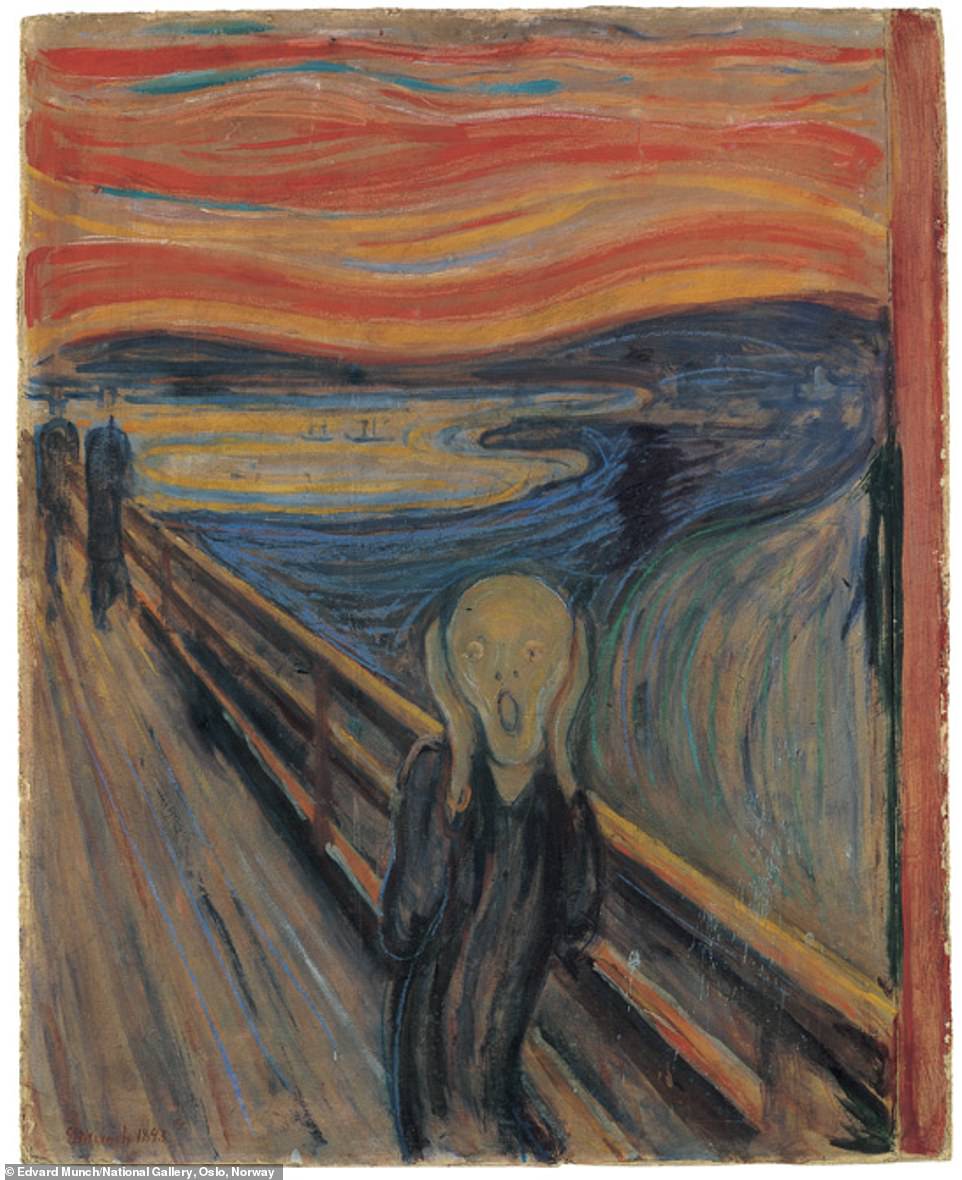
Edvard Munch, The Scream, 1893, oil, tempera, pastel and crayon on cardboard: Kelly said: 'Edvard Munch’s 1893 portrait of a howling figure has become an archetype of existential angst and continues to hypnotise, like a flickering bulb swaying above us. Munch took an anxious interest in electricity and the technological advances of the day, and once confessed to his journal that he was haunted by a mysterious shape that 'directed the wires — and held the machinery in his hand'

Edvard Munch, The Scream, 1893, oil, tempera, pastel and crayon on cardboard: Kelly said: ‘Edvard Munch’s 1893 portrait of a howling figure has become an archetype of existential angst and continues to hypnotise, like a flickering bulb swaying above us. Munch took an anxious interest in electricity and the technological advances of the day, and once confessed to his journal that he was haunted by a mysterious shape that ‘directed the wires — and held the machinery in his hand’

Kelly said: 'One can only imagine how he reacted to the spectacle at the 1889 Exposition Universelle in Paris of 13,000 incandescent lamps arranged into the luminous shape of a gigantic light bulb. Like a bulging glass skull whose bulbous cranium tapers to an elongated jaw, the lamp towered above visitors. The shape appears to have seeped deep into Munch’s imagination. It flipped a switch. The yowling head that glows in The Scream echoes with uncanny precision the crystalline contours of Edison’s modern god'

Kelly said: ‘One can only imagine how he reacted to the spectacle at the 1889 Exposition Universelle in Paris of 13,000 incandescent lamps arranged into the luminous shape of a gigantic light bulb. Like a bulging glass skull whose bulbous cranium tapers to an elongated jaw, the lamp towered above visitors. The shape appears to have seeped deep into Munch’s imagination. It flipped a switch. The yowling head that glows in The Scream echoes with uncanny precision the crystalline contours of Edison’s modern god’

A New Way of Seeing: The History of Art in 57 Works by Kelly Grovier (Thames & Hudson)

Share this:

  • Email a link to a friend (Opens in new window) Email
  • Print (Opens in new window) Print
  • Share on Facebook (Opens in new window) Facebook
  • Share on LinkedIn (Opens in new window) LinkedIn
  • Share on Pinterest (Opens in new window) Pinterest
  • Share on Reddit (Opens in new window) Reddit
  • Share on X (Opens in new window) X
  • Share on Tumblr (Opens in new window) Tumblr
Like Loading...

Best Christmas ads 2018: Watch Google’s amazing Home Alone Again and more

22 Saturday Dec 2018

Posted by Donna L. Roberts, PhD in Psychology

≈ Comments Off on Best Christmas ads 2018: Watch Google’s amazing Home Alone Again and more

Watch Macaulay Culkin revisit his glory days in the Google Home ad, plus many more excellent festive commercials.

Source: Best Christmas ads 2018: Watch Google’s amazing Home Alone Again and more

Rik Henderson    20 December 2018

We thought we’d seen the all the Christmas adverts this year already, with only a few days left until the big day itself. However, Google has arrived late to the party with what could be the best of them all.

Its Home Alone Again commercial, posted on YouTube, is quite simply brilliant. It brings Kevin McAllister (Macaulay Culkin) back for a modern retake on the classic Christmas movie – one of our favourites of all time.

You can watch it below, along with a selection of the best Christmas adverts that have appeared on UK TVs or online during the 2018 festive period.

Google: Home Alone Again

Imagine what Kevin McAllister’s Home Alone experience would have been like with a Google Home digital assistant.

It must also be said that Macaulay Culkin is looking great these days. Would be good to see him more active on TV or film in 2019.

John Lewis: The Boy and the Piano

You might be a bit sick of it by now, and it’s no patch on former years’ efforts, but the 2018 John Lewis Christmas ad is still one of the best around.

We’re not convinced many small kids will be getting pianos this year though.

Twitter: #NotARetailStore

While you can watch the actual John Lewis advert above, spare a moment for the real John Lewis who is regularly inundated on Twitter by confused customers.

Twitter brilliantly captured this in its own festive advert this year.

Waitrose: Fast Forward

Another great John Lewis spoof comes from one of the retailer’s own brand partners, Waitrose.

It apes a lot of family’s thoughts on the annual unveiling of the JL Christmas ad.

Aldi: Kevin the Carrot and the Wicked Parsnip

Aldi went all out with its Kevin the Carrot Christmas adverts this year, with several reimagined fairy tales featuring an evil parsnip.

This is our fave, not least for the punchline.

Sainsbury’s: The Big Night

Sainsbury’s went with the tried and trusted children’s Christmas play for its 2018 commercial.

Here, you can see a much longer version than the one aired on TV. We still like the bit with the plug.

Iceland: Say Hello to Rang-tan

You won’t have seen this Iceland advert on British TV this Christmas as it was banned for being too political.

However, it is a great commercial with a good message that’s well worth a watch.

Apple: Share your Gifts

To highlight the creative applications possible with Apple devices, it made a wonderfully animated short film about a girl afraid to show others her work.

The much longer version than shown on TV is available above.

McDonald’s: Reindeer Ready

As a follow up to last year’s McDonald’s ad, the 2018 version now features Santa treating his own herd to the fast food chain’s “Reindeer Treats”.

To be honest, they’d probably have preferred Big Macs.

Visa: Keep it Local this Christmas

Finally, another good message, this time from Visa.

With online shopping and Christmas deliveries being easier than ever, don’t forget the humble high street shop keeper who relies on your custom – especially at this time of year.

Share this:

  • Email a link to a friend (Opens in new window) Email
  • Print (Opens in new window) Print
  • Share on Facebook (Opens in new window) Facebook
  • Share on LinkedIn (Opens in new window) LinkedIn
  • Share on Pinterest (Opens in new window) Pinterest
  • Share on Reddit (Opens in new window) Reddit
  • Share on X (Opens in new window) X
  • Share on Tumblr (Opens in new window) Tumblr
Like Loading...

End of the world: MIT prediction from 1973 is proving true

03 Monday Dec 2018

Posted by Donna L. Roberts, PhD in Psychology

≈ Comments Off on End of the world: MIT prediction from 1973 is proving true

An MIT model predicted when and how human civilization would end. Hint: it’s soon.

Credit: ABC.

Source: End of the world: MIT prediction from 1973 is proving true

by PAUL RATNER

In 1973, a computer program was developed at MIT to model global sustainability. Instead, it predicted that by 2040 our civilization would end. While many in history have made apocalyptic predictions that have so far failed to materialize, what the computer envisioned in the 1970s has by and large been coming true. Could the machine be right?

Why the program was created

The prediction, which recently re-appeared in Australian media, was made by a program dubbed World One. It was originally created by the computer pioneer Jay Forrester, who was commissioned by the Club of Rome to model how well the world could sustain its growth. The Club of Rome is an organization comprised of thinkers, former world heads of states, scientists, and UN bureaucrats with the mission to “promote understanding of the global challenges facing humanity and to propose solutions through scientific analysis, communication, and advocacy.”

The predictions

What World One showed was that by 2040 there would be a global collapse if the expansion of the population and industry was to continue at the current levels.

As reported by the Australian broadcaster ABC, the model’s calculations took into account trends in pollution levels, population growth, the amount of natural resources and the overall quality of life on Earth. The model’s predictions for the worsening quality of life and the dwindling natural resources have so far been unnervingly on target.

In fact, 2020 is the first milestone envisioned by World One. That’s when the quality of life is supposed to drop dramatically. The broadcaster presentedthis scenario that will lead to the demise of large numbers of people:

At around 2020, the condition of the planet becomes highly critical. If we do nothing about it, the quality of life goes down to zero. Pollution becomes so seriously it will start to kill people, which in turn will cause the population to diminish, lower than it was in the 1900. At this stage, around 2040 to 2050, civilised life as we know it on this planet will cease to exist.

Alexander King, the then-leader of the Club of Rome, evaluated the program’s results to also mean that nation-states will lose their sovereignty, forecasting a New World Order with corporations managing everything.

Sovereignty of nations is no longer absolute,” King told ABC. “There is a gradual diminishing of sovereignty, little bit by little bit. Even in the big nations, this will happen.

How did the program work?

World One, the computer program, looked at the world as one system. The report called it “an electronic guided tour of our behavior since 1900 and where that behavior will lead us.” The program produced graphs that showed what would happen to the planet decades into the future. It plotted statistics and forecasts for such variables as population, quality of life, the supply of natural resources, pollution, and more. Following the trend lines, one could see where the crises might take place.

Can we stave off disaster?

As one measure to prevent catastrophe, the Club of Rome predicted some nations like the U.S. would have to cut back on their appetites for gobbling up the world’s resources. It hoped that in the future world, prestige would stem from “low consumption”—one fact that has so far not materialized. Currently, nine in ten people around the world breathe air that has high levels of pollution, according to data from the World Health Organization (WHO). The agency estimates that 7 million deaths each year can be attributed to pollution.

Here, Parag Khanna gets into the specifics of what the world may be like in the near future, if we don’t change course:

Share this:

  • Email a link to a friend (Opens in new window) Email
  • Print (Opens in new window) Print
  • Share on Facebook (Opens in new window) Facebook
  • Share on LinkedIn (Opens in new window) LinkedIn
  • Share on Pinterest (Opens in new window) Pinterest
  • Share on Reddit (Opens in new window) Reddit
  • Share on X (Opens in new window) X
  • Share on Tumblr (Opens in new window) Tumblr
Like Loading...

Control of Screen Time Should Begin by Age 2

26 Monday Nov 2018

Posted by Donna L. Roberts, PhD in Psychology

≈ Comments Off on Control of Screen Time Should Begin by Age 2


Source: Control of Screen Time Should Begin by Age 2

By Rick Nauert PhD

A Canadian study suggests that watching too much television can contribute to poor eating habits in adolescence and suboptimal school performance. While the concept is not new, the study suggests that screen time must be controlled by the early age of two, confirming new recommendations by the American Academy of Pediatrics.

Researchers at Université de Montréal’s School of Psychoeducation, performed a longitudinal study looking at a birth cohort of nearly 2,000 Quebec boys and girls born between spring 1997 and 1998. The children were followed since they were five months old as part of the Quebec Longitudinal Study of Child Development.

When they reached two years of age, their parents reported on their daily television habits. Then, at age 13, the youths themselves reported on their dietary habits and behavior in school.

The research appears in the journal Preventive Medicine.

“Not much is known about how excessive screen exposure in early childhood relates to lifestyle choices in adolescence,” explains Professor Linda Pagani. Pagnai supervised the research of graduate student Isabelle Simonato.

“This birth cohort is ideal, because the children were born before smartphones and tablets, and before any pediatric viewing guidelines were publicized for parents to follow. They were raising their children with TV and seeing it as harmless. This makes our study very naturalistic, with no outside guidelines or interference — a huge advantage.”

Simonato added, “Watching TV is mentally and physically sedentary behavior because it does not require sustained effort. We hypothesized that when toddlers watch too much TV it encourages them to be sedentary, and if they learn to prefer effortless leisure activities at a very young age, they likely won’t think much of non-leisure ones, like school, when they’re older.”

In their study, the researchers found that every hourly increase in toddlers’ TV viewing forecasted bad eating habits down the road — an increase of eight percent at age 13 for every hourly increase at age two.

In questionnaires, those early-TV adolescents reported consuming more French fries, prepared meats and cold cuts, white bread, regular and diet soft drinks, fruit-flavored drinks, sports drinks, energy drinks, salty or sweet snacks, and desserts.

Early TV viewing also translated into less eating of breakfast on school days (by 10 percent) and led to more overall screen time at age 13.

Every additional hour of watching TV also predicted a higher body mass index (a 10 percent increase) and less effortful behavior at school in the first year of secondary school, ultimately affecting performance and ambition.

“This study tells us that overindulgent lifestyle habits begin in early childhood and seem to persist throughout the life course,” Pagani noted. “An effortless existence creates health risks. For our society that means a bigger health care burden associated with obesity and lack of cardiovascular fitness.”

The researchers also measured their results against revised screen time guidelines by the American Academy of Pediatrics, which reduced the amount of daily viewing from two hours a day to one a day for children between ages two and five.

Compared to children who viewed less than one hour a day at age two, those who viewed between one and four a day later reported (at age 13) having less healthy dietary habits, skipping breakfast on weekdays, having a higher BMI, engaging in more intense screen time, and being less engaged as students.

“Because we had a lot of information on each child and family we were able to eliminate other psychological and socio-demographic factors that could have explained the results, which is a really ideal situation,” said Simonato.

“We even removed any influence of screen time habits at age 13 to really isolate long-term associations with toddler viewing.”

Source: University of Montreal/EurekAlert

Dr. Rick Nauert has over 25 years experience in clinical, administrative and academic healthcare. He is currently an associate professor for Rocky Mountain University of Health Professionals doctoral program in health promotion and wellness. Dr. Nauert began his career as a clinical physical therapist and served as a regional manager for a publicly traded multidisciplinary rehabilitation agency for 12 years. He has masters degrees in health-fitness management and healthcare administration and a doctoral degree from The University of Texas at Austin focused on health care informatics, health administration, health education and health policy. His research efforts included the area of telehealth with a specialty in disease management.

Share this:

  • Email a link to a friend (Opens in new window) Email
  • Print (Opens in new window) Print
  • Share on Facebook (Opens in new window) Facebook
  • Share on LinkedIn (Opens in new window) LinkedIn
  • Share on Pinterest (Opens in new window) Pinterest
  • Share on Reddit (Opens in new window) Reddit
  • Share on X (Opens in new window) X
  • Share on Tumblr (Opens in new window) Tumblr
Like Loading...

Don’t Become an Information Junkie: A Balance Between Learning And Taking Action

19 Monday Nov 2018

Posted by Donna L. Roberts, PhD in Psychology

≈ Comments Off on Don’t Become an Information Junkie: A Balance Between Learning And Taking Action

One big trap in self improvement is becoming an “information junkie.” This is when we spend more time learning new information than putting it into action.

Source: Don’t Become an Information Junkie: A Balance Between Learning And Taking Action

by Steven Handel

An “information junkie” is someone who spends a lot of time reading books, watching videos, and listening to podcasts about self improvement, but they spend very little time actually putting what they learn into practice.

This is a very common problem for many people. We stuff our brains with loads of information, but then we find ourselves not knowing what to do with all of it. This is especially true in our current “information age,” where we are constantly consuming stuff on the internet and social media.

Of course, it’s a very positive thing to want to learn as much as possible and to do your own research into various topics. Overall — reading books, watching videos, and listening to podcasts is a very healthy and beneficial thing to do. Even the occasional surfing on Google and Wikipedia can be fun and informative.

But there comes a point when if you’re NOT able to apply this information to your everyday life, how useful is it really?

Endlessly seeking new information can ultimately become a distraction. We feel we’re not ready to make a change yet, so we think “Well, I should really read more articles or books before I decide what the best course of action is!”

But this can often become an impossible and never-ending task.

You’ll never know everything about a topic. Often times, being successful with your goals means learning how to “take action” even when you realize you don’t have perfect knowledge and perfect information.

And even more importantly, much of what we learn throughout our lives comes not just from books and videos, but through personal experience.

By focusing on information and not action, you’re actually limiting your education and self-growth by ignoring the importance of getting hands-on experience and real world knowledge.

It’s like reading books about how to play baseball without ever picking up a baseball and throwing it, or watching videos of people riding a bike without ever getting on a bike yourself. How good can you really get without any experience?

Have you fallen into the trap of becoming an “information junkie?” Do you spend too much time “learning” and not enough time “doing?”

Here’s advice on how to break out of this habit.

The “Consumer” vs. “Producer” Mindset

One important shift in your attitude is to go from a “consumer mindset” to a “producer mindset.”

The “information junkie” typically views themselves as a consumer. They feel they need to find the right book, the right video, or the right podcast that finally reveals to them some important piece of information that they’ve been waiting for.

Ultimately, they are searching for something outside of themselves before they can move forward, and not simply looking inside and doing the best with what they have.

Unlike the “consumer,” the “producer” is someone that is taking action with the knowledge they have and creating something of value that they can share with the world.

One important question to ask yourself is: “What am I creating on a daily basis? How am I adding value to the world and not just subtracting from it?”

This is a great question for everyone – not just people who are actively seeking self improvement.

In many ways, our culture has turned us all into crazed consumers. We’re constantly searching for the next movie to watch, the next video game to buy, the next fashion trend to jump on, etc. And this is where we draw a lot of our “happiness” from.

But we must also learn how to think of ourselves as “producers,” and not just “consumers.” And often this shift in your mindset can be far more fulfilling.

One important shift for me was making it a personal mission to create something new everyday. Even if it was just working on a new article or new video, I wanted to at least have something that I could show people and say, “I created this!”

The best part is: When you shift into a “producer mindset,” it does wonders for your confidence and self-esteem.

You stop seeing yourself as just a mindless consumer that depends on others. Instead, you become someone who is actually adding to the world and creating stuff – and that gives you an important sense of accomplishment that every human being craves.

There’s no better feeling than being able to point at something in the real world and say “I did this.” It shows you are participating in life and making a difference, however small it may seem to others.

To avoid becoming an “information junkie,” ask yourself, “What am I doing on a daily basis that brings me closer to my goals?” Take a second and write down the small steps you can begin taking within the next 24-48 hours.

Another important rule-of-thumb to follow is for every book, article, video, or podcast you consume, try to identify at least one action you can take based on the information you’ve learned.

Always remember: learning isn’t enough, we must put our knowledge into action, or whatever we learn will be meaningless.


Steven Handel is a self improvement author, blogger, speaker, and coach. He first started The Emotion Machine in June 2009 and has since published over 800 articles covering a wide-range of topics including Positive Psychology, Cognitive-Behavioral Therapy, Social Psychology, Mindfulness Meditation, Emotional Intelligence, and much more!

Share this:

  • Email a link to a friend (Opens in new window) Email
  • Print (Opens in new window) Print
  • Share on Facebook (Opens in new window) Facebook
  • Share on LinkedIn (Opens in new window) LinkedIn
  • Share on Pinterest (Opens in new window) Pinterest
  • Share on Reddit (Opens in new window) Reddit
  • Share on X (Opens in new window) X
  • Share on Tumblr (Opens in new window) Tumblr
Like Loading...
← Older posts
Newer posts →
Ken Heller on

Enter your email address to follow this blog and receive notifications of new posts by email.

Join 4,624 other subscribers

Media Psychology

  • RSS - Posts
  • RSS - Comments

Blog Stats

  • 115,865 hits

Archives

  • December 2020 (3)
  • November 2020 (4)
  • September 2020 (1)
  • June 2020 (1)
  • April 2020 (1)
  • March 2020 (1)
  • February 2020 (3)
  • January 2020 (4)
  • December 2019 (8)
  • November 2019 (1)
  • October 2019 (5)
  • September 2019 (10)
  • August 2019 (7)
  • July 2019 (4)
  • June 2019 (3)
  • May 2019 (5)
  • April 2019 (8)
  • March 2019 (7)
  • February 2019 (4)
  • January 2019 (5)
  • December 2018 (4)
  • November 2018 (4)
  • October 2018 (5)
  • September 2018 (8)
  • August 2018 (7)
  • July 2018 (4)
  • June 2018 (3)
  • May 2018 (6)
  • April 2018 (4)
  • March 2018 (6)
  • February 2018 (6)
  • January 2018 (6)
  • December 2017 (4)
  • November 2017 (5)
  • October 2017 (5)
  • September 2017 (5)
  • August 2017 (5)
  • July 2017 (5)
  • June 2017 (5)
  • May 2017 (2)
  • April 2017 (2)
  • March 2017 (5)
  • February 2017 (4)
  • January 2017 (7)
  • December 2016 (3)
  • November 2016 (2)
  • October 2016 (4)
  • September 2016 (2)
  • August 2016 (2)
  • July 2016 (3)
  • June 2016 (5)
  • May 2016 (6)
  • April 2016 (4)
  • March 2016 (2)
  • February 2016 (1)
  • January 2016 (1)
  • December 2015 (1)
  • November 2015 (2)
  • January 2015 (1)
  • November 2014 (1)
  • September 2014 (1)
  • August 2014 (1)
  • July 2014 (4)
  • May 2014 (1)
  • April 2014 (1)
  • March 2014 (2)
  • February 2014 (2)
  • January 2014 (2)
  • December 2013 (4)
  • November 2013 (2)
  • October 2013 (1)
  • September 2013 (1)
  • August 2013 (4)
  • July 2013 (1)
  • June 2013 (1)
  • April 2013 (1)
  • March 2013 (4)
  • February 2013 (3)
  • January 2013 (5)
  • December 2012 (4)
  • November 2012 (6)

Addiction Advertising Agenda Setting Al-Jazeera Associated Press Behavioralism Bernays Cartoons Causality Cognitive Correlation Cultivation Theory Digital Immigrants Digital Natives Ellul Facebook Fallacious Arguments Film Framing Gaming Gerbner Giles Google Greenwald ICT Identity Imagery Impact of ICT Influence Ingress Internet Internet.org Journalism Marketing McCombs McLuhan Mean World Sydrome Media Media Effects Media Literacy Media Psychology Mobile Computing Mobile Phones Moscow Olympics Neural Pathways news coverage Operant Conditioning Persuasive Technology Physiological Psychology Pinterest Potter Prensky Privacy Propaganda Psychological Effects Psychological Operations Psychology Public Diplomacy Public Relations Quotes Sexism Skinner Smartphone Social Change Social Identity Social Media Social Networks Social Psychology Sports Taylor Technology The Engineering of Consent Transmedia Twitter Walking Dead

RSS The Amplifier – APA Div. 46 Newsletter

  • The Legend of Zelda: Echoes of Wisdom as a Feminist Breakthrough and Contradiction
  • Digital Mourning: Grief Expression on Social Media
  • Book Review: Black Film Through a Psychodynamic Lens
  • The History of (Media) Multitasking Research
  • AI and Mental Health: Can Chatbots and Digital Coaches Bridge the Gap for Perinatal Mental Health Support?
  • To Infinity and Beyond: Best Practices for Data-informed Telemental Intensive Outpatient Programs
  • Editor’s Column: Authentically Inclusive Representation in Film and Television
  • President’s Column: Charting the Future of Media Psychology: Division 46 at APA 2025
  • Past President’s Column: Division 46 Announcements
  • TikTok and Self-Diagnosis: What Clinicians Need to Know

RSS APA Div. 46 Media Psychology and Technology Facebook Feed – Come check it out!

  • Kids Are Using Minecraft To Design A More Sustainable World
  • Home – UsMeU
  • Huggable Robot Befriends Girl in Hospital
  • Lifelong learning is made possible by recycling of histones, study says
  • Synthetic Love: Can a Human Fall in Love With a Robot? –
  • Today’s Photo:
  • Dr. Joanne Broder Sumerson
  • Could Storytelling Be the Secret Sauce to STEM Education?
  • Google driverless cars were in 11 accidents, but officer, it wasn’t their fault
  • All-But-Dissertation Survival Guide

RSS Changing Minds

  • An error has occurred; the feed is probably down. Try again later.

RSS Media Smarts

  • Outcome Chart – New Brunswick – Digital Production 120
  • Outcome Chart – New Brunswick – Dramatic Arts 120 (Grade 12)
  • Outcome Chart – New Brunswick – Dramatic Arts 110 (Grade 11)
  • Outcome Chart – New Brunswick – Graphic Art and Design 120 (Grade 12)
  • Outcome Chart – New Brunswick – Graphic Art and Design 110 (Grade 11)
  • Outcome Chart – New Brunswick – Film 110 (Grade 11)
  • Outcome Chart – New Brunswick – Popular Music 120 (Grade 12)
  • Outcome Chart – New Brunswick – Music 122 (Grade 12)
  • Outcome Chart – New Brunswick – Music 112 (Grade 11)
  • Outcome Chart – New Brunswick – Music 9

RSS Adam Curtis

  • HYPERNORMALISATION
  • TRAILER TRASH
  • HAPPIDROME - Part One
  • THE VEGETABLES OF TRUTH
  • NOW THEN
  • SUSPICIOUS MINDS
  • ONE'S PRIVATE LIFE
  • WHAT THE FLUCK!
  • THE BABY AND THE BAATH WATER
  • BUGGER

RSS Media Psychology Blog

  • does resurge work : Resurge weight reduction supplement is a...

RSS The Psych Files

  • The Psych Files – Most Popular Episodes
  • Psych Files Episodes on Youtube

RSS The Media Zone

  • And He Knew All the Words
  • Sexy, Dangerous Women Are Everywhere
  • In Praise of Older Women
  • "Commercial Creep"—I Hate Commercials and You Should Too
  • How A Laundry Detergent Commercial Saved the World
  • Jodie Foster: To Come Out Lesbian Or Let Sleeping Rumors Lie
  • Why No Photos of the Slaughtered Newtown Children?
  • HBO's "The Newsroom": Sorkin Talks Truth To Stupid
  • Dorothy Sandusky: A Woman Who Saw Nothing
  • Celebrity - The Incest of Actors, Politicians, and Journalists.

RSS The Media Psychology Effect

  • The Importance of Synesthesia in Artificial Intelligence
  • Media and Communications Psychology in the 21st Century
  • Media Psychology Is a New-Collar Profession
  • The Psychology of Crowds
  • AI Is Reshaping Workers as Well as Work
  • Understanding the Eye in AI
  • Where's Smokey the Bear When You Need Him?
  • Personalized AI and the Future of Teaching and Learning
  • The Future of Learning and Education Is Already in Your Pocket
  • Psychology and the Importance of Perfect Practice

RSS On The Media

  • An error has occurred; the feed is probably down. Try again later.

Create a free website or blog at WordPress.com.

Privacy & Cookies: This site uses cookies. By continuing to use this website, you agree to their use.
To find out more, including how to control cookies, see here: Cookie Policy
  • Subscribe Subscribed
    • Media Psychology
    • Join 555 other subscribers
    • Already have a WordPress.com account? Log in now.
    • Media Psychology
    • Subscribe Subscribed
    • Sign up
    • Log in
    • Report this content
    • View site in Reader
    • Manage subscriptions
    • Collapse this bar
 

Loading Comments...
 

    %d