• About the Authors
  • Blogs and Shows
  • Journals
  • Open Invitation
  • References
  • Resources
  • Taxonomy
  • Who’s Who?

Media Psychology

~ Informing, Educating and Influencing

Media Psychology

Author Archives: Donna L. Roberts, PhD

Viral App FaceApp Now Owns Access To More Than 150 Million People’s Faces And Names

14 Monday Oct 2019

Posted by Donna L. Roberts, PhD in Psychology

≈ Comments Off on Viral App FaceApp Now Owns Access To More Than 150 Million People’s Faces And Names

“Your face will most likely end up training some AI facial-recognition algorithm”

Source: Viral App FaceApp Now Owns Access To More Than 150 Million People’s Faces And Names

John Koetsier
John Koetsier is a journalist, analyst, author, and speaker.

Everyone’s seen them: friends posting pictures of themselves now, and years in the future.

Viral app FaceApp has been giving people the power to change their facial expressions, looks, and now age for several years. But at the same time, people have been giving FaceApp the power to use their pictures — and names — for any purpose it wishes, for as long as it desires.

And we thought we learned a lesson from Cambridge Analytica.

More than 100 million people have downloaded the app from Google Play. And FaceApp is now the top-ranked app on the iOS App Store in 121 countries, according to App Annie.

While according to FaceApp’s terms of service people still own their own “user content” (read: face), the company owns a never-ending and irrevocable royalty-free license to do anything they want with it … in front of whoever they wish:

You grant FaceApp a perpetual, irrevocable, nonexclusive, royalty-free, worldwide, fully-paid, transferable sub-licensable license to use, reproduce, modify, adapt, publish, translate, create derivative works from, distribute, publicly perform and display your User Content and any name, username or likeness provided in connection with your User Content in all media formats and channels now known or later developed, without compensation to you. When you post or otherwise share User Content on or through our Services, you understand that your User Content and any associated information (such as your [username], location or profile photo) will be visible to the public.

FaceApp terms of use

That may not be dangerous and your likeness may stay on Amazon servers in America, as Forbes has determined, but they still own a license to do whatever they want with it. That doesn’t mean the app’s Russian parent company, Wireless Labs, will offer your face to the FSB, but it does have consequences, as PhoneArena’s Peter Kostadinov says:

You might end up on a billboard somewhere in Moscow, but your face will most likely end up training some AI facial-recognition algorithm.

Peter Kostadinov 

Whether that matters to you or not is your decision.

But what we have learned in the past few years about viral Facebook apps is that the data they collect is not always used for the purposes that we might assume. And, that the data collected is not always stored securely, safely, privately.

Once something is uploaded to the cloud, you’ve lost control whether or not you’ve given away legal license to your content. That’s one reason why privacy-sensitive Apple is doing most of its AI work on-device.

And it’s a good reason to be wary when any app wants access and a license to your digital content and/or identity.

As former Rackspace manager Rob La Gesse mentioned today:

To make FaceApp actually work, you have to give it permissions to access your photos – ALL of them. But it also gains access to Siri and Search …. Oh, and it has access to refreshing in the background – so even when you are not using it, it is using you.

Rob La Gesse

The app doesn’t have to be doing anything nefarious today to make you cautious about giving it that much access to your most personal computing device.

Follow John Koetsier on Twitter or LinkedIn. Check out his website or some of his other work here.

John Koetsier
John Koetsier

Share this:

  • Email a link to a friend (Opens in new window) Email
  • Print (Opens in new window) Print
  • Share on Facebook (Opens in new window) Facebook
  • Share on LinkedIn (Opens in new window) LinkedIn
  • Share on Pinterest (Opens in new window) Pinterest
  • Share on Reddit (Opens in new window) Reddit
  • Share on X (Opens in new window) X
  • Share on Tumblr (Opens in new window) Tumblr
Like Loading...

Labeling Theory: How do the labels we use change our reality?

07 Monday Oct 2019

Posted by Donna L. Roberts, PhD in Psychology

≈ Comments Off on Labeling Theory: How do the labels we use change our reality?

Labeling Theory: The labels we apply – or the others apply to us – determine our identity, our behaviour and also our reality.

Source: ▷ Labeling Theory: How do the labels we use change our reality?

“Be curious, not judgmental”, wrote Walt Whitman. Life is neither good nor bad. Where some see a problem, others may find an opportunity. Every time we label the events, we turn them into good or bad. Every time we judge what happens to us, we start a battle against the reality in which we will almost always have the chance to lose.

Labels, that rudimentary mechanism of reaction with which we limit reality

Labels can become so useful that we find it difficult to escape them. In some situations they make life easier for us since they become cardinal points, a rapid system of orientation that activates the response mechanisms we have learned without having to think too much. They are like a simplified trigger that connects a complex reality with a simple answer.

Our deep passion for labels comes, in large part, from our need to feel safe and control our environment. A label is a quick response that makes us feel that we have the control, even if it is only an illusionary perception.

If we labeled a person as “toxic”, we don’t need anything more, we will try to stay away from him. If we labeled a situation as “undesirable” we will do everything possible to escape it.

The problem is that the world is not so simple. Every time we apply a label we are reducing the wealth of what we’re labeling. When we classify the events as “good” or “bad”, we stop perceiving the complete image. As Søren Kierkegaard said: “When you label me, you deny me”, because every time we label someone we deny his wealth and complexity.

The Labeling Theory: How do the labels we use shape our reality?

Psychologists began to study labels in the 1930s, when linguist Benjamin Whorf proposed the hypothesis of linguistic relativity. He believed that the words we use to describe what we see are not mere labels, but end up determining what we see.

Decades later, cognitive psychologist Lera Boroditsky demonstrated it with an experiment. She asked people of English or Russian mother tongue to distinguish between two very similar but subtly different shades of blue. In English, there is only one word for the blue color, but the Russians automatically divide the spectrum of blue into lighter blues (goluboy) and darker blues (siniy). Interestingly, those who spoke Russian distinguished the difference between the two tones faster, while those who spoke English needed much more.

Labels not only shape our perception of the color, but also change the way we perceive more complex situations. A classic study conducted at Princeton University showed the enormous scope of labels.

These psychologists showed a group of people a video of a girl playing in a low-income neighborhood and to another group showed the same girl, playing in the same way, but in a high-middle class neighborhood. In the video were also asked some questions to the girl, to some she answered well, with others she made mistakes.

Darley and Gross discovered that people used the socioeconomic status label as an index of academic ability. When the girl was labeled as “middle class”, people believed that her cognitive performance was better. This reveals to us that a simple label, apparently innocuous and objective, activates a series of prejudices or preconceived ideas that end up determining our image of people or reality.

The problem goes much further, the implications of labeling are immense, as demonstrated by Robert Rosenthal and Lenore Jacobson. These educational psychologists found that if teachers believe that a child has less intellectual capacity – even if it’s not true – they will treat him as such and that child will end up getting worse grades, not because he lacks the necessary skills but simply because he received less attention during the lessons. It’s a self-fulfilling prophecy: when we believe that something is real, we can make it real with our attitudes and behaviors.

Nobody is immune to the influence of labels. The labeling theory indicates that our identity and behaviors are determined or influenced by the terms that we or others use to describe us.

The labels say more about who’s labeling, than who is labeled

Toni Morrison, the American writer, winner of a Pulitzer Prize and Nobel Prize for Literature, wrote: “The definitions belong to the definers, not the defined”. Each label we place, with the objective of limiting the others, actually restricts our world. Each label is the expression of our inability to deal with complexity and uncertainty, with the unexpected and the ambivalent.

In fact, we usually resort to labels when reality is so complex that it overwhelms us psychologically, or when we don’t have the cognitive tools to assess in a fair measure what is happening.

From this perspective, each label is like a tunnel that closes our vision to a more vast, wide and complex reality. And if we don’t have a global perspective of what is happening, we cannot respond adaptively. In that moment we stop responding to reality to begin to respond to the biased image of reality that we have built in our mind.

Flexible labels reduce our stress

Using fixed terms to describe people or ourselves is not only limiting, but also stressful. On the contrary, thinking about identity more flexibly will decrease our level of stress, as indicated by psychologists at the University of Texas.

The study, carried out with students, revealed that those who believed that the personality could change, both their own and that of the classmates they labeled, were less stressed in situations of social exclusion and, at the end of the year, they become less ill than people who used to apply fixed labels.

Having a more flexible view of the world allows us to adapt more easily to changes, so we will stress much less. Furthermore, understanding that everything can change – ourselves or people – will prevent us from falling into the arms of fatalism, so that we can develop a more optimistic vision of life.

How to escape from labels?

We need to remember that “good” and “bad” are two sides of the same coin. If we don’t understand it, we will remain trapped in dichotomous thinking, victims of the labels we apply ourselves.

We also need to understand that if someone does something wrong from our point of view, it doesn’t mean that he is a bad person, but simply a person who did something that doesn’t correspond to our value system.

Remember that “Sometimes it is the people no one can imagine anything of who do the things no one can imagine”,  as Alan Turing said. Because sometimes, we just have to open up to experiences, without pre-established ideas, and let them surprise us.

Sources:

Yeager, D.S. et. Al. (2014) The far-reaching effects of believing people can change: implicit theories of personality shape stress, health, and achievement during adolescence. J Pers Soc Psychol; 106(6): 867-884.

Boroditsky, L. et. Al. (2007) Russian blues reveal effects of language on color discrimination. Proc Natl Acad Sci USA; 104(19): 7780-7785.

Darley, J.M. & Gross, P.H. (1983) A hypothesis-confirming bias in labeling effects. Journal of Personality and Social Psychology; 44(1): 20-33.

Rosenthal, R., y Jacobson, L. (1980) Pygmalion en la escuela. Expectativas del maestro y desarrollo intelectual del alumno. Madrid: Ed. Marova.

Share this:

  • Email a link to a friend (Opens in new window) Email
  • Print (Opens in new window) Print
  • Share on Facebook (Opens in new window) Facebook
  • Share on LinkedIn (Opens in new window) LinkedIn
  • Share on Pinterest (Opens in new window) Pinterest
  • Share on Reddit (Opens in new window) Reddit
  • Share on X (Opens in new window) X
  • Share on Tumblr (Opens in new window) Tumblr
Like Loading...

Virtually Better: How Virtual Reality Is Helping Treat Social Anxiety 

30 Monday Sep 2019

Posted by Donna L. Roberts, PhD in Psychology

≈ Comments Off on Virtually Better: How Virtual Reality Is Helping Treat Social Anxiety 

“The effectiveness of virtual reality exposure therapy is important because social anxiety disorder is vastly undertreated,” says Dr. Page Anderson.

Source: Virtually Better: How Virtual Reality Is Helping Treat Social Anxiety » Brain World

Kellie Williamson

We humans are deeply social creatures. We live our lives in the company of others: we work together, eat together, play together, and sleep together. Yet, for some of us, interacting with other people can really be “hell.” The prospect of talking with a stranger, ordering food in a restaurant, or speaking up in a work meeting, can, for some people, be an incredibly daunting and fear-provoking experience. This is very much the case for sufferers of “social anxiety disorder.”

Social anxiety is the intense fear of being negatively evaluated or judged in social situations. While it is not uncommon to feel nervous in certain social settings (think first date or giving a presentation), sufferers of social anxiety disorder experience this fear to such an extreme and excessive degree that they tend to avoid opportunities to socialize. Sufferers may find themselves avoiding job interviews, missing out on opportunities for promotion, and, in some severe cases, avoid public spaces altogether. As many as 15 million Americans suffer from social anxiety disorder, yet, only one-third of sufferers receive treatment. Seeking treatment can be difficult as doing so requires sufferers to interact with strangers — the kind of interpersonal experience that many sufferers are prone to avoiding.

Social anxiety is typically treated using a combination of cognitive behavioral therapy and exposure therapy. Under the guidance of a psychologist, patients are initially supported in facing their fears by imagining the fear-provoking setting, and later, by encountering the setting in real life, while accompanied by their therapist. One of the challenges of this kind of therapy is that exposing patients to fears in the real world involves unpredictability and uncertainty, where things can go awry, risking reinforcing a patient’s fear. In light of this, some psychologists are now embracing virtual reality technologies, which are offering a new form of exposure therapy to patients, an approach with very promising results.

At the Virtual Reality Medical Center in La Jolla, California, executive director and clinical health psychologist Dr. Brenda Wiederhold specializes in treating social anxiety disorder with the use of virtual reality exposure therapy. For over 20 years, Wiederhold has used various forms of virtual reality technology to help patients cope with the public-speaking demands of a new job, adjust to major life transitions (like going away to college), and enter new and challenging social environments. For Wiederhold, virtual reality creates a benign setting in which the feared social scenario can be controlled, and the patient’s responses can be carefully monitored, in a safe environment.

As with traditional cognitive behavioral therapy, Wiederhold’s treatment begins by teaching patients to recognize their bodily signals of anxiety, and then helps them to reframe the automatic thoughts they experience when encountering their feared situation. Once a patient has made progress with these skills, they can begin practicing in virtual social environments. Under Wiederhold’s careful supervision, patients wear virtual reality headsets and enter a virtual representation of the scenario they fear the most — be it talking in a boardroom meeting, presenting to an auditorium full of people, ordering a meal at a restaurant, or stopping a stranger on the street to ask for the time.

These virtual settings are populated with avatars that act and respond dynamically, almost like real people. As patients become more familiar with their virtual setting, Wiederhold is then able to adjust and ramp up the stressors in the controlled environment, giving patients an opportunity to practice their most feared worst case scenarios — for instance, by imitating restless, bored, or disruptive co-workers, or uninterested audience members, the patient is given a chance to build up a sense of control in these otherwise erratic settings. As such, patients are able to experience being in their feared situation, and coping through it, in the presence and safety of a therapist. Thanks to this controlled exposure, patients are then better equipped to face their fears in the real world.

Wiederhold has an extremely high success rate, with 92 percent of her patients showing considerable improvement in their social anxiety, leaving therapy displaying less avoidant behavior. Yet, according to Wiederhold, virtual reality exposure therapy does not work for everyone. “There is a small subset of people for whom virtual reality therapy does not work because they cannot become immersed in the setting,” says Wiederhold. “To be effective, patients have to suspend disbelief, let go of control, and give themselves permission to enter into the world.”

Perhaps surprisingly, immersion in the virtual world does not depend too heavily on the virtual world being an exact replica of the real world. As Wiederhold explains: “The very first virtual reality settings I used were crudely animated, and I did not think they would work. However, even crude animation is helpful for my clients.” For Wiederhold, it is about featuring the right cues. With social anxiety disorder, patients are very aware of other people’s eyes, gestures, and emotions, so it’s a matter of making the eyes very visible, with good and clear hand gestures. When presented with the right cues, patients’ brains then fill in the rest of the fear-provoking details, and the situation feels remarkably real. By facing their fears in a virtual world, patients are then one step closer to facing their fears in the real world.

The clinical successes of virtual reality exposure therapy have been underscored by growing empirical evidence. In a study, Dr. Page Anderson, associate professor from the department of psychology at Georgia State University, and colleagues conducted a randomized controlled trial of virtual reality exposure therapy in treating social anxiety disorder. There were 97 participants in the study. Each participant suffered from social anxiety disorder and a fear of public speaking. Anderson found that participants randomly allocated to virtual reality exposure therapy experienced improvement in their symptoms, and were less avoidant in public speaking contexts. Even after a one-year follow-up, participants’ improvements had been sustained.

According to Anderson: “The effectiveness of virtual reality exposure therapy is important because social anxiety disorder is vastly undertreated, especially among young adults, and is associated with being less likely to go to college, gaining employment, and remaining in employment.” Virtual reality technology not only offers therapists more control of the social setting, but also allows patients to benefit from safe, repeated exposure to feared situations. “In the real world, if you put yourself out there, and face your fear, you try to get through it as quickly as possible and it is not therapeutic. In a virtual reality environment, patients can repeat the experience until they feel they have mastery over it.”

In explaining how this virtual reality exposure therapy works, Anderson highlights recent psychological and neurological theories of how fear works: “Fear memories do not just fade away. Instead you have to develop competing memories, by giving yourself new experiences of whatever you fear. By doing this, the brain pathways that tell you to avoid something become less strong relative to the pathways that tell you to approach something. It is a matter of learning to inhibit your avoidance response.” The brain regions involved in fear responses are the limbic system, specifically the amygdala and hippocampus, and the prefrontal cortex.

“The prefrontal cortex is where your decision-making is happening. With exposure therapy, the idea is, you improve the ability of your prefrontal cortex to inhibit or override the powerful fear response of the more primal and instinctive limbic system,” says Anderson. Virtual reality exposure therapy gives patients the opportunity to form new, less fearful memories of their feared situations, which overtime can lead patients to override their avoidance tendencies.

Having found strong evidence in support of the efficacy of virtual reality exposure therapy, Anderson’s next venture is to develop and test self-administered, online treatment for social anxiety disorder that allows patients to be treated from home. In the future, it may well be possible for sufferers of social anxiety disorder to more easily overcome their initial aversion to seeking treatment in person, and to begin the daunting process of facing their fears alone.

This article was originally published in the Spring 2017 issue of Brain World Magazine.

Share this:

  • Email a link to a friend (Opens in new window) Email
  • Print (Opens in new window) Print
  • Share on Facebook (Opens in new window) Facebook
  • Share on LinkedIn (Opens in new window) LinkedIn
  • Share on Pinterest (Opens in new window) Pinterest
  • Share on Reddit (Opens in new window) Reddit
  • Share on X (Opens in new window) X
  • Share on Tumblr (Opens in new window) Tumblr
Like Loading...

Information Addiction: When information becomes a “drug”

23 Monday Sep 2019

Posted by Donna L. Roberts, PhD in Psychology

≈ Comments Off on Information Addiction: When information becomes a “drug”

New studies reveal that the excess of information can make us develop information addiction.  How the excess of information can turn you infoholic?

Source: ▷ Information Addiction: When information becomes a “drug”

JENNIFER DELGADO

Can’t stop checking your Smartphone, even if you are not waiting for any important message? Do you enter the online newspapers several times to check the news? Are you curious to know more about your neighbor or co-worker, even though you have no intention of relating to them? Do you “check” what others share in their social networks just out of curiosity? Maybe you are an infoholic!

It’s your brain’s fault! Researchers at the University of Berkeley discovered that information acts on the reward system of the brain in the same way as food or drugs.

Sometimes, we just want to know

We are curious. It’s not a secret. Curiosity encourages us to explore and discover. But perhaps we are much more curious and tattlers than we would be willing to admit. And maybe that curiosity can make us get saturated with useless information. Or that we get stuck in a search loop in which we never go into action, stunned by the number of options, the number of factors to consider and the new information that appears every day and contradicts the previous one, generating chaos and eliminating the space for the necessary reflection.

These researchers scanned people’s brains while they were immersed in a game of betting. Each participant received a series of lottery tickets and had to decide how much he was willing to pay to get more information about the odds he had of winning. In some cases, the information was valuable, as when there was a lot of money at stake, but in other cases that information did not contribute anything, as when there was little money at stake.

There was a trend: participants tended to overestimate the importance and value of information. And the greater the risk or the likelihood of winning, the more curiosity about that information increased, although in reality this had no influence on their decisions. I mean, they just wanted to know, for the sake of knowing.

Researchers believe that this behavior indicates that we not only look for information that is beneficial or valuable for some reason, but we like to obtain information in a general sense, whether we use it or not. It’s like wanting to know if we will receive a job offer, even if we don’t intend to accept it.

“Anticipation helps us determine how good or bad something can be. Anticipating a more pleasurable reward will make the information look more valuable than it really is”, the researchers said.

The brain scans revealed that the information activated the areas of the brain related to the reward, those that cause a release of dopamine and that are also activated in cases of addiction.

They concluded that “For the brain, information is its own reward, regardless of whether it is useful or not … In the same way that our brain likes the empty calories of junk food, information makes us feel good, even if it’s not useful.”

More information is not always better

We tend to think that the more information, the better. But it’s not always that way. Sometimes accumulating a lot of information can be detrimental to analysis, reflection and critical thinking. Consuming information as a drug implies that there is no processing of it, so it is useless.

In a world that bombards us with information constantly, we must keep it in mind or we risk losing ourselves in a sea of ​​news and content specifically created to “dope” us, not to grow or encourage us to reflect. We can really become infoholics.

In fact, a previous study conducted at the University of California revealed that social networks activate the amygdala and the striatum, brain structures involved in emotions and the anticipation of rewards, which are the same that are activated in addictions.

The desire to obtain more and more information, without doing anything profitable with it, generates the same impulsive behavior that is seen in addictions, silencing the inhibitory system that allows us to regain control.

Of course, that does not mean we should stop informing ourselves. It means that we must be critical with the information we consume and, above all, that we need to pass it through a sieve. Is it really worth losing so much time of our life consuming information that we will forget the next day?

Sources:

Kobayashi, K. &i Hsu, M. (2019) Common neural code for reward and information value. PNAS; 116 (26); 13061-13066.

Turel, O. et. Al. (2014) Examination of neural systems sub-serving facebook «addiction». Psychol Rep; 115(3): 675-695.

Share this:

  • Email a link to a friend (Opens in new window) Email
  • Print (Opens in new window) Print
  • Share on Facebook (Opens in new window) Facebook
  • Share on LinkedIn (Opens in new window) LinkedIn
  • Share on Pinterest (Opens in new window) Pinterest
  • Share on Reddit (Opens in new window) Reddit
  • Share on X (Opens in new window) X
  • Share on Tumblr (Opens in new window) Tumblr
Like Loading...

Quote

The brand connected consumer – Media Psychology

22 Sunday Sep 2019

Posted by Donna L. Roberts, PhD in Psychology

≈ Leave a comment

Tiffany White tells a cautionary tale about the modern, connected consumer. Tiffany Barnett White is Associate Professor of Business Administration and Bruce and Anne Strohm Faculty Fellow at the University of Illinois, College of Business. She joined the faculty at Illinois in 1999 and received a Ph.D. in marketing from Duke University in 2000. […]

via The [brand] connected consumer – Tiffany White  — consumer psychology research

Share this:

  • Email a link to a friend (Opens in new window) Email
  • Print (Opens in new window) Print
  • Share on Facebook (Opens in new window) Facebook
  • Share on LinkedIn (Opens in new window) LinkedIn
  • Share on Pinterest (Opens in new window) Pinterest
  • Share on Reddit (Opens in new window) Reddit
  • Share on X (Opens in new window) X
  • Share on Tumblr (Opens in new window) Tumblr
Like Loading...

The [brand] connected consumer – Tiffany White 

22 Sunday Sep 2019

Posted by Donna L. Roberts, PhD in Psychology

≈ Leave a comment

Share this:

  • Email a link to a friend (Opens in new window) Email
  • Print (Opens in new window) Print
  • Share on Facebook (Opens in new window) Facebook
  • Share on LinkedIn (Opens in new window) LinkedIn
  • Share on Pinterest (Opens in new window) Pinterest
  • Share on Reddit (Opens in new window) Reddit
  • Share on X (Opens in new window) X
  • Share on Tumblr (Opens in new window) Tumblr
Like Loading...

How the Tech Industry Uses Psychology to Hook Children

16 Monday Sep 2019

Posted by Donna L. Roberts, PhD in Psychology

≈ Comments Off on How the Tech Industry Uses Psychology to Hook Children

Source: Wavebreakmedia/Shutterstock

Why do kids struggle to look up from devices? The answer is persuasive design.

Source: How the Tech Industry Uses Psychology to Hook Children

This guest post is written by Richard Freed, Ph.D., psychologist and author of Wired Child: Reclaiming Childhood in a Digital Age, and Meghan Owenz, Ph.D., assistant teaching professor at Penn State University and founder of ScreenFreeParenting.com.

“Something’s wrong with my son. He won’t spend time with us, won’t do his homework… all he wants to do is be in his room and play his game.”

Parents, educators, and health professionals around the world are expressing frustration and alarm that children are being lost to video games, social media, and phones. What’s vital to understand is that children’s fixation with gadgets and entertainment applications is by design. Actually, a relatively new concept called persuasive design.

Persuasive design has been in the news a lot recently. Put simply, persuasive design is the practice of combining psychology and technology to change people’s behavior. Gadgets and applications are developed by psychologists and other user experience (UX) researchers who apply behavioral change techniques to manipulate users. The concept can sound scary, however, these techniques can be used to encourage positive behaviors, such as exercise, healthy eating, and smoking cessation.

Nonetheless, persuasive design is increasingly employed by video game and social media companies to pull users onto their sites and keep them there for as long as possible—as this drives revenue. While persuasive design is applied through technology, the power to alter behavior is primarily derived from psychology. Video game developer and psychologist John Hopson describes how Skinner-box principles are used to increase video game use, comparing players to lab animals: “This is not to say that players are the same as rats, but that there are general rules of learning which apply equally to both.” In his paper “Behavioral Game Design,” Hopson explains how psychology is used to keep players staring at screens, answering questions such as: “How do we make players maintain a high, consistent rate of activity?” and “How to make players play forever.”

Persuasive design works by creating digital environments that users believe fulfill their basic human drives — to be social or obtain goals — better than real-world alternatives. Specific techniques used by psychologists and other UX designers to hook users include the use of variable rewards, as video games and social networks are designed to act like slot machines. “Likes,” friend requests, game rewards, and loot boxes are doled out at just the right time to increase what’s referred to in the industry as “time on device.”

Persuasive Design’s Power Over Children and Teens

Many adults, influenced by persuasive design, are challenged to look away from their phones. However, children and teenagers are far more vulnerable, as their brains are still developing and executive functions—including impulse control—are not well developed. As Ramsay Brown, neuroscientist and co-founder of the artificial intelligence/machine learning company Boundless Mind, says in a recent Time article, “Your kid is not weak-willed because he can’t get off his phone… Your kid’s brain is being engineered to get him to stay on his phone.”

Techniques used by video game and social media companies often exploit children’s developmental vulnerabilities. For example, teens’ highly elevated desire for social acceptance and fear of social rejection is a well-known aspect of their psychological development. Rather than handling this limitation with caution, proponents of behavioral design see it as a gold mine. As psychologist B.J. Fogg, the father of persuasive design and creator of the Stanford University Behavioral Design Lab, says, “Today, with social technologies a reality, the methods for motivating people through social acceptance or social rejection have blossomed.”

Revealing another dark side of persuasive design, Bill Fulton, who trained in cognitive and quantitative psychology, says of video game makers, “If game designers are going to pull a person away from every other voluntary social activity or hobby or pastime, they’re going to have to engage that person at a very deep level in every possible way they can.” And that is a key reason why persuasive design is having such a negative impact on childhood, as digital products are built to be so seductive that they replace real-world activities—many of which kids need to grow up to be happy and successful.

Children’s time on screens and phones has increased exponentially in the past decade, with the typical U.S. teen now spending 6 hours, 40 minutes a day using screens for entertainment. Less advantaged children are even more immersed in screens: lower-income teens spend 8 hours, 7 minutes a day using screens for entertainment, compared to 5 hours, 42 minutes for their higher-income peers; and teens of high-school-educated parents spend 7 hours, 21 minutes each day with entertainment screens compared to 5 hours, 36 minutes for teens of parents with a college degree.

Persuasive Design’s Impact on Children’s Well-being

The technology industry’s use of behavioral psychologists and psychological manipulation tactics is contributing to high levels of stress in families and putting children’s well-being at risk. The American Psychological Association’s (APA’s) most recent Annual Stress in America study found that 48% of parents surveyed said that regulating their child’s screen-time is a “constant battle,” while 58% said their children spend too much time with their devices.

Even teenagers are admitting that screen-based technology is a problem. Fifty percent of U.S. teens report that they feel “addicted” to their devices. And hinting at compulsive or even addictive use, according to the Pew Research Center, over half of teens report that they have tried to cut back on their phone use. And, according to Pew, ninety percent of teens say that spending too much time online is a major problem for their generation.

Quality, peer-reviewed research is also demonstrating the serious negative effects of kids spending long periods of time with screens and phones. Psychologist Jean Twenge’s research reveals that the greater time teen girls spend on social media and smartphones the more likely they are to be depressed and have suicide-related behaviors. Kids’ wired lives are destructive because of their displacement of vital developmental activities, such as engaging with family, but also because screen immersion increases kids’ exposure to problem content, including cyberbullying and the fear of missing out (FOMO).

While girls are especially taken with social media, boys are more likely than girls to overuse video games, a problem associated with lower academic achievement. A recent National Bureau of Economic research study arguedthat the rise in recreational video game play may explain the decreased labor force participation of young males. Boys and young men are also more prone than their female counterparts to video game addiction, a diagnosis recently recognized by the World Health Organization, which is estimated to affect 8.5% of adolescent male gamers (compared to 4.5% of female adolescent gamers). Such addictions often lead to tragic outcomes for kids and their families.

What is the Psychology Profession Doing About Persuasive Design?

A surprising group has stepped forward to call attention to the harmful effects of persuasive design on children: technology executives. Tristan Harris, formerly a design ethicist at Google and now with the Center for Human Technology, says, “The job of these companies is to hook people, and they do that by hijacking our psychological vulnerabilities.” Likewise, Sean Parker, Facebook’s former president, says that Facebook exploits “vulnerability in human psychology” and remarked, “God only knows what it’s doing to our children’s brains.”

While tech execs are speaking out about the industry’s use of psychological manipulation, the American Psychological Association (APA) has not yet made a statement about psychologists and other UX designers employing psychological techniques that encourage kids’ screen and phone overuse. This is in spite of the APA Ethics Code, which says that psychologists are to do no harm, not engage in subterfuge, and be extra cautious in the treatment of children because of their struggles with “autonomous decision making.”

Moreover, every psychological intervention requires informed consent, e.g., efforts to change behavior through treatment are explained so that consumers can make informed choices about their treatment. This is obviously not happening with persuasive design. No one is informing these children or their parents that the reason kids cannot get off their devices is because the technology is designed that way. The bottom line: Psychologists’ use of persuasive design to influence children and teens is unethical, is hurting a generation of kids and their families, and should be immediately addressed by the APA.

By taking action, the APA has the opportunity to not only address psychologists’ use of persuasive design but also uphold public confidencein the profession. Parents around the world are increasingly angered by their inability to control their children’s destructive overuse of social media, video games, and smartphones. As the spotlight increasingly turns on psychologists’ role in creating digital products that encourage overuse, public confidence in psychologists and the profession will be jeopardized.

How You Can Help Children Hurt by Persuasive Design

We believe the APA should act to ensure that psychologists are engaged in healing children, not manipulating them through persuasive design. In conjunction with the Campaign for a Commercial-Free Childhood and Children’s Screen Time Action Network, we have written a letter to the APAasking that the organization take action on persuasive design.

We encourage the APA to call on psychologists and the tech industry to disclose their use of psychological persuasion, especially in digital products used by children. And we ask that the APA issue a formal public statement condemning psychologists’ role in designing persuasive technologies that increase children’s time spent on digital devices, as screen overuse poses risks to kids’ emotional well-being and academic success. Finally, the APA will benefit this generation of children by leading the charge to educate families about the negative effects of persuasive design and the potential for harm with device overuse.

Our letter to the APA gained national attention and has already been signed by many renowned psychologists and leaders in the field—including Mihaly Csikszentmihaly, Douglas Gentile, Mary Pipher, Sherry Turkle, and Jean Twenge. We now believe it’s time for the APA to hear your voice—that of parents, educators, health care providers, and concerned citizens. Add your name to the effort calling on the APA to address psychological manipulation in tech products used by kids, which you can view and sign here. By taking action, you will encourage the APA to fulfill its duty to protect children and families. You will also send a clear message that psychologists and their powerful tools should be dedicated to advancing, not detracting from, children’s health and well-being.

  • For help with fostering family connection and school success see Wired Child.  
  • For help with practical ways to return to natural play, visit screenfreeparenting.com
  • For help reversing the effects of screen time see Reset Your Child’s Brain. 

Sources

Aguiar, M., Bils, M., Charles, K. K., & Hurst, E. (2017). Leisure luxuries and the labor supply of young men. Cambridge, MA: National Bureau of Economic Research. Retrieved September 27, 2018, from https://scholar.princeton.edu/sites/default/files/maguiar/files/leisure-…

Fogg, B. (2009). A behavior model for persuasive design. Proceedings of the 4th International Conference on Persuasive Technology—Persuasive ‘09. Retrieved September 28, 2018, from https://www.mebook.se/images/page_file/38/Fogg%20Behavior%20Model.pdf

Gentile, D. (2009). Pathological video-game use among youth ages 8 to 18. Psychological Science, 20(5), 594-602.

Sharif, I., & Sargent, J. D. (2006). Association between television, movie, and video game exposure and school performance. Pediatrics,118(4).

Twenge, J.M, Joiner, T.E., Rogers, M.L., & Martin, G. N. (2017). Increases in depressive symptoms, suicide-related outcomes, and suicide rates among U.S. adolescents after 2010 and links to increased new media screen time. Clinical Psychological Science, 6, 3-17


Share this:

  • Email a link to a friend (Opens in new window) Email
  • Print (Opens in new window) Print
  • Share on Facebook (Opens in new window) Facebook
  • Share on LinkedIn (Opens in new window) LinkedIn
  • Share on Pinterest (Opens in new window) Pinterest
  • Share on Reddit (Opens in new window) Reddit
  • Share on X (Opens in new window) X
  • Share on Tumblr (Opens in new window) Tumblr
Like Loading...

Brain Hacking

09 Monday Sep 2019

Posted by Donna L. Roberts, PhD in Psychology

≈ Comments Off on Brain Hacking

Silicon Valley is engineering your phone, apps and social media to get you hooked, says a former Google product manager.


Share this:

  • Email a link to a friend (Opens in new window) Email
  • Print (Opens in new window) Print
  • Share on Facebook (Opens in new window) Facebook
  • Share on LinkedIn (Opens in new window) LinkedIn
  • Share on Pinterest (Opens in new window) Pinterest
  • Share on Reddit (Opens in new window) Reddit
  • Share on X (Opens in new window) X
  • Share on Tumblr (Opens in new window) Tumblr
Like Loading...

The Real-Life Benefits of Reading Fiction

29 Monday Jul 2019

Posted by Donna L. Roberts, PhD in Psychology

≈ Comments Off on The Real-Life Benefits of Reading Fiction

Research reveals how compelling stories can make us better people.

Source: The Real-Life Benefits of Reading Fiction

Holly Parker, Ph.D.

Raise your hand if you’ve ever felt even just a teensy bit guilty for carving precious time out of your busy, full life to dive into a book and relish a made-up story. If your hand is in the air, it’s there alongside a bevy of others. National Public Radio (NPR) has a program called “My Guilty Pleasure,” featuring books that authors savor privately. Some scholars argue that Oprah’s Book Club eases people’s guilt for enjoying works of fiction by highlighting stories that simultaneously educate and entertain. A piece in The New Yorker explicitly spells out our unease with leisure reading:

“Basically, a guilty pleasure is a fix in the form of a story, a narrative cocktail that helps us temporarily forget the narratives of our own humdrum lives. And, for not a few readers, there’s the additional kick of feeling that they’re getting away with something. Instead of milking the cows or reading the Meno, they’re dallying somewhere with ‘Fifty Shades of Grey.'”

Mihtiander/Depositphotos
Source: Mihtiander/Depositphotos


With work, errands, chores, and family obligations, the notion of giving ourselves permission to walk through a pretend world for a while may seem a bit frivolous or fruitless. Why read stories when there’s so much to do?

For now, I’m going to just set aside the fact that leisure time and personal enjoyment are meaningful and important for their own sake, and get to the heart of what this piece is actually about: How the world of fiction enriches who we are in the real world.

In a 2018 study, researchers reviewed experiments on the effect of reading fiction. They found that it modestly improves people’s capacity to understand and mentally react to other individuals and social situations. And by and large, that was after reading a single story.

But why does reading fiction fine-tune our social awareness? That’s not entirely clear.  One possible reason is that when we devote our mental energy to stepping into an imaginary person’s inner world, we’re essentially honing our ability to do the very same thing with actual people. Indeed, scientific evidence suggests that the same regions of the brain are at work when we’re thinking about other people and their points of view, regardless of whether those individuals happen to be real or fictional characters. Another potential reason is that even though we’re trekking into a make-believe realm, the struggles and concerns, the pleasures and hopes, the nuances and social dynamics that unfold for the characters in the story can offer valuable insights on humanity and life. And this knowledge may put us in a better position to understand the people in our social world.

But reading a good tale doesn’t seem to be enough, in and of itself, to boost our capacity to empathize with others. For reading to help us do that, we need to actively step out of our own lives and mentally and emotionally carry ourselves away into the story. You can picture the scene you’re reading like it’s a movie; you feel with the characters and for them. Sadness bubbles up with poignant moments in the story. Absurdity awakens confusion, surprise, or amusement. Cliff-hangers and tense dilemmas evoke jitters and disquiet. As you’re winding through a murder mystery, with characters who are absolutely terrified because they know that the killer is among them and one of them is next, your muscles tense and the hairs on your arm stand up.

And when you mentally travel into a story, picturing it in rich detail and getting into the minds of the characters, not only will you be more adept at relating to people, you’ll be more inclined to assist others when they’re in need.  What’s more, there are other significant fruits of fiction, such as lessening people’s racial bias and raising their interest in the well-being of animals. There’s even evidence that reading a book for 30-minutes every day forecasts a sharper, healthier mind, which predicts 20% lower odds of dying about a decade later.

To sum it all up, we can take time to delight in a compelling yarn, and in the process become better human beings who may even live a little longer. That sounds more like a worthwhile investment than a guilty pleasure. Happy reading, everyone.

References

Bal, P. M., & Veltkamp, M. (2013). How does fiction reading influence empathy? An experimental investigation on the role of emotional transportation. PLoS One, 8(1), e55341. DOI: 10.1371/journal.pone.0055341.

Bavishi, A., Slade, M.D., & Levy, B.R. (2016). A chapter a day: Association of book reading with longevity. Social Science and Medicine, 164, 44-48.

Dodell-Feder, D., & Tamir, D.I. (2018). Fiction reading has a small positive impact on social cognition: A meta-analysis. Journal of Experimental Psychology: General. 10.1037/xge0000395.


Holly Parker, Ph.D. is a lecturer at Harvard University and a practicing psychologist and Associate Director of Training at the Edith Nourse Rogers Memorial Veterans Hospital.

In Print:
If We’re Together, Why Do I Feel So Alone?: How to Build Intimacy with an Emotionally Unavailable Partner
Online:
Dr. Holly Parker

Share this:

  • Email a link to a friend (Opens in new window) Email
  • Print (Opens in new window) Print
  • Share on Facebook (Opens in new window) Facebook
  • Share on LinkedIn (Opens in new window) LinkedIn
  • Share on Pinterest (Opens in new window) Pinterest
  • Share on Reddit (Opens in new window) Reddit
  • Share on X (Opens in new window) X
  • Share on Tumblr (Opens in new window) Tumblr
Like Loading...

The Environmental Cues that Affect our Online Decisions

15 Monday Jul 2019

Posted by Donna L. Roberts, PhD in Psychology

≈ Comments Off on The Environmental Cues that Affect our Online Decisions

People make decisions based on external cues they might not even be aware of

Photo by Brooke Cagleon Unsplash

Source: The Environmental Cues that Affect our Online Decisions

Liraz Margalit Ph.D.

Why do people tend to read a particular article on a news site while skipping another? When browsing through dozens of recipes on the web, what compels people to choose one over the other? What are the odds you’ll finish reading this article?

To understand the psychology driving human behavior, it’s important to note that incidental variables affect the way visitors evaluate a product more than one might imagine. Often, browsers are not aware of the environmental cues affecting their online decision-making. If asked, website visitors will generally explain their decisions as completely rational and based on a logic thinking process. However, when web users choose between several options, most of the time their decisions are based on automatic evaluations that occur without conscious awareness. They are often unaware of the variables that influence automatic decisions.

When dealing with a cognitivetask, we subconsciously evaluate the amount of cognitive resources required for that specific task. If we have the available resources and motivationfor the task, we will move forward with it. If, on the other hand, we don’t have the available resources or motivation for the task, we will skip it.

When Making Online Decisions, Visitors Tend to Choose the Easiest Way Possible

People are more likely to engage in a given behavior based on the amount of effort it requires. Thus, online visitors rely on the fluency of the information process to determine how they feel. People often misread the difficulty associated with processing information as indicative of their feelings about a product, and this misperception directly impacts their willingness to purchase a product or service, or to engage with a certain article.

When making online decisions, most visitors are applying a low level thought process, which is used when one is unable or unwilling to execute the cognitive assignment. For example, no matter how pleased a shopper is with a brand or product, the invisible cues delivered from online forms and questionnaires might cause the shopper to feel too mentally exhausted to fill them out. The low level process is governed by rules of thumb called heuristics, to infer the validity of the content that one is exposed to. Examples of such rules might include: “Messages with many arguments are more likely to be valid than messages with fewer arguments;” or “A message coming from a man dressed like a doctor may seem more valid than the exact same message coming from a guy in shorts.”

Online users tend to choose the easiest route possible and try hard to avoid high level processing. The surprising finding is that most users do so even when dealing with insurance websites, which demand high cognitive efforts. We’ve found that the lion’s share of online visitors base their decisions on simple intuitive calculations instead of going deeply into the details (more here). Internet users prefer to make decision as quickly and effortlessly as possible.

Thinking about thinking

Techcrunch
Source: Techcrunch


Consider for example the identical exercise instructions shown above. When presented in an easy-to-read font, readers assumed that the exercise would take 8.2 minutes to complete. But when the instructions were presented in a difficult-to-read font, readers assumed it would take nearly twice as long, a full 15.1 minutes (Song & Schwarz, 2008b; PDF). Readers also thought that the exercise would flow quite naturally when the font was easy to read, but feared that it would drag on when it was difficult to read.

Similar results were obtained when people read a recipe for a Japanese lunch roll (Song & Schwarz, 2008b; PDF). When the identical recipe was presented in the elegant but difficult-to-read Mistral font, they assumed that it would require more time and more skill than when it was presented in the easy-to-read Arial font. Other research shows that font can influence whether people make any decision at all or delay the decision to a later time (Novemsky et al., 2007; PDF).

People equate the difficulty of reading instructions with the difficulty involved in the exercise itself. Similarly, ClickTale’s analysis of 10,000 of visitors to a major global brand’s website revealed that short articles with the ‘View More’ option attracted significantly higher percentages of visitors compared to the percentage of visitors who were presented with the same article in its full length. Since I cannot reveal our client’s identity, below I have selected sample web pages to illustrate the conclusions we drew based on our findings.

While watching recordings of anonymous web users’ online behavior for our clients, we saw the same pattern of behavior repeat itself again and again. When visitors would browse online publications, they would find an article, scroll all the way down, and then upon realizing its length, continued to browse without even considering the content of the article. In an instant, they decided it was too long. Meanwhile, when visitors were presented with just two paragraphs of the exact same article, along with a “Read More” button, the willingness to read the article significantly increased.

Techcrunch
Source: Techcrunch


The “Read More” option makes the article seem less demanding. It doesn’t overwhelm visitors and even entices them to continue reading the hidden content. The result is that visitors remain engaged with the article. The discernible differences in visitor behavior here indicate that the evaluation of the article has nothing to do with its content; it has everything to do with the way it is presented. Similarly, we see from online user recordings that the likelihood of adding an item to one’s cart is affected by environmental factors such as the density of the text, the font and size of the wording and the amount of product information available.

Rapha
Source: Rapha

For example, when comparing e-commerce product pages with detailed information (such as the representative e-commerce page above) with a new version of the page that seems exactly the same, but has the information hidden behind tabs (like the one below), the percentage of visitors who added the product to their cart was significantly higher.

Liebling
Source: Liebling

Exposure to too much information and data forces customers to invest cognitive resources that they weren’t planning on investing. Although in reality they do not have to read all of the product data, once they are aware that additional information exists, most customers won’t allow themselves to overlook it. People misread the effort required by the cognitive process of reading the information as heuristic(or indicative) of how they should treat the purchasing process. The detailed information is thus used as an indication that the visitor should invest more effort in the thought process.

ClickTale
Source: ClickTale

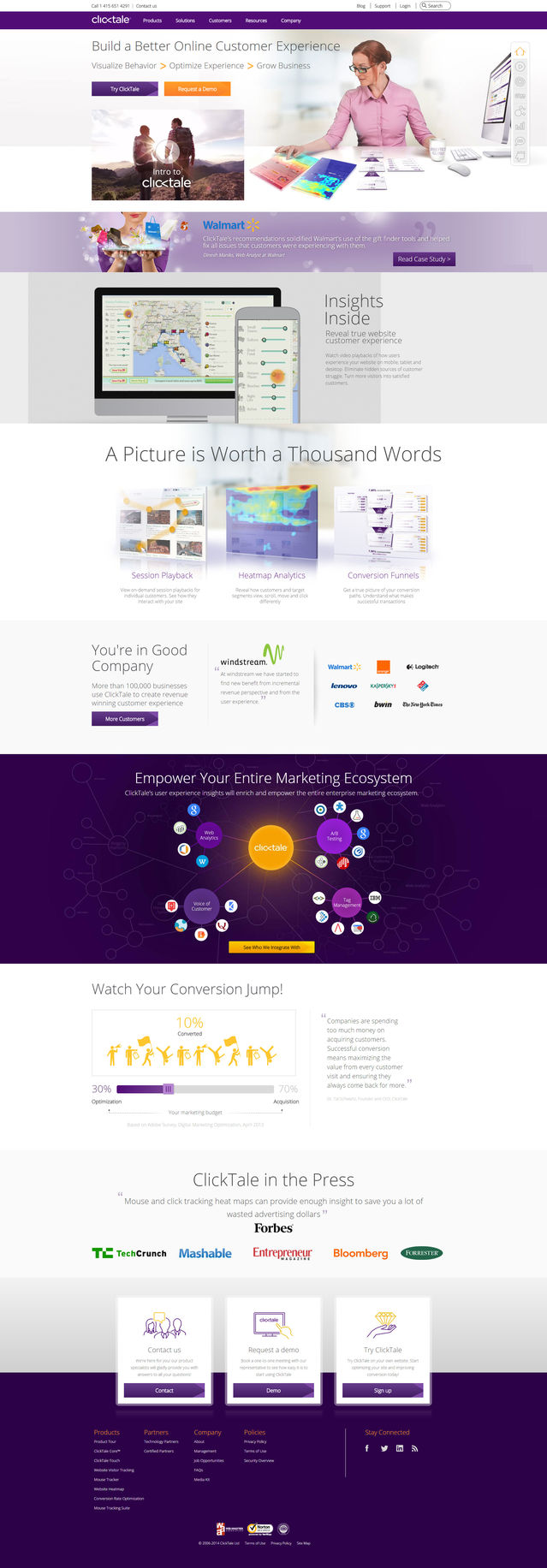
We also noticed that the look and feel of the home page directly affects its bounce rate. Home pages that contain a high level of visuals, pages that are text heavy, have an asymmetric layout (symmetric layouts are easier to process) and don’t contain white spaces—like ClickTale’s old homepage, pictured above—generate higher bounce rates, as visitors are unconsciously overwhelmed by the dense amount of stimulation that they are being forced process. If they have not accessed the website for a specific reason, they’ll often leave the website altogether, which lead ClickTale’s to rethink their homepage, as you can see below.

ClickTale
Source: ClickTale

When designing your company’s website or evaluating its effectiveness, keep in mind that the likelihood of engaging in a certain mental activity online is heavily influenced by incidental factors. People are sensitive to their feelings of ease or difficulty, but unaware of what triggers these feelings. As a result, they misattribute the experienced ease or difficulty to whatever is in the focus of their attention. That causes them to delay decisions or avoid purchasing or reading, simply because the print font makes the information difficult to process or the way content is presented seems too time-consuming.


Liraz Margalit, Ph.D., analyzes online consumer behavior, incorporating theory and academic research into a conceptual framework.

Online:
ClickTale

Share this:

  • Email a link to a friend (Opens in new window) Email
  • Print (Opens in new window) Print
  • Share on Facebook (Opens in new window) Facebook
  • Share on LinkedIn (Opens in new window) LinkedIn
  • Share on Pinterest (Opens in new window) Pinterest
  • Share on Reddit (Opens in new window) Reddit
  • Share on X (Opens in new window) X
  • Share on Tumblr (Opens in new window) Tumblr
Like Loading...
← Older posts
Newer posts →
Ken Heller on

Enter your email address to follow this blog and receive notifications of new posts by email.

Join 4,624 other subscribers

Media Psychology

  • RSS - Posts
  • RSS - Comments

Blog Stats

  • 115,861 hits

Archives

  • December 2020 (3)
  • November 2020 (4)
  • September 2020 (1)
  • June 2020 (1)
  • April 2020 (1)
  • March 2020 (1)
  • February 2020 (3)
  • January 2020 (4)
  • December 2019 (8)
  • November 2019 (1)
  • October 2019 (5)
  • September 2019 (10)
  • August 2019 (7)
  • July 2019 (4)
  • June 2019 (3)
  • May 2019 (5)
  • April 2019 (8)
  • March 2019 (7)
  • February 2019 (4)
  • January 2019 (5)
  • December 2018 (4)
  • November 2018 (4)
  • October 2018 (5)
  • September 2018 (8)
  • August 2018 (7)
  • July 2018 (4)
  • June 2018 (3)
  • May 2018 (6)
  • April 2018 (4)
  • March 2018 (6)
  • February 2018 (6)
  • January 2018 (6)
  • December 2017 (4)
  • November 2017 (5)
  • October 2017 (5)
  • September 2017 (5)
  • August 2017 (5)
  • July 2017 (5)
  • June 2017 (5)
  • May 2017 (2)
  • April 2017 (2)
  • March 2017 (5)
  • February 2017 (4)
  • January 2017 (7)
  • December 2016 (3)
  • November 2016 (2)
  • October 2016 (4)
  • September 2016 (2)
  • August 2016 (2)
  • July 2016 (3)
  • June 2016 (5)
  • May 2016 (6)
  • April 2016 (4)
  • March 2016 (2)
  • February 2016 (1)
  • January 2016 (1)
  • December 2015 (1)
  • November 2015 (2)
  • January 2015 (1)
  • November 2014 (1)
  • September 2014 (1)
  • August 2014 (1)
  • July 2014 (4)
  • May 2014 (1)
  • April 2014 (1)
  • March 2014 (2)
  • February 2014 (2)
  • January 2014 (2)
  • December 2013 (4)
  • November 2013 (2)
  • October 2013 (1)
  • September 2013 (1)
  • August 2013 (4)
  • July 2013 (1)
  • June 2013 (1)
  • April 2013 (1)
  • March 2013 (4)
  • February 2013 (3)
  • January 2013 (5)
  • December 2012 (4)
  • November 2012 (6)

Addiction Advertising Agenda Setting Al-Jazeera Associated Press Behavioralism Bernays Cartoons Causality Cognitive Correlation Cultivation Theory Digital Immigrants Digital Natives Ellul Facebook Fallacious Arguments Film Framing Gaming Gerbner Giles Google Greenwald ICT Identity Imagery Impact of ICT Influence Ingress Internet Internet.org Journalism Marketing McCombs McLuhan Mean World Sydrome Media Media Effects Media Literacy Media Psychology Mobile Computing Mobile Phones Moscow Olympics Neural Pathways news coverage Operant Conditioning Persuasive Technology Physiological Psychology Pinterest Potter Prensky Privacy Propaganda Psychological Effects Psychological Operations Psychology Public Diplomacy Public Relations Quotes Sexism Skinner Smartphone Social Change Social Identity Social Media Social Networks Social Psychology Sports Taylor Technology The Engineering of Consent Transmedia Twitter Walking Dead

RSS The Amplifier – APA Div. 46 Newsletter

  • The Legend of Zelda: Echoes of Wisdom as a Feminist Breakthrough and Contradiction
  • Digital Mourning: Grief Expression on Social Media
  • Book Review: Black Film Through a Psychodynamic Lens
  • The History of (Media) Multitasking Research
  • AI and Mental Health: Can Chatbots and Digital Coaches Bridge the Gap for Perinatal Mental Health Support?
  • To Infinity and Beyond: Best Practices for Data-informed Telemental Intensive Outpatient Programs
  • Editor’s Column: Authentically Inclusive Representation in Film and Television
  • President’s Column: Charting the Future of Media Psychology: Division 46 at APA 2025
  • Past President’s Column: Division 46 Announcements
  • TikTok and Self-Diagnosis: What Clinicians Need to Know

RSS APA Div. 46 Media Psychology and Technology Facebook Feed – Come check it out!

  • Kids Are Using Minecraft To Design A More Sustainable World
  • Home – UsMeU
  • Huggable Robot Befriends Girl in Hospital
  • Lifelong learning is made possible by recycling of histones, study says
  • Synthetic Love: Can a Human Fall in Love With a Robot? –
  • Today’s Photo:
  • Dr. Joanne Broder Sumerson
  • Could Storytelling Be the Secret Sauce to STEM Education?
  • Google driverless cars were in 11 accidents, but officer, it wasn’t their fault
  • All-But-Dissertation Survival Guide

RSS Changing Minds

  • An error has occurred; the feed is probably down. Try again later.

RSS Media Smarts

  • Outcome Chart – New Brunswick – Digital Production 120
  • Outcome Chart – New Brunswick – Dramatic Arts 120 (Grade 12)
  • Outcome Chart – New Brunswick – Dramatic Arts 110 (Grade 11)
  • Outcome Chart – New Brunswick – Graphic Art and Design 120 (Grade 12)
  • Outcome Chart – New Brunswick – Graphic Art and Design 110 (Grade 11)
  • Outcome Chart – New Brunswick – Film 110 (Grade 11)
  • Outcome Chart – New Brunswick – Popular Music 120 (Grade 12)
  • Outcome Chart – New Brunswick – Music 122 (Grade 12)
  • Outcome Chart – New Brunswick – Music 112 (Grade 11)
  • Outcome Chart – New Brunswick – Music 9

RSS Adam Curtis

  • HYPERNORMALISATION
  • TRAILER TRASH
  • HAPPIDROME - Part One
  • THE VEGETABLES OF TRUTH
  • NOW THEN
  • SUSPICIOUS MINDS
  • ONE'S PRIVATE LIFE
  • WHAT THE FLUCK!
  • THE BABY AND THE BAATH WATER
  • BUGGER

RSS Media Psychology Blog

  • does resurge work : Resurge weight reduction supplement is a...

RSS The Psych Files

  • The Psych Files – Most Popular Episodes
  • Psych Files Episodes on Youtube

RSS The Media Zone

  • And He Knew All the Words
  • Sexy, Dangerous Women Are Everywhere
  • In Praise of Older Women
  • "Commercial Creep"—I Hate Commercials and You Should Too
  • How A Laundry Detergent Commercial Saved the World
  • Jodie Foster: To Come Out Lesbian Or Let Sleeping Rumors Lie
  • Why No Photos of the Slaughtered Newtown Children?
  • HBO's "The Newsroom": Sorkin Talks Truth To Stupid
  • Dorothy Sandusky: A Woman Who Saw Nothing
  • Celebrity - The Incest of Actors, Politicians, and Journalists.

RSS The Media Psychology Effect

  • The Importance of Synesthesia in Artificial Intelligence
  • Media and Communications Psychology in the 21st Century
  • Media Psychology Is a New-Collar Profession
  • The Psychology of Crowds
  • AI Is Reshaping Workers as Well as Work
  • Understanding the Eye in AI
  • Where's Smokey the Bear When You Need Him?
  • Personalized AI and the Future of Teaching and Learning
  • The Future of Learning and Education Is Already in Your Pocket
  • Psychology and the Importance of Perfect Practice

RSS On The Media

  • An error has occurred; the feed is probably down. Try again later.

Blog at WordPress.com.

Privacy & Cookies: This site uses cookies. By continuing to use this website, you agree to their use.
To find out more, including how to control cookies, see here: Cookie Policy
  • Subscribe Subscribed
    • Media Psychology
    • Join 555 other subscribers
    • Already have a WordPress.com account? Log in now.
    • Media Psychology
    • Subscribe Subscribed
    • Sign up
    • Log in
    • Report this content
    • View site in Reader
    • Manage subscriptions
    • Collapse this bar
 

Loading Comments...
 

    %d